Aug 262011
 

Today’s guest post is by Stephen Luk, the lead author of Fireflies of Ontario (Coleoptera: Lampyridae), which was recently published in the Canadian Journal of Arthropod Identification. Stephen is an M.Sc. candidate at the University of Guelph as part of the Insect Systematics Lab, and while his main research is now focusing on Sphaeroceridae taxonomy, he has maintained a keen interest in the remaining Insecta. Stephen is a frequent contributor to BugGuide.net, and an avid nature photographer.

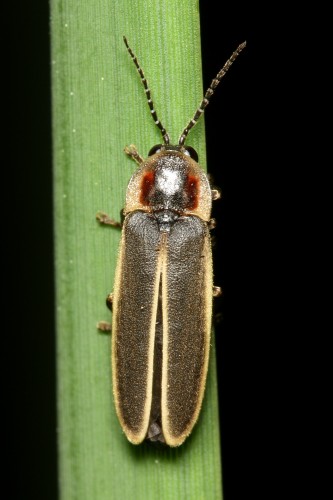
Lampyridae - Lampyrinae - Photinus obscurellus (m) - Stephen Luk Firefly

Photinus obscurellus by Stephen Luk

Over the moist meadows where stargazers behold the star-studded sky, insect enthusiasts can admire the summer scintillations of fireflies. Their neon glows spark fond childhood memories: of fields lit by symphonic displays; of brilliant twinkling in a jar set among the grass or over a book. But the fireflies of lore and poetry are truthfully poorly understood. They are often difficult to identify both in the field and in the laboratory. The shape and colour of a species can vary bewilderingly, and only an informed observer is capable of confidently identifying species amid the dazzling nocturnal orchestration. This is said of adults, and scarcely of immature stages, the knowledge of which is mostly sparse to absent.

Thankfully, the confusion is subsiding with the advent of novel identification tools. “The Fireflies of Ontario (Coleoptera: Lampyridae)”, published in the Canadian Journal of Arthropod Identification, features an updated list of Ontario fireflies as well as a comprehensive and user-friendly key to adult fireflies in Canada east of Ontario. Users will discover a practical platform upon which to illuminate the fascinating lives of fireflies. This resource arrived just as these wonderful beetles mesmerized the public with their seasonal light shows. Fireflies were certainly well represented this summer in southwestern Ontario — I observed nearly a dozen species upon a few occasions here in Guelph.

Behind the scenes with fireflies

I became acquainted with fireflies as an undergraduate student, and was appalled that creatures so familiar were so harrowing to identify. Thus, I assembled obscure literature, meticulously determined specimens and wrestled long with species in the genus Photinus (remarkably similar species in this region). I amalgamated and redesigned keys while gladly illustrating them with pinned specimens, but disapproved the paucity of suitable live images, and have since embarked on a quest to rectify this personally. The product was defended and published fourteen months later, rendering Ontario’s adult fireflies identifiable. I have since accumulated additional images, and was even privileged to dispense some expertise through the CBC.

Steve’s CBC Radio Interview

Steve was also interviewed for an article in the London Free Press

ResearchBlogging.orgLuk, S., Marshall, S., & Branham, M. (2011). The Fireflies of Ontario (Coleoptera: Lampyridae) Canadian Journal of Arthropod Identification DOI: 10.3752/cjai.2011.16 OPEN ACCESS

Aug 242011
 

… to put the name of your choice on a new species, and have your name become a permanent piece of biological history?
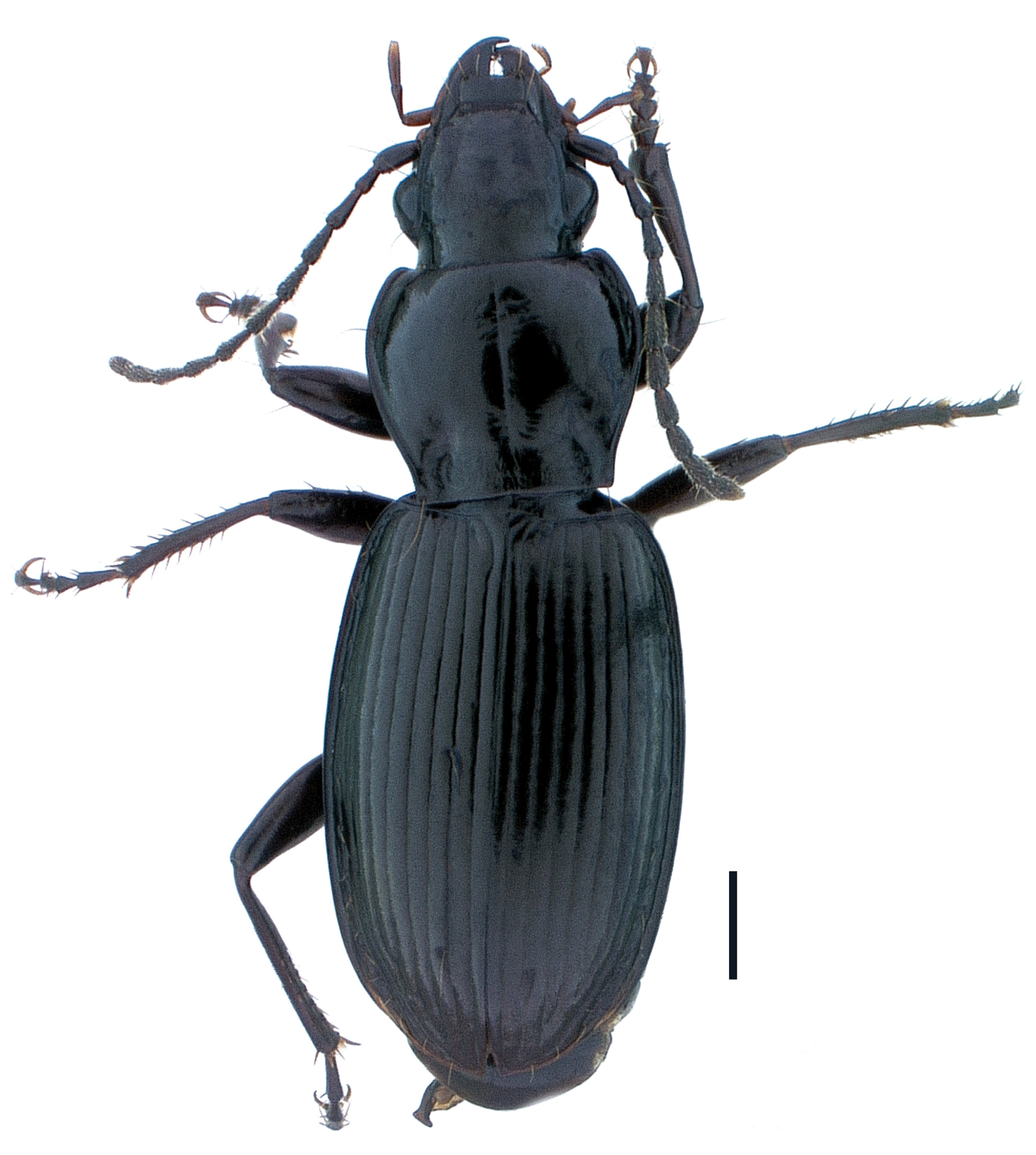
Pterostichus (Pseudoferonina) bousqueti Holotype

Holotype male, Pterostichus (Pseudoferonina) bousqueti Bergdahl, sp. n., dorsal habitus. Scale line = 1.0 mm. Automontage digital image by D. H. Kavanaugh. (Bergdahl & Kavanaugh, 2011)

The topic of nomenclature for sale arises every now and again, occasionally even making mainstream media. You may recall the story of a recently discovered Australian shrimp, who’s naming rights were auctioned off to the highest bidder on eBay (that bidder turned out to be a professional athlete interested in conservation biology) and the resulting funds donated to marine conservation (McCallum & Poore, 2010). Or perhaps the $650,000 Golden Palace Casino paid to give Callicebus aureipalatii it’s name (that money was also donated to conserving the native habitat of the species).

While the wholesale of species naming rights is relatively uncommon, ask any taxonomist and they’ll likely have an opinion on the subject, often one of caution and fear of abuse. Consider what may happen if the business of species naming becomes as popular as the business of selling star names (which is pretty well a scam by the way; stars aren’t officially named, they’re numbered by the IAU); countless fly-by-night companies splitting the slightest variation to turn a few bucks and causing true taxonomists endless headaches as they deal with an infinite number of synonymies. A pretty simple ruse given the current rules of zoological nomenclature; give a brief description, say you’re depositing the type specimen somewhere, and then provide several public libraries with copies of the descriptions, which don’t even need to be peer-reviewed.

You can see why taxonomists have a vested interest in keeping a close eye on sponsored taxonomy; we have enough true species to find and describe without needing to waste our time dealing with splitting-for-profit names.

While the threat of poor taxonomy is ever present with current ICZN regulations, most taxonomists are extremely underfunded (if funded at all) and would love some extra money to help do their jobs, even if it means providing a patronym.

So why am I bringing up the subject now? Just this week James Bergdahl, an “amateur” taxonomist, posted to the ENTOMO-L email listserv offering the name of a recently discovered ground beetle (Carabidae) for sale. From the email:

The species is a flightless ground-beetle (Coleoptera: Carabidae) in the genus Pterostichus. Adults of the species are primarily black, flightless, and approximately 1 cm in length, and live exclusively along small, forested headwater streams. Similar species have recently been described by Bergdahl & Kavanaugh (2011)*. The species is a member of a closely related group of beetles, restricted in distribution (endemic) to the Pacific Northwest, that have experienced a spectacular radiation across the many coastal and interior mountain ranges of the region.

The minimum offer accepted is estimated to be approximately US$20,000. These funds will be used to support all aspects of wildlife and habitat research by the Conservation Biology Center, including office, travel, lab and publication expenses.

You may think that US$20,000 is a lot of money to ask for naming an obscure, tiny, black beetle, but consider a partial list of the costs associated with taxonomy:

  • 15 years of field research to find it (according to the email) – safely assume $500 of expenditures/year (collecting equipment/traps, travel & accommodation costs, etc)
  • lab materials for conducting research (pins, drawers, cabinets, microscopes, imaging resources, etc) – $2000+
  • publication costs – $250+
  • acquisition of taxonomic knowledge necessary to distinguish a new species (literature, museum visits, specimen shipping costs, etc) – priceless

That brings a low end estimate of the cost to describe this species at around $10,000, not including salary and that all-important priceless category, making a $20,000 asking price less incredulous. In fact, it’s been hypothesized that the average cost for describing a species is US$48,500 (Carbayo & Marques, 2011), making this ground beetle a steal of a deal (especially compared to that GoldenPalace.com Monkey)!

While in a perfect world taxonomists wouldn’t need to prostitute their work to pay the bills, if done responsibly, it may be an alternative mode of rectifying the taxonomic impediment.

So if you or someone you know has an extra $20,000 laying around and would like to help a taxonomist disseminate his knowledge, why not contact James and become a part of history?

What do you think of taxonomic funding via patronage? Would you consider paying a taxonomist for the honour of naming a species? Leave a comment below!


ResearchBlogging.orgBergdahl, J., & Kavanaugh, D. (2011). Two new species of Pterostichus Bonelli subgenus Pseudoferonina Ball (Coleoptera, Carabidae, Pterostichini) from the mountains of central Idaho, U.S.A. ZooKeys, 104 DOI: 10.3897/zookeys.104.1272 (OPEN ACCESS)

Carbayo, F., & Marques, A. (2011). The costs of describing the entire animal kingdom Trends in Ecology & Evolution, 26 (4), 154-155 DOI: 10.1016/j.tree.2011.01.004

ANNA W. McCALLUM, & GARY C. B. POORE (2010). Two crested and colourful new species of Lebbeus (Crustacea: Caridea: Hippolytidae) from the continental margin of Western Australia Zootaxa, 2372, 126-137 Preview Here

<span class=”Z3988″ title=”ctx_ver=Z39.88-2004&rft_val_fmt=info%3Aofi%2Ffmt%3Akev%3Amtx%3Ajournal&rft.jtitle=Trends+in+Ecology+%26+Evolution&rft_id=info%3Adoi%2F10.1016%2Fj.tree.2011.01.004&rfr_id=info%3Asid%2Fresearchblogging.org&rft.atitle=The+costs+of+describing+the+entire+animal+kingdom&rft.issn=01695347&rft.date=2011&rft.volume=26&rft.issue=4&rft.spage=154&rft.epage=155&rft.artnum=http%3A%2F%2Flinkinghub.elsevier.com%2Fretrieve%2Fpii%2FS0169534711000176&rft.au=Carbayo%2C+F.&rft.au=Marques%2C+A.&rfe_dat=bpr3.included=1;bpr3.tags=Biology%2CTaxonomy”>Carbayo, F., & Marques, A. (2011). The costs of describing the entire animal kingdom <span style=”font-style: italic;”>Trends in Ecology & Evolution, 26</span> (4), 154-155 DOI: <a rev=”review” href=”http://dx.doi.org/10.1016/j.tree.2011.01.004″>10.1016/j.tree.2011.01.004</a></span>

Aug 232011
 

Ryan FleacrestWhen I first found this song, I had to double check that the artist actually titled it “Call of the Beettle”, and sure enough, it was spelled that horribly. I guess it’s supposed to be “hip”, I don’t know.

With that settled, I was curious whether there was any scientific validity to a song about calling dung beetles, and it just so happens that there are plenty of dung beetles which signal one another through stridulation! Take for example Aphodius ater, a European dung beetle which has been shown to serenade ladies over a fine meal of barn yard waste (Hirschberger, 2001)!


Aphodius ater – photo by BioImages – the Virtual Fieldguide (UK) (CC BY-NC-SA accessed via EOL)


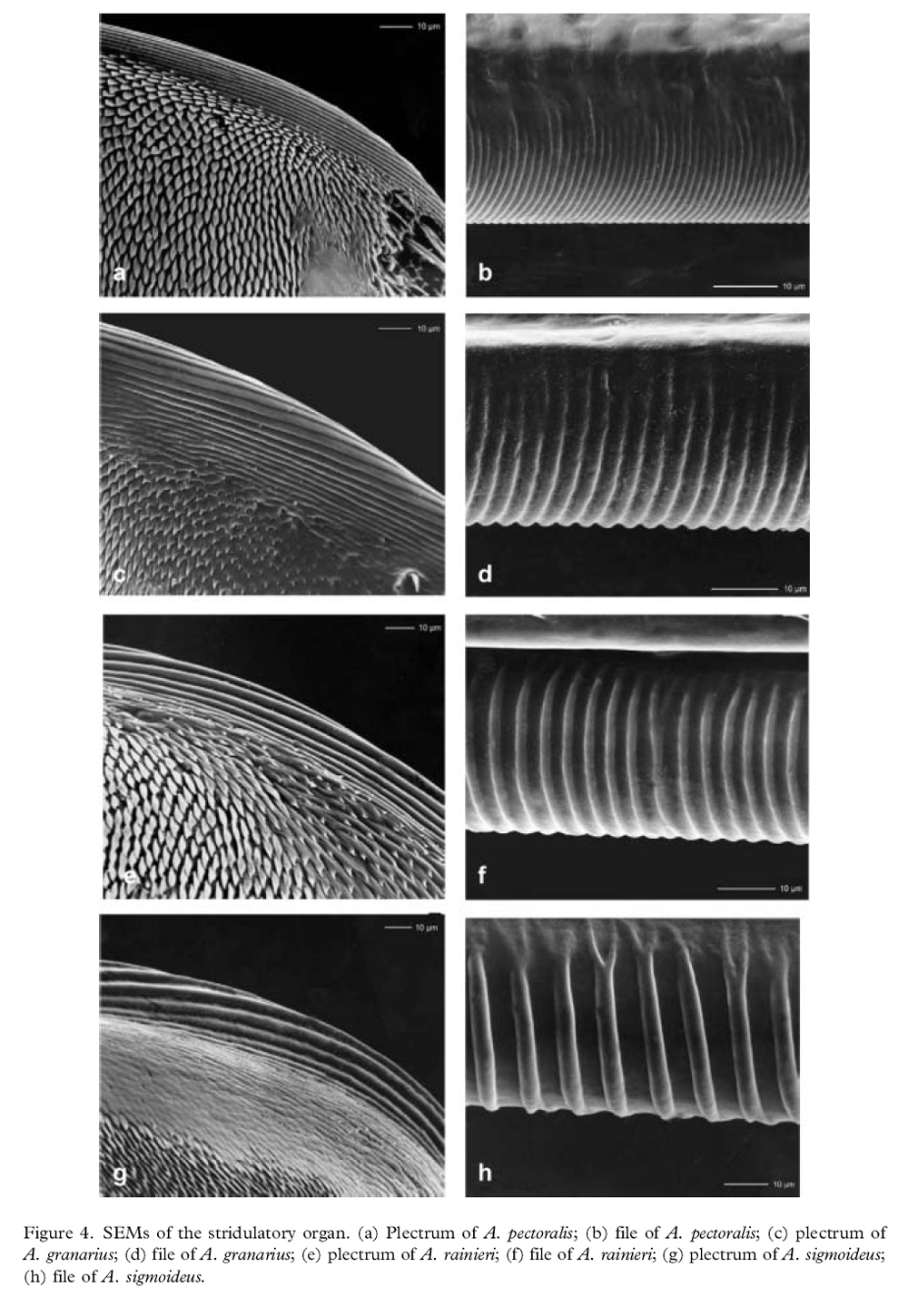
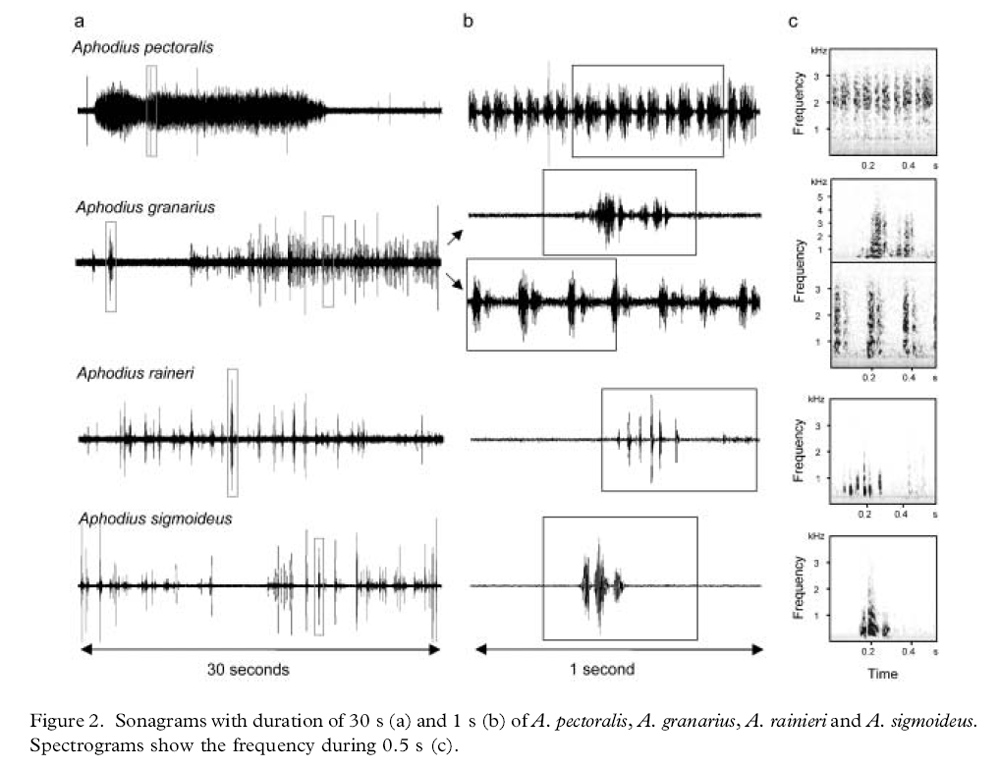
It seems that most (if not all) of the 1200 Aphodius species communicate in a similar manner (Kasper & Hirschberger, 2005). The sounds themselves are made by rubbing a file (found on the base of the membranous hind wings) against a structure known as the plectrum on the first abdominal segment. As can be seen, the structures are variable between species, and so are the resulting songs.


Aphodius Stridulatory Morphology from Kasper & Hirschberger 2005

Kaspar & Hirschberger 2005 Aphodius Stridulation Patterns

Aphodius Stridulation Patterns from Kasper & Hirschberger 2005


So now that we know that the artist can’t spell but does have  a solid handle on scarab beetle biology, lets check out the song!

I assume Aphodius beetles understand one another better than I understand that song… Reading the lyrics doesn’t help either, and may have confused me even more! Oh well, at least we learned about dung beetle dinner conversation!


This song is available on iTunes – Call of the Dung Beettle – Sonic Imperial – Sounds of the Prophets


ResearchBlogging.org
Hirschberger, P. (2001). Stridulation in Aphodius Dung Beetles: Behavioral
Context and Intraspecific Variability of Song Patterns
in Aphodius ater (Scarabaeidae) Journal of Insect Behavior, 14 (1), 69-88 DOI: 10.1023/A:1007801713479


Kasper, J., & Hirschberger, P. (2005). Stridulation in Aphodius dung beetles: Songs and morphology of stridulatory organs in North American Aphodius species (Scarabaeidae) Journal of Natural History, 39 (1), 91-99 DOI: 10.1080/00222930310001018877

Aug 172011
 

This past weekend saw the peak of the Perseid Meteor Shower for 2011, so the wife and I headed out to a local high point to see what we could see.

People star gazing looking for meteors Perseids

What’s with the funky sky and shadows at 1am? That’s thanks to the full moon high in the sky and urban light pollution, which significantly decreased our ability to see stars, nevermind smaller pieces of comet dust burning up in the atmosphere! Of course, it did create some interesting effects…

Telephone pole highlighted by full moon and urban light pollution

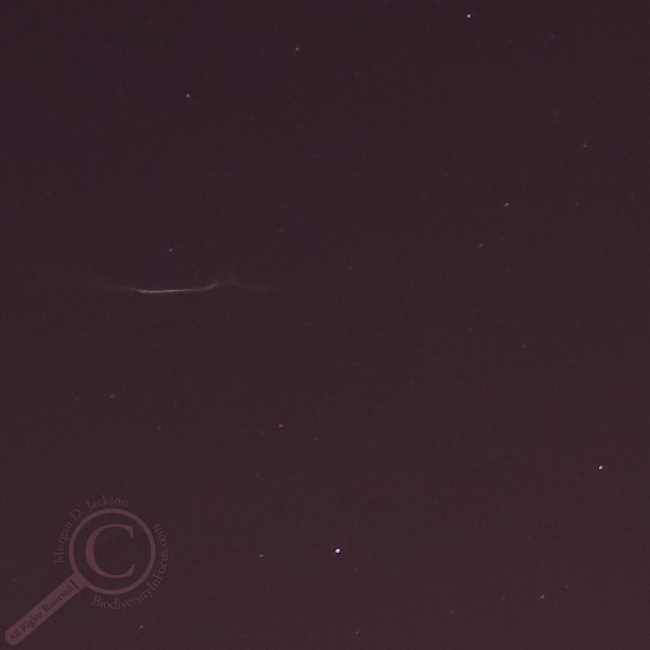
So did we see any meteors despite the lighting? We were lucky enough to observe 7 by my count, including a super bright, green fireball which left a green residue hanging in the night air for several seconds. Definitely one of the best I’ve seen. But the more important question; did I capture any on camera? Sort of…

Perseids Meteor Shower 2011

Can you see the meteor trail? No? Can’t blame you really, how about I blow up the left hand side a tad:

Meteor trail from Perseid Meteor Shower 2011

Yep, that’s my first successful meteor capture! Nothing special, but it’s something at least. I’ll keep working on it, hopefully during a couple of different meteor showers this fall/winter before next summer’s big show!

I think I need to find a way onto the International Space Station for next years Perseids though…

Aug 162011
 

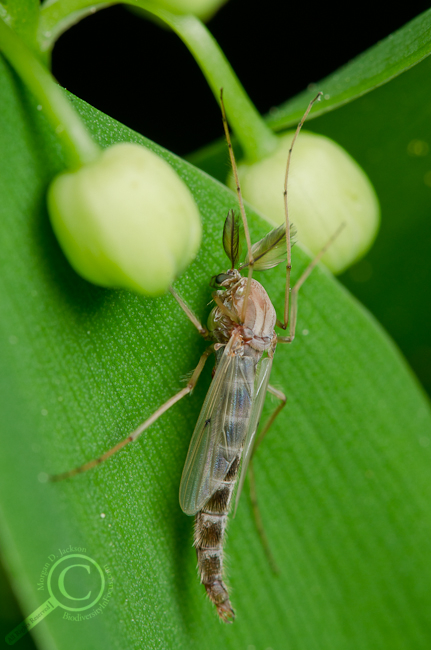
Ryan FleacrestA simple association for this Tuesday’s tune, and a reminder that flies are pretty ubiquitous, and can be found all around you! Take for example, this midge (Chironomidae: Chironominae) resting on a leaf at the Royal Botanical Gardens in Hamilton, Ontario:

Midge on leaf with flowers Chironomidae Chironominae


I visited the gardens with other things in mind, but seeing this large midge just hanging out, I couldn’t resist a shot or two!


Short and sweet this week, but stay tuned later this week as I hope to get back to a more frequent blogging schedule!


This song is available on iTunes – All Around Me – Flyleaf

P.S. – Midges are a pain to identify, especially from photos! If anyone has tips on their identification or a further guess on what genus this might be, I’d love to hear about it!

Aug 102011
 

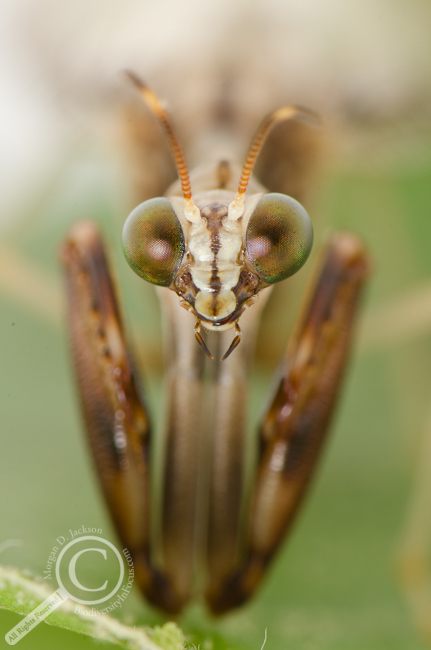
You may remember I offered an ID challenge a few days weeks month ago (where did that month go?), so I figured I’d best tally some points. What was that bug-eyed beast staring out from the screen?

Bug-eyed Beast

This deceiving photo may at first glance remind you of a praying mantis (order Mantodea), but is in fact the face of an insect in a totally different order; the Neuroptera. As Miles correctly deduced, this is Dicromantispa interrupta, a member of the mantisfly family (Mantispidae).

One of four species of mantisfly found in Canada, Dicromantispa interrupta is restricted to southern Ontario and Quebec in Canada (this specimen was brought back from Turkey Point Provincial Park in Norfolk County, Ontario during a recent survey), but occurs all the way down to Florida and southern Mexico and as far west as Minnesota. As can be guessed by the large eyes and raptorial front legs, adults are predatory on other insects, while larvae are parasitic in juvenile spiders. The mantisfly larvae are mobile and enter a spider’s egg sac as it’s being spun (or possibly find their way into completed egg sacs), where they await the hatching of spiderlings. Once the spiderling has hatched, the mantisfly larva will wrap itself around the pedicel (waist) of the spider until it’s next molt, at which point it will enter the book lungs and continue its development, eventually pupating and emerging from the egg sac as an adult!

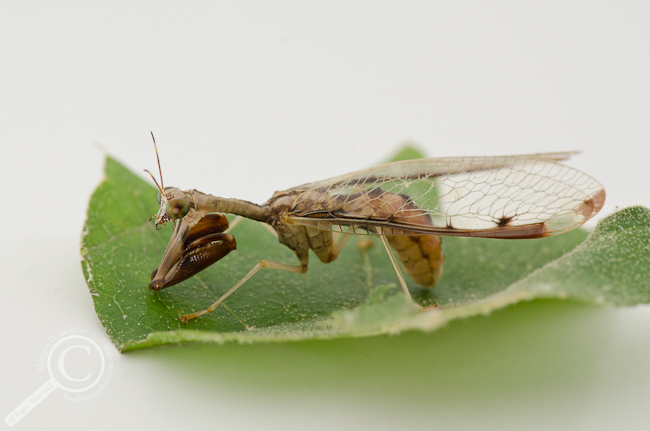
There is another closely related species found in the extreme south of Ontario, and which Chris Borkent alluded to; Dicromantispa sayi. Although very similar in appearance, D. interrupta can be recognized by the brown markings at the tip of the wings and about 1/3 of the way from the tips (D. sayi has no such markings with the wing entirely clear other than the leading edge) .

Dicromantispa interrupta mantisfly lateral

Dicromantispa interrupta (staged)


As for BioPoints, I’m giving 2 to Peter Coffey for participating and hazarding a guess on the order; Miles walks away with 15 for the correct order, family, genus and species; and Chris gets 5 for taking a chance on the other sympatric species! Thanks for playing, and I’ll try to do challenges more frequently to allow everyone a chance at getting to the magic number of 200, so be sure to check back for other opportunities!

 
ResearchBlogging.orgCannings, R., & Cannings, S. (2006). The Mantispidae (Insecta: Neuroptera) of Canada, with notes on morphology, ecology, and distribution The Canadian Entomologist, 138 (4), 531-544 DOI: 10.4039/n06-806
 

Aug 092011
 

Ryan FleacrestSomething a little different for this weeks Tuesday Tunes, as we trace a simple yet successful phrase through the annals of music history and touch on some of the entomological connections associated with it!

Our phrase of the week is “A Taste of Honey”, and it’s pretty obvious why it’s being featured as a Tuesday Tune. If we dig a little deeper however (and go on a tangent or two), we’ll uncover some rather interesting ties between some big names and entomology! Lets start at the beginning shall we?

A Taste of Honey was written by Bobby Scott & Ric Marlow in 1960 for the Broadway adaptation of a British play of the same name. This original version went on to win a Grammy for Best Instrumental Theme at the 1963 Grammy Awards. The instrumental version was soon covered by a band already featured on Tuesday Tunes, Herb Alpert & the Tijuana Brass, who made the song a commercial hit on their album Whipped Cream & Other Delights in 1965, and the song was subsequently awarded 3 more Grammy Awards (Record of the Year, Best Instrumental Arrangement, and Best Instrumental Performance).

There was another big name who was taking the 1966 Grammy Awards by storm – Barbra Streisand, who’s debut album My Name is Barbra (which won the Grammy for Best Vocal Performance, Female that year) featured a vocal rendition of a familiar song…

Strangely enough, Barbra Streisand wasn’t even nominated for Best New Artist that year, with the Grammy going to Tom Jones, who would cover A Taste of Honey the very next year. Time for Tangent #1 – Barbra Streisand would release an album titled ButterFly in 1974, with the cover art featuring a fly on a stick of butter. I must say I like this kind of ButterFly more than the traditional Lepidoptera…


Before we leave the red carpet, there’s one more link between the Grammy Awards and A Taste of Honey. This time the award goes to the band A Taste of Honey, who won the award for Best New Artist in 1978, largely on the success of their smash disco hit Boogie Oogie Oogie. It seems that the members of the band were such fans of Herb Alpert’s rendition of A Taste of Honey that they adopted it as their band name!

There’s one more big name who enjoyed A Taste of Honey in a big way; The Beatles! The Fab 4 included a version on their debut album Please Please Me in 1963, an album which shot to number 1 on the UK charts and which would ultimately pave the way for Beatlemania and the British Invasion.

Tangent #2 – the entomological Beatles is pretty obvious, but did you know that the origin of the band name is also entomological? The Beatles chose their name as a tribute to Buddy Holly and his band The Crickets for their influence over their music. This of course leads us to Tangent #3 (wait, can you have a tangent off of a tangent? Hmmm, geometry never was my strong suit) – Buddy Holly (along with J.P. “The Big Bopper” Richardson and Ritchie Valens) was tragically killed in a plane crash on The Day The Music Died, which just so happened to be 25 years to the day before a familiar entomologist was born – me!

To wrap things up, Tangent #4 (geometry be damned) is going to take us back to our original theme of A Taste of Honey. Also paying tribute to Buddy Holly, fellow British Invaders and recent Rock and Roll Hall of Fame inductees, The Hollies covered our song of the week in 1966 on their US album Beat Group! (which also featured Fifi the Flea on the B-side).

So there you go, a full round trip through musical history on the back of a simple phrase! I hope you’ve enjoyed this little web of insect-associated music, and remember to come back next week to find an all new song!

These songs are available on iTunes:

A Taste of Honey – Whipped Cream & Other Delights
A Taste of Honey – The Barbra Streisand Album
Boogie Oogie Oogie (Re-Recorded / Remastered) – 100 Hits – ’60s & ’70s (Re-Recorded / Remastered Versions)
A Taste of Honey – Please Please Me
American Pie – American Pie – Single
A Taste of Honey – The Clarke, Hicks & Nash Years – The Complete Hollies April 1963 – October 1968 (Remastered)


Tuesday Tunes – Butterfly – Crazy Town

 Fun Stuff, Insects, Tongue in Cheek, Tuesday Tunes  Comments Off on Tuesday Tunes – Butterfly – Crazy Town
Aug 022011
 

Ryan FleacrestAdmit it, you’ve found a trendy pop song somewhat entertaining at some point in your life. Whether it was Rick Astley or Aqua, I’m sure everyone has had a guilty pleasure song or two which they find kind of fun despite the public backlash that may result from admitting it. Today I present you with one of mine… Butterfly by Crazy Town. While I’m not proud of it, I did make a mix CD with this song on it at the height of its popularity. Ugh.


Wow, I must say that takes the cake as the cheesiest music video I’ve shared here on Tuesday Tunes. Sorry about that.

Now can we all forgot this ever happened? Ok, thanks.


This song is available on iTunes – Butterfly (Album Version) – The Gift of Game

Jul 262011
 

Ryan FleacrestI’m busy. Not just a little busy, but really busy.

I’m on track to have 5-6 peer-reviewed papers submitted and/or published by the end of the year, I’m co-authoring a field guide which should be coming out this fall, I’m running a field trial for the first time in my life to help pay the bills while I wait for PhD funding, I can’t say no when asked for help from friends and colleagues, and of course the blog (although lately it’s been slightly neglected; sorry about that). Don’t get me wrong, I’m not complaining and love what I do, and I willingly signed up for all of these projects knowing hoping that time spent now will pay off later when I’m applying for funding and looking for PhD/Post-Doc/Faculty positions.

But with all of these projects on the go, something has had to give, and lately it’s been my photography. After I defended my MSc this spring, I figured I’d have plenty of time to shoot more insects, experiment with a few ideas I’ve been thinking about (when I was supposed to be writing my thesis) and just spend more time in the field relaxing and creating new images to share. As the summer has slipped by (can someone tell me where July went?), photo opportunities have come and gone, and I’ve found myself repeating that there’s always next year…

A recent post by travel photographer and inspirational blogger David duChemin has given me pause however, and made me consider my priorities somewhat. I think it’s one of his best (which is really saying something), and hit close to home. Take the time to give it a read, then come on back (I’ll wait, don’t worry).

Well, what did you think? Amazing that a seemingly small commitment can add up to such a significant amount of time!

While I have dreams of becoming a tenured professor at a mid-sized university teaching, researching, and looking at flies until retirement, I also dream of that perfect photo, and the road trip with no fixed destination or deadline, dreams that seem nearly incompatible with my professional aspirations at times. But an hour a day? I think I could work that in. Whether it’s an hour writing something for the blog, editing photos that have become back-logged, or banking a couple of day’s worth for an afternoon out with my camera, I’m going to do my best to take a breath more often and leave something in the tank for things other than academia. While 45 days in a row could allow a pretty kick ass road trip or South American odyssey, let’s be honest; I’d probably end up with another project on my platter instead. I think the daily hour is a pretty good place to start.

This week’s song fits nicely with the idea of taking time for yourself, and allowing yourself a moment’s peace away from the busy colony life.


That’s it for this week, but I hope you’ll take the time to find an hour a day for yourself and your outside interests. If you’re interested in hearing about my “daily” hours, I’ll try to keep a Tweet-log about my time spent; feel free to follow along (@BioInFocus) or contribute your own journal by using the hashtag #1hr4life.

Have you found yourself passing up opportunities in order to get just one more paper/project/promotion? Feel free to air your thoughts below in the comments.

This week’s song is available on iTunes – Ants Marching – Under the Table and Dreaming