 A quick Tuesday Tunes this week as I’m on vacation and there’s not much internet on the cottage dock!
Enjoy Army Ants by the Stone Temple Pilots!
Sorry for the delayed results of the ID Challenge, but look for it next week!

Another week, another tune! Sarah Brightman’s The Fly
It’s also time for another ID Challenge:
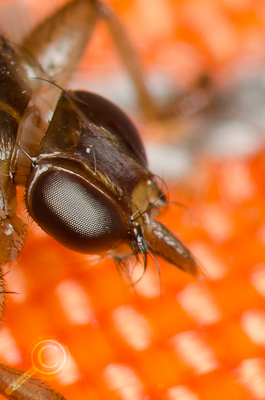
Time to earn some more BioPoints! Provide as many taxonomic or biological notes you can think of, and I’ll dole out the points! Good luck!
(I’m taking a page out of Ted’s book and turning on moderated comments so everyone has a chance at some points!)
When I first found this song, I had to double check that the artist actually titled it “Call of the Beettle”, and sure enough, it was spelled that horribly. I guess it’s supposed to be “hip”, I don’t know.
With that settled, I was curious whether there was any scientific validity to a song about calling dung beetles, and it just so happens that there are plenty of dung beetles which signal one another through stridulation! Take for example Aphodius ater, a European dung beetle which has been shown to serenade ladies over a fine meal of barn yard waste (Hirschberger, 2001)!

It seems that most (if not all) of the 1200 Aphodius species communicate in a similar manner (Kasper & Hirschberger, 2005). The sounds themselves are made by rubbing a file (found on the base of the membranous hind wings) against a structure known as the plectrum on the first abdominal segment. As can be seen, the structures are variable between species, and so are the resulting songs.
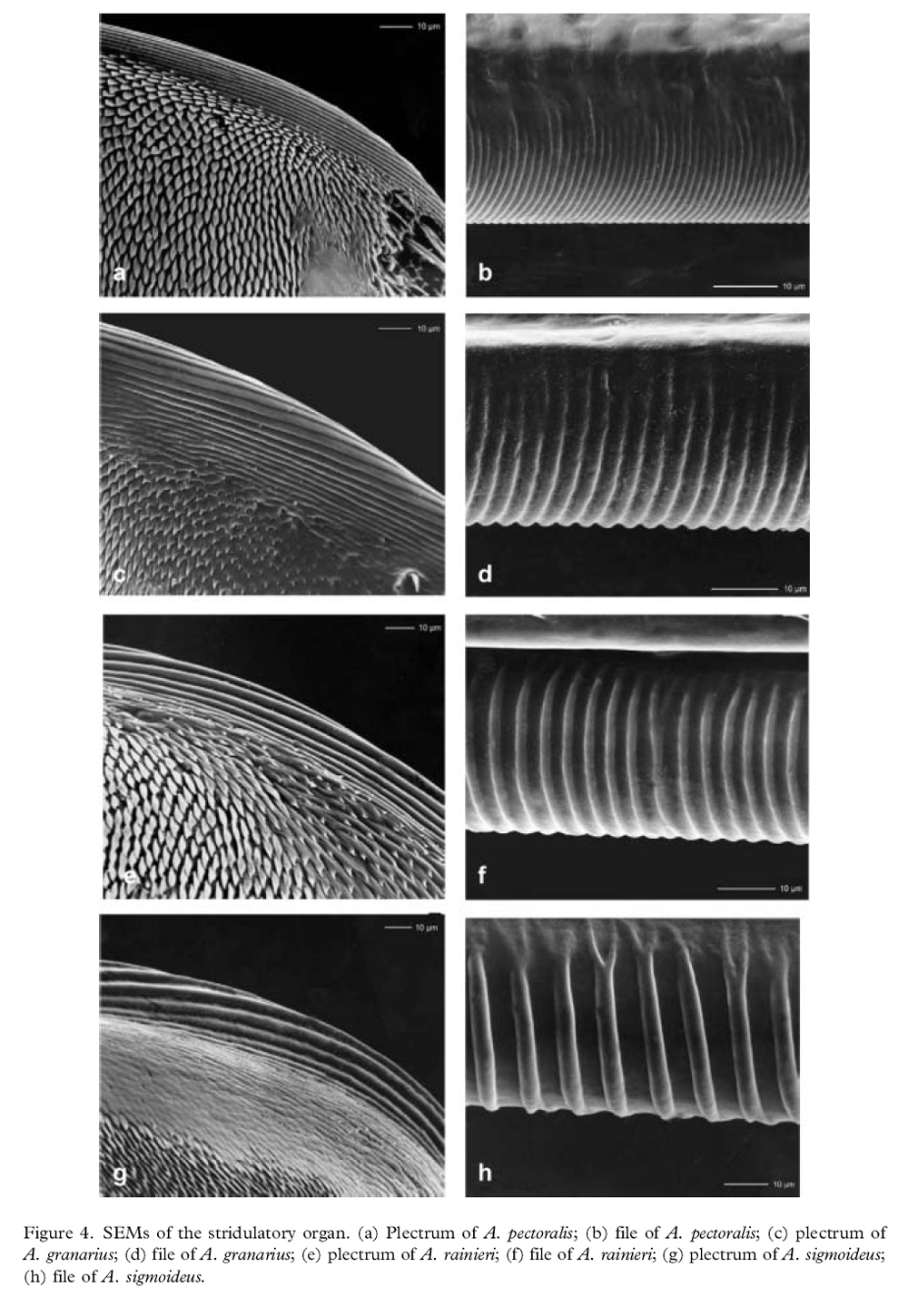
Aphodius Stridulatory Morphology from Kasper & Hirschberger 2005
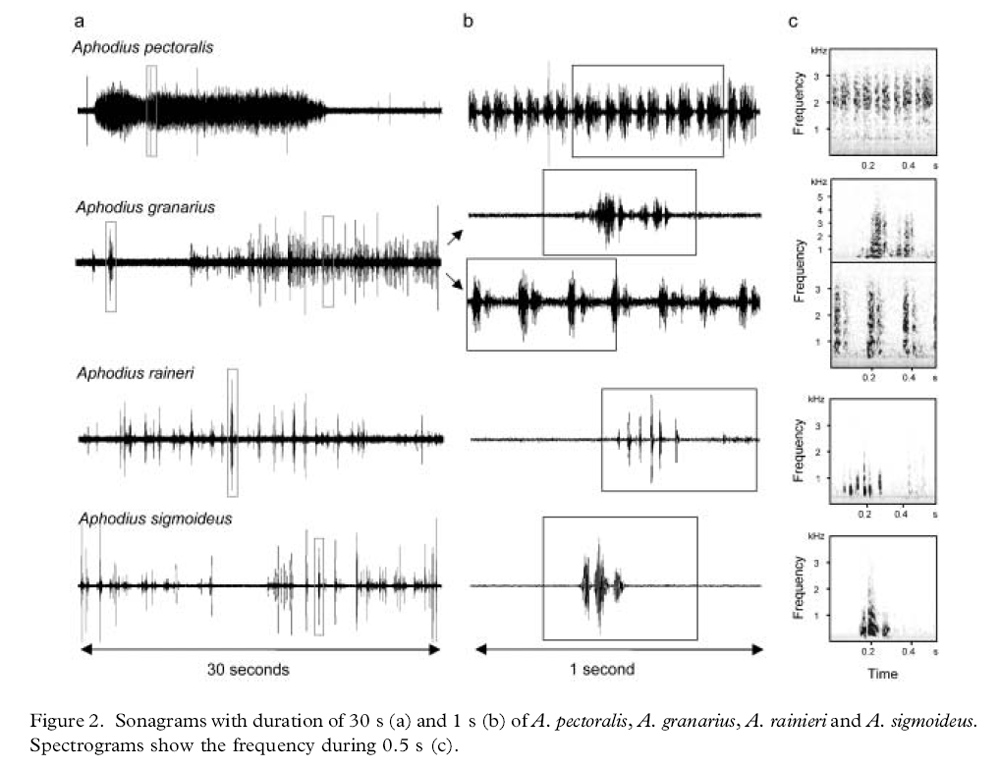
Aphodius Stridulation Patterns from Kasper & Hirschberger 2005
So now that we know that the artist can’t spell but does have a solid handle on scarab beetle biology, lets check out the song!
I assume Aphodius beetles understand one another better than I understand that song… Reading the lyrics doesn’t help either, and may have confused me even more! Oh well, at least we learned about dung beetle dinner conversation!
This song is available on iTunes – Call of the Dung Beettle – Sonic Imperial – Sounds of the Prophets

Hirschberger, P. (2001). Stridulation in Aphodius Dung Beetles: Behavioral
Context and Intraspecific Variability of Song Patterns
in Aphodius ater (Scarabaeidae) Journal of Insect Behavior, 14 (1), 69-88 DOI: 10.1023/A:1007801713479
Kasper, J., & Hirschberger, P. (2005). Stridulation in Aphodius dung beetles: Songs and morphology of stridulatory organs in North American Aphodius species (Scarabaeidae) Journal of Natural History, 39 (1), 91-99 DOI: 10.1080/00222930310001018877
A simple association for this Tuesday’s tune, and a reminder that flies are pretty ubiquitous, and can be found all around you! Take for example, this midge (Chironomidae: Chironominae) resting on a leaf at the Royal Botanical Gardens in Hamilton, Ontario:
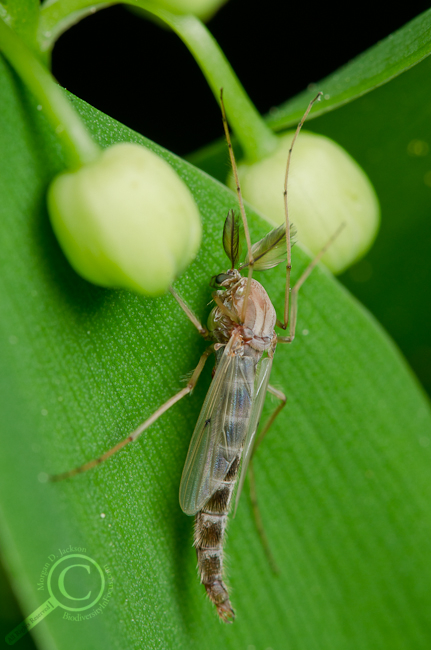
I visited the gardens with other things in mind, but seeing this large midge just hanging out, I couldn’t resist a shot or two!
Short and sweet this week, but stay tuned later this week as I hope to get back to a more frequent blogging schedule!
This song is available on iTunes – All Around Me – Flyleaf
P.S. – Midges are a pain to identify, especially from photos! If anyone has tips on their identification or a further guess on what genus this might be, I’d love to hear about it!
You may remember I offered an ID challenge a few days weeks month ago (where did that month go?), so I figured I’d best tally some points. What was that bug-eyed beast staring out from the screen?
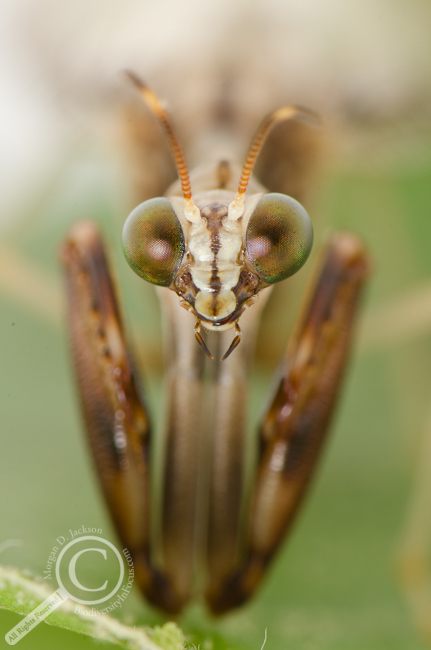
This deceiving photo may at first glance remind you of a praying mantis (order Mantodea), but is in fact the face of an insect in a totally different order; the Neuroptera. As Miles correctly deduced, this is Dicromantispa interrupta, a member of the mantisfly family (Mantispidae).
One of four species of mantisfly found in Canada, Dicromantispa interrupta is restricted to southern Ontario and Quebec in Canada (this specimen was brought back from Turkey Point Provincial Park in Norfolk County, Ontario during a recent survey), but occurs all the way down to Florida and southern Mexico and as far west as Minnesota. As can be guessed by the large eyes and raptorial front legs, adults are predatory on other insects, while larvae are parasitic in juvenile spiders. The mantisfly larvae are mobile and enter a spider’s egg sac as it’s being spun (or possibly find their way into completed egg sacs), where they await the hatching of spiderlings. Once the spiderling has hatched, the mantisfly larva will wrap itself around the pedicel (waist) of the spider until it’s next molt, at which point it will enter the book lungs and continue its development, eventually pupating and emerging from the egg sac as an adult!
There is another closely related species found in the extreme south of Ontario, and which Chris Borkent alluded to; Dicromantispa sayi. Although very similar in appearance, D. interrupta can be recognized by the brown markings at the tip of the wings and about 1/3 of the way from the tips (D. sayi has no such markings with the wing entirely clear other than the leading edge) .
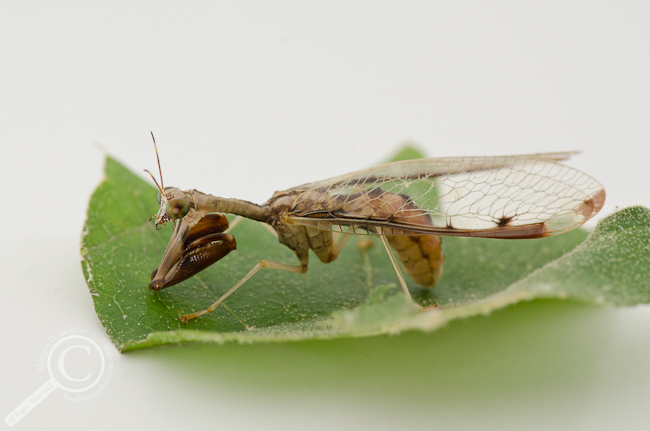
Dicromantispa interrupta (staged)
As for BioPoints, I’m giving 2 to Peter Coffey for participating and hazarding a guess on the order; Miles walks away with 15 for the correct order, family, genus and species; and Chris gets 5 for taking a chance on the other sympatric species! Thanks for playing, and I’ll try to do challenges more frequently to allow everyone a chance at getting to the magic number of 200, so be sure to check back for other opportunities!
Cannings, R., & Cannings, S. (2006). The Mantispidae (Insecta: Neuroptera) of Canada, with notes on morphology, ecology, and distribution The Canadian Entomologist, 138 (4), 531-544 DOI: 10.4039/n06-806
Something a little different for this weeks Tuesday Tunes, as we trace a simple yet successful phrase through the annals of music history and touch on some of the entomological connections associated with it!
Our phrase of the week is “A Taste of Honey”, and it’s pretty obvious why it’s being featured as a Tuesday Tune. If we dig a little deeper however (and go on a tangent or two), we’ll uncover some rather interesting ties between some big names and entomology! Lets start at the beginning shall we?
A Taste of Honey was written by Bobby Scott & Ric Marlow in 1960 for the Broadway adaptation of a British play of the same name. This original version went on to win a Grammy for Best Instrumental Theme at the 1963 Grammy Awards. The instrumental version was soon covered by a band already featured on Tuesday Tunes, Herb Alpert & the Tijuana Brass, who made the song a commercial hit on their album Whipped Cream & Other Delights in 1965, and the song was subsequently awarded 3 more Grammy Awards (Record of the Year, Best Instrumental Arrangement, and Best Instrumental Performance).
There was another big name who was taking the 1966 Grammy Awards by storm – Barbra Streisand, who’s debut album My Name is Barbra (which won the Grammy for Best Vocal Performance, Female that year) featured a vocal rendition of a familiar song…
 Strangely enough, Barbra Streisand wasn’t even nominated for Best New Artist that year, with the Grammy going to Tom Jones, who would cover A Taste of Honey the very next year. Time for Tangent #1 – Barbra Streisand would release an album titled ButterFly in 1974, with the cover art featuring a fly on a stick of butter. I must say I like this kind of ButterFly more than the traditional Lepidoptera…
Before we leave the red carpet, there’s one more link between the Grammy Awards and A Taste of Honey. This time the award goes to the band A Taste of Honey, who won the award for Best New Artist in 1978, largely on the success of their smash disco hit Boogie Oogie Oogie. It seems that the members of the band were such fans of Herb Alpert’s rendition of A Taste of Honey that they adopted it as their band name!
There’s one more big name who enjoyed A Taste of Honey in a big way; The Beatles! The Fab 4 included a version on their debut album Please Please Me in 1963, an album which shot to number 1 on the UK charts and which would ultimately pave the way for Beatlemania and the British Invasion.
Tangent #2 – the entomological Beatles is pretty obvious, but did you know that the origin of the band name is also entomological? The Beatles chose their name as a tribute to Buddy Holly and his band The Crickets for their influence over their music. This of course leads us to Tangent #3 (wait, can you have a tangent off of a tangent? Hmmm, geometry never was my strong suit) – Buddy Holly (along with J.P. “The Big Bopper” Richardson and Ritchie Valens) was tragically killed in a plane crash on The Day The Music Died, which just so happened to be 25 years to the day before a familiar entomologist was born – me!
To wrap things up, Tangent #4 (geometry be damned) is going to take us back to our original theme of A Taste of Honey. Also paying tribute to Buddy Holly, fellow British Invaders and recent Rock and Roll Hall of Fame inductees, The Hollies covered our song of the week in 1966 on their US album Beat Group! (which also featured Fifi the Flea on the B-side).
So there you go, a full round trip through musical history on the back of a simple phrase! I hope you’ve enjoyed this little web of insect-associated music, and remember to come back next week to find an all new song!
These songs are available on iTunes:
A Taste of Honey – Whipped Cream & Other Delights
A Taste of Honey – The Barbra Streisand Album
Boogie Oogie Oogie (Re-Recorded / Remastered) – 100 Hits – ’60s & ’70s (Re-Recorded / Remastered Versions)
A Taste of Honey – Please Please Me
American Pie – American Pie – Single
A Taste of Honey – The Clarke, Hicks & Nash Years – The Complete Hollies April 1963 – October 1968 (Remastered)
Admit it, you’ve found a trendy pop song somewhat entertaining at some point in your life. Whether it was Rick Astley or Aqua, I’m sure everyone has had a guilty pleasure song or two which they find kind of fun despite the public backlash that may result from admitting it. Today I present you with one of mine… Butterfly by Crazy Town. While I’m not proud of it, I did make a mix CD with this song on it at the height of its popularity. Ugh.
Wow, I must say that takes the cake as the cheesiest music video I’ve shared here on Tuesday Tunes. Sorry about that.
Now can we all forgot this ever happened? Ok, thanks.
This song is available on iTunes – Butterfly (Album Version) – The Gift of Game
This week’s song enjoys fresh ceviche eaten by candlelight near the sea, puppies, and long walks on the beach. Please give a warm welcome to Herb Albert and the Tijuana Brass with their signature piece, Spaniiiiish Flea!
A song instantly recognizable thanks to The Dating Game (and several Simpson’s episodes), Spanish Flea is one of those songs that will be stuck in your head for the remainder of the day (you’re welcome). Try to not whistle this little diddy while you walk down the hall, work on your computer, or fall off to sleep this evening!
Yep, we here at Biodiversity in Focus like to make sure insects and their related music are always on your mind! Speaking of on your mind, last week’s tune came with an ID challenge which still has plenty of BioPts up for grabs. Since it’s the summer and you’ve likely been playing outdoors looking for insects (you have haven’t you?), I’ll leave the insect a mystery for another week, giving you a chance to relax in the air conditioning and figure out what it may be. Until next time, I’m Ryan Fleacrest!
This song is available on iTunes – Spanish Flea – Herb Alpert & The Tijuana Brass
Almost forgot about Tuesday Tunes this week! Been a busy summer so far, and this one just about slipped through the cracks. Today’s song has very little to do with insects besides the title, but the song is an old favourite of mine, so it’ll work for this last minute edition!
As consolation for being kind of lame with the song and write up, here’s some cooler “bug” eyes, and I’ll put some BioPoints up for the identification! 2 pts for order, 3 pts for family, and 5 pts each for genus & species. Remember, with 200 BioPts, I’ll send you a framed photo of your choice from my archives! Enjoy!
This song is available on iTunes – Bug Eyes – Catch Without Arms
Today marks the birthday of one of the most influential and important insect authors; Robert Evans Snodgrass (1875-1962). Snodgrass’ special interest was insect morphology, especially within an evolutionary context, as he sought to not only understand how insects are put together, but also how those structures contributed to the evolutionary history of species. His 1935 opus, Principles of Insect Morphology, is still relevant in many regards (my 4th year Insect Physiology professor referred to it several times throughout the semester), and can be considered one of the most important entomology texts of the 20th century.
Being a morphologist, Snodgrass would be an expert in insect dissection in order to examine the intricacies of insect muscles, nerves and exoskeletons. That being said, I’m sure his techniques were pretty refined and not quite comparable to ripping out the wings of a butterfly, but unfortunately there isn’t a song title “Careful Dissection of the Flight Apparatus of Lepidoptera”, so we’ll stick to some hard rock!
If you’re interested in learning more about PIM (instead of HIM), check out this post by Trichoptera grad student Zach Burington on his excellent blog, Trichopterology!
This song is available on iTunes – Wings of a Butterfly – Wings of a Butterfly – Single