Jul 012011
 

T.G.I.Formicidae is a new occasional feature here on the blog, and this inaugural edition features some collusion between Alex Wild, Ted MacRae and myself. Alex normally features beetles on Fridays, and Ted and I thought it might be fun to continue the trend, with Ted blogging flies today while I cover ants to complete the triad of major insect groups! Make sure to check out their blogs to see what fantastic Friday finds they have to share!

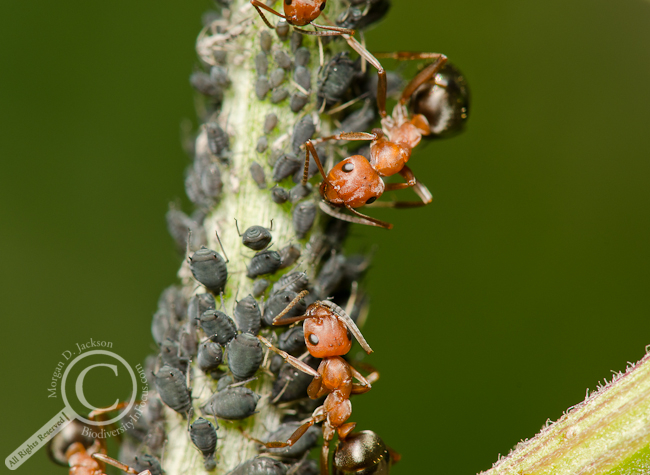
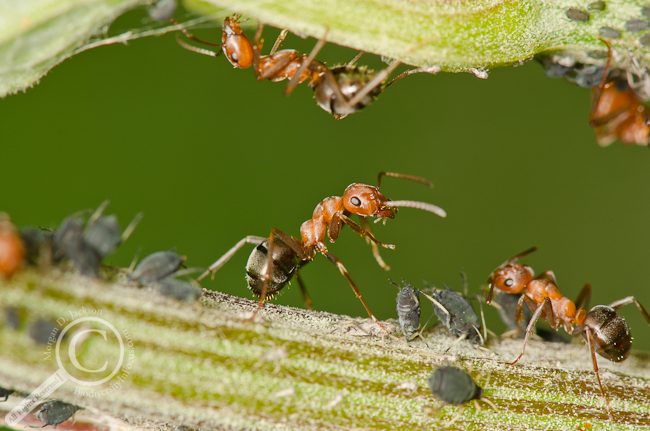
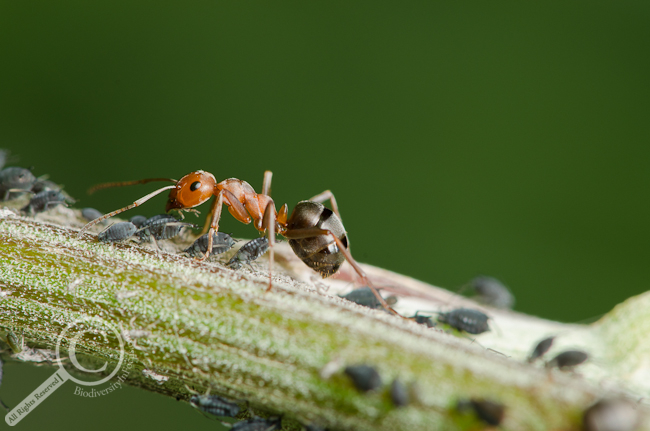
In a last minute rush to produce some ant photos to compliment the fine photographs of Ted’s and Alex’s, I ran back to the Dairy Bush on the University of Guelph campus with hopes of finding some interesting ants to shoot. Luckily for me, I happened across what I believe are Camponotus Formica ants tending to masses of aphids. Ant mutualism with aphids was one of the first insect interactions I can remember learning about in my intro entomology courses, and I can’t resist watching and photographing these tiny ranchers whenever I come across them!

Camponotus ant tending aphids on a plant


Two Camponotus ants tending an aphid herd


Camponotus ant seemingly dancing with the aphids it is tending


Jun 282011
 

Ryan FleacrestThis Friday is Canada Day, and what better entomological representation of Canada than the scourge of the Great White North, the black fly! Well, I suppose grylloblattids are a better choice, but so far no one has written a song about them, so black flies will have to do! (The Grylloblattidae are a group of rare insects first discovered on a glacier in western Canada, and are the mascot of the Entomological Society of Canada)

Along with our igloos and friendship with Charlie from Thunder Bay, swarms of black flies waiting to bleed unlucky Canadians dry is one of the more common misconceptions about Canada. Luckily, most of southern Canada is relatively free of black flies, but once you get into cottage country, the woods do indeed belong to the bikojisi, as they are known to the Ojibwe. The clouds of black flies present in the back country of Northern Canada have been known to instill fear in even the most adventurous outdoorsman (or outdoorswoman), and those required to work outdoors during the spring in Boreal Canada can undoubtedly sympathize with this weeks artist, Wade Hemsworth as he sings about his experiences with black flies while working for Hydro Ontario!


Incidentally, this short film by Christopher Hinton was nominated for an Academy Award in 1992 for Best Animated Short (it lost to this entertaining cartoon unfortunately). Pretty good for an insect loathed by most Canadians eh?

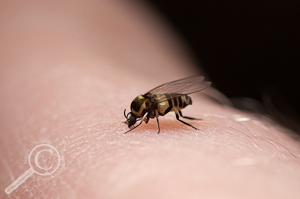
Black Fly - Simuliidae - Ecuador

This black fly may be from Ecuador, but that arm is 100% Canadian!

H/T to Bug Girl for sharing this song!

This song is available on iTunes – The Blackfly Song – Folk Songs of the Canadian North Woods

Jun 212011
 

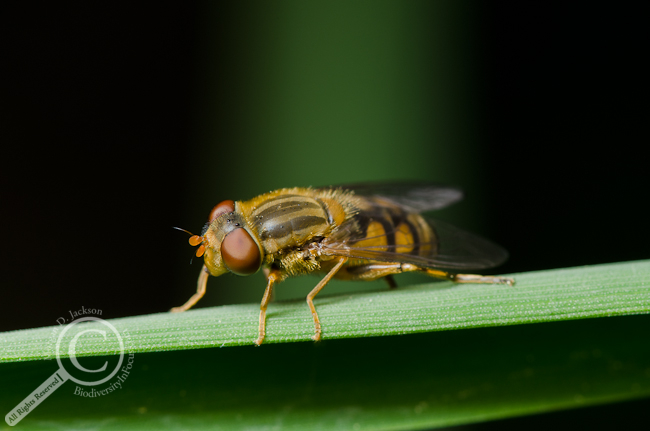
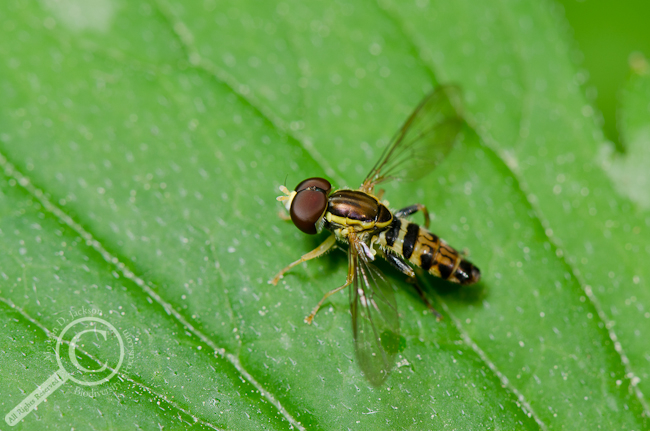
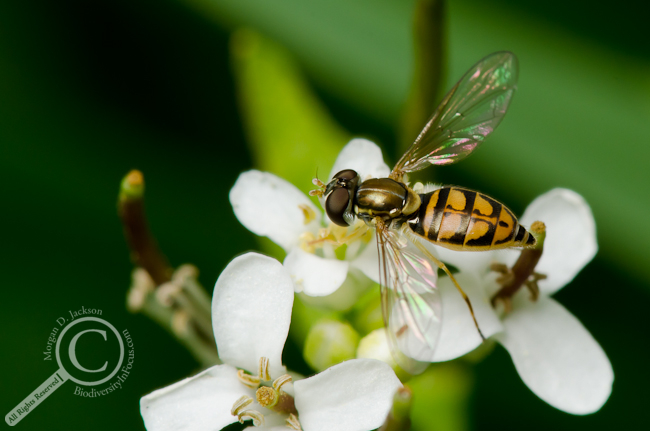
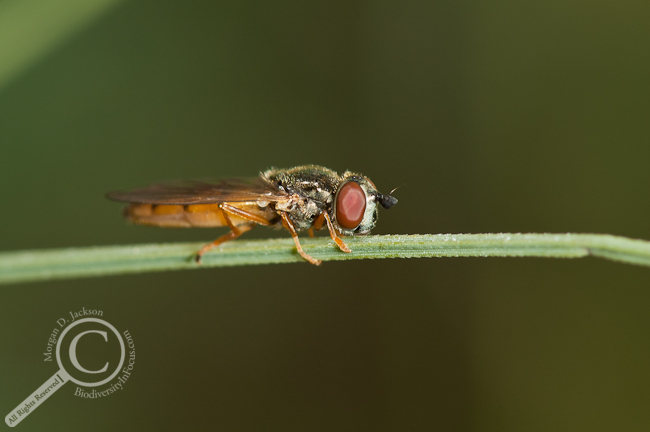
Ryan FleacrestIt’s National Pollinator Week in the US, and although Canada doesn’t have their own celebration of insect-facilitated sex, that doesn’t mean I can’t promote some sexy fly pollinators! Honey bees and their hymenopteran brethren get most of the credit for pollination, but flies are likely just as powerful pollinators, only underappreciated and understudied thus far. Some of the world’s most vital crops (i.e. chocolate) depend on flies for pollination (in this case a biting midge of the family Ceratopogonidae), while countless other plants find themselves in a veritable orgy of Diptera deliveries. Some of the more striking of these include the Syrphidae, conveniently known as flower flies for their propensity to visit flowers for pollen and nectar.

Parhelophilus laetus Syrphidae

Parhelophilus laetus

Toxomerus geminatus Syrphidae

Toxomerus geminatus


Toxomerus marginatus Syrphidae on flower

Toxomerus marginatus

While these 3 species are pollinators of compound flowers (like the ones in the last photo being visited by Toxomerus marginatus), some flower flies are specialists on plants which were typically thought to be wind pollinated, such as grasses.

Platycheirus sp. Syrphidae on grass

Platycheirus sp.


With around 900 species of Syrphidae in North America (and more than 6000 species around the world), not to mention the countless other fly families which visit flowers, there are plenty of flies available to act as plant escorts. You might say that fly pollinators do a little dance of love on behalf of the flowers. I can imagine these fast-flying flower phallus’ bumping and grinding to something a little like this…


The next time you stop to smell the flowers, don’t forget what it is you’re smelling, the sultry perfume of a flower looking for a little fly action!


This song is available on iTunes – Pollinator (Gary Beck Remix) – Global Underground – Tom Novy

If you’d like some more insect sexiness, check out Bug Girl’s excellent, innuendo filled explanation of pollination!


Tuesday Tunes – Fireflies – Owl City

 Fun Stuff, Insects, Pop Culture, Tuesday Tunes  Comments Off on Tuesday Tunes – Fireflies – Owl City
Jun 072011
 

Ryan FleacrestWell it seems the summer has finally arrived, and with it the warm temperatures! I always associate fireflies with summer, with their flickering lights during hot nights. I’m going to attribute my procrastination lately to the heat, and call in lame, providing you a simple song with simple lyrics! Perhaps, take a moment and think back to summer’s past and the memories you’ve had with fireflies!


I’ll try to stop being lame this week and finish up all those posts I promised for last week! Until then, keep cool and enjoy the summer’s eve!


This song is available on iTunes – Fireflies – Ocean Eyes

May 312011
 

Ryan FleacrestThere are few insects which enjoy the adoration, fame and geographical range that the domestic honey bee (Apis mellifera) does, so it’s surprising that there are relatively few songs singing their praises. Of course, that doesn’t stop artists of all eras from using the sweet “nectar” produced by these entomological factory farms as a cutesy term of endearment for a loved one! Makes you wonder whether Blake Shelton is known as “honey bee” to his wife…

I first head this song on Twitter via Dr. May Berenbaum (@MayBerenbaum) which makes a slick segue into my next post; a review of the new documentary Queen of the Sun, which features Dr. Berenbaum’s expert opinions on the plight of the honey bee in America! Pretty good eh? Make sure you check it out soon, but until then, Fleacrest, out!

This song is available on iTunes – Honey Bee – Honey Bee – Single


May 292011
 

Just a quick post to pass along a menage a trois of new insect blogs which have ties to McGill University in Montreal, Quebec!

Chris Borkent is not only a PhD student working on fungus gnat (Mycetophilidae) taxonomy at McGill, but also an avid naturalist. Chris will be sharing his knowledge and observations on all things natural that he makes during his walk to work at the Lyman Entomological Museum over at his new blog, Natural History in Suburbia. Another dipterist is now online; beware!

Speaking of the Lyman Entomological Museum, they’ve recently started a blog highlighting the research accomplishments and field work being undertaken at their institution. There are a bunch of great entomologists working in the Lyman Museum, so be sure to watch for lots of interesting news!

Finally, McGill alum Brigette Zacharczenko is working towards her MSc PhD at the University of Connecticut by studying the systematics of moths in the family Noctuidae, and has just started a blog chronicling the life history of her research subjects. With some absolutely stunning photos of moth eggs and caterpillars, caterpillarblog is definitely going to be one to watch! Also, Brigette is a super creative seamstress who designs, creates and sells plush invertebrates under the pseudonym Weird Bug Lady. An awesome nickname, and anyone with an interest in insects should check out those cute-n-cuddly works of art right now!


Tuesday Tunes – Fruit Fly – Nada Surf

 Fun Stuff, Insects, Tongue in Cheek, Tuesday Tunes  Comments Off on Tuesday Tunes – Fruit Fly – Nada Surf
May 242011
 

Ryan FleacrestIt was a great long weekend for us Canadians, with more than decent weather in my area, cold beer, and BBQ! I also came to the conclusion that I’m going to start referring to the holiday as Linneaus Day rather than Victoria Day; Linneaus contributed more to global society, considered himself royalty, and holds taxonomic priority – he was born in 1707 while Queen Victoria wasn’t born until 1819! But I digress…

Along with the great weather and beer, I’ve put the final touches on my first peer-reviewed journal article, which should be coming online sometime around lunch today! I’ll be blogging about it later on, but for now, here’s a song somewhat on topic by Nada Surf; Fruit Fly.


I’m pretty sure this song is referring to a family which are frequently called “fruit flies” but which I call “vinegar flies” – Drosophilidae. These diverse nuisances aren’t the same family as I’m publishing on, but the title “Fruit Fly” does fit my group, the Tephritidae. The closest I could come to finding a tephritid-relevant musical selection was the Seattle-area punk band Apple Maggot Quarantine Area, but they didn’t have any useful videos to share…

Anyways, keep an eye out later today for the full story!


This song is available on iTunes – Fruit Fly – Let Go


May 112011
 

A few days ago I was walking through the University of Guelph Arboretum taking some down time and trying to get back into the photography groove when I noticed a peculiar sight…
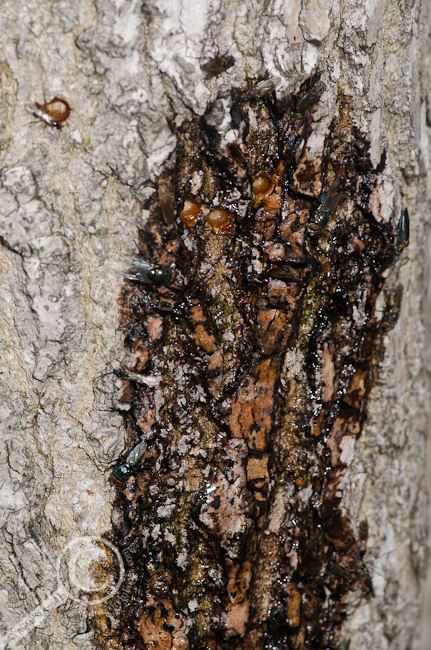
 

Tree weeping sap covered in insects

The trees were weeping, and dozens of flies were lapping up the sweet, sweet tears! Since there were several of these patches on two nearby trees (my tree bark ID skills are severely lacking, I’m a leaf man) and the wet marks were 4 to 10 feet off the ground, I felt it was a safe guess that it wasn’t a territorial marking (unless the UofG men’s basketball team was having a summer camp…), and last I checked I wasn’t in Fangorn Forest, so I did a little detective work to discover the story behind the sadness.

Closer inspection revealed these curious holes:
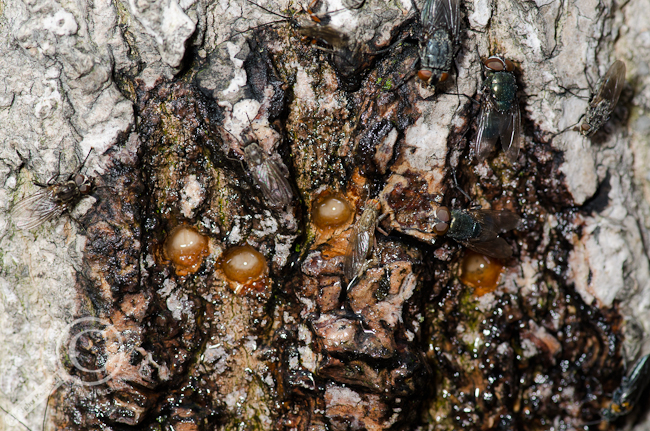
Yellow-bellied Sapsucker holes drilled into tree bark

My first thought was to scan for long-horned beetles (Cerambycidae) or perhaps metallic jewel beetles (Buprestidae), but after seeing nothing but flies and wasps, I took a closer look and noticed that the holes only pierced the bark, and not the xylem (aka sapwood). It dawned on me that what I was looking at was a tricky, sticky lure set by a bird I’d seen plenty of times before in the Arb; the Yellow-bellied Sapsucker (Sphyrapicus varius). This crafty woodpecker will cause superficial injuries to a tree, and then sit back while the sap flows free. The bird will then return to the tree and pick off the insects which are feeding on the sap, as well as some of the sap itself! Clever bird…

Pretty cool biology, so I took the opportunity to see what sort of insects were at risk of becoming an early spring brunch for the hungry sapsucker.

I observed a few butterflies when I first approached the trees, but they quickly flitted away, not to return while I was there. I’m by no means a Leper (i.e. a Lepidopterist), but I think they may have been Red Admirals (Vanessa atalanta, Nymphalidae), which are one of the earlier butterfly species to be found in Southern Ontario.

There were a number of hymenopterans taking advantage of the Saturday afternoon bounty including many Ichneuomoid wasps and this fuzzy female:
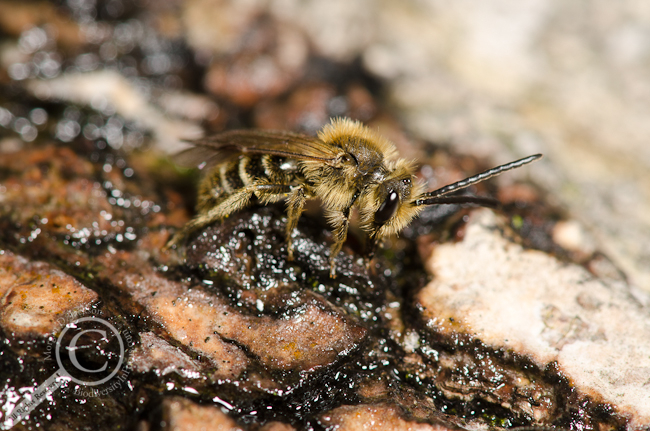
Andrenid bee eating tree sap Andrenidae

This andrenid bee (Andrenidae) seemed quite content to sit and lap up the sugary sap running down the tree bark, not caring when I moved in and out trying to get a decent photograph of it’s amazing hairdo.
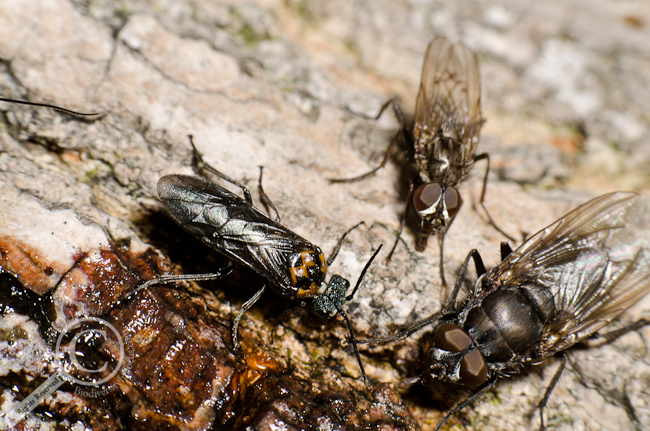
Tenthridinidae wasp eating tree sap with a calliphoridae and muscidae fly

While the bee was busy enjoying a solitary meal, this sawfly (Dolerus unicolor, Tenthredinidae) was more than happy to share the sap with a couple of calyptrate flies (a blowfly [Calliphoridae] on the right and what I believe to be a Muscidae at the top). In fact, the calyptrates made up the vast majority of the insects visiting the tree, in some places packed so tightly you couldn’t see the tree for the flies!
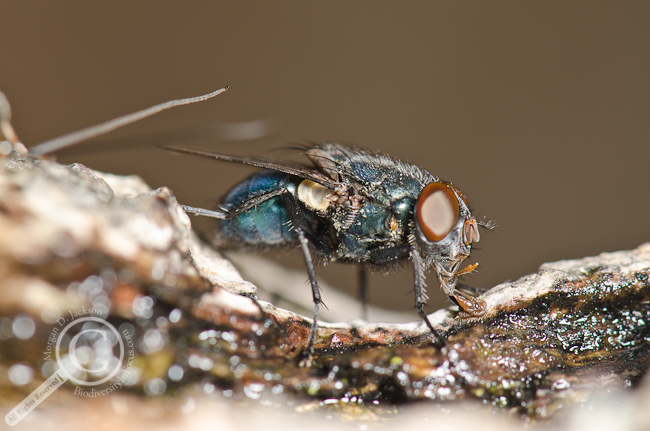
Blow fly Calliphoridae sponging up tree sap

The sponge-like mouthparts found in many calyptrates are well demonstrated in this blowfly (Calliphoridae, possibly subfamily Chrysomyinae). You can see the maxillary palpi sticking straight ahead as the membranous labrum and associated sclerites mop up any residual tree sap on the bark.
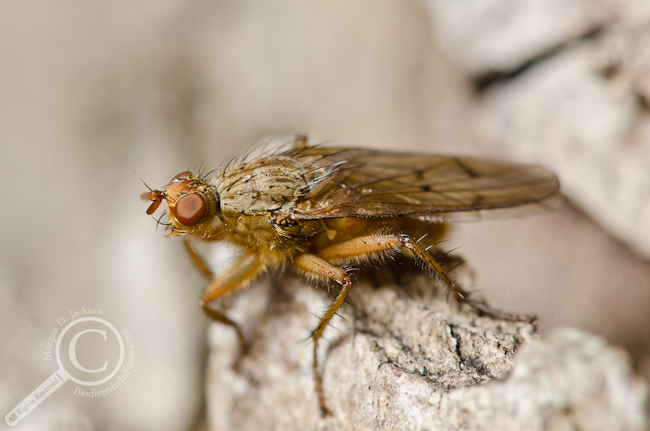
Scathophaga sp. Scathophagidae

Another, lesser known calyptrate family was also making an appearance; the Scathophagidae. I could make out what looked to be two species of scathophagid, including this Scathophaga sp. perched nearby awaiting its turn at the sugar shack.
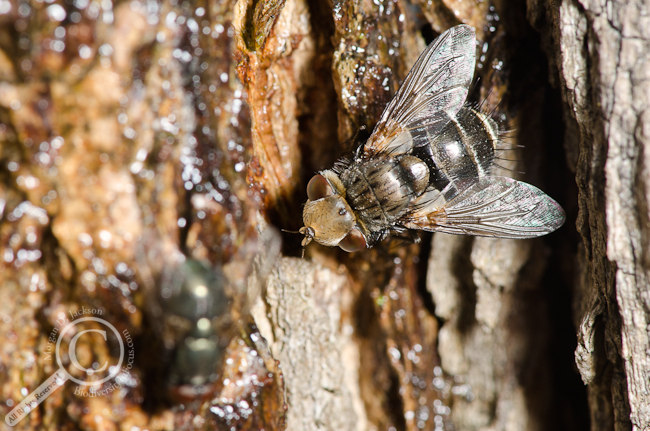
Tachinidae fly on tree drinking tree sap

Not everything went according to plan on this outing however, as I made a major n00b move – I forgot to pack specimen vials! While normally I’d have a dozen or so snap-top vials in my camera bag in case I ran into something which needed to be examined at a later date and added to the University of Guelph Insect Collection, after transferring my photo equipment into my new camera bag (courtesy of the best wife ever), I neglected to throw in the vials! The first rule of entomology (besides “ALWAYS talk about entomology”) is to collect the damn specimen, and as luck would have it, I came across a fly which I instantly wanted to collect (pictured above & below).
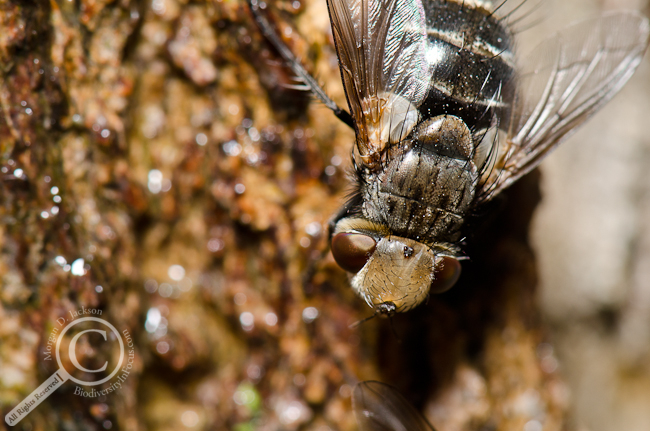
Tachinidae with tree sap fly

This Tachinidae caught my eye right away, and after several attempts, I managed to get a couple of decent images. Unfortunately, tachinid flies are one of the most diverse groups of animals on the planet, and the specimen would be vital in identifying it to the genus or subfamily level on my own. A lesson learned, and needless to say I threw a couple of vials in my bag as soon as I got home!

After getting my fill of photos and not having any means to collect some specimens, I decided to pull back and let nature take it’s course. While I never saw the sapsucker, I certainly appreciated the opportunity it created, allowing me to photograph a great diversity of flies and wasps!

Tuesday Tunes – La Cucaracha

 Fun Stuff, Insects, Pop Culture, Tongue in Cheek, Tuesday Tunes  Comments Off on Tuesday Tunes – La Cucaracha
May 102011
 

Ryan FleacrestIn honour of the Latin American celebration of Cinco de Mayo, I bring you an iconic entomological song that most people will instantly recognize! While the original lyrics were about a disabled cockroach, this song became popular during the Mexican Revolution, with people creating their own lyrics to mirror their political ties. The original lyrics however are pretty fun:


Spanish English
La cucaracha, la cucaracha, The cockroach, the cockroach,
ya no puede caminar can’t walk anymore
porque no tiene, porque le falta because it doesn’t have, because it’s lacking
las dos patitas de atrás. its two back legs.

(Lyrics courtesy of Wikipedia)

I’ve seen many insects which are lacking legs and still mobile, so it’s a little odd that these are the lyrics which started it all. As many urbanites may attest, killing a cockroach is not the simplest task and urban legends maintain that cockroaches will inherit the world following a nuclear holocaust. Perhaps we’ve just been taking the wrong approach this whole time, and removing the back legs is all that’s needed to stop these household pests!

Certainly a catchy tune, and one I’m sure will be infesting my head for the remainder of the day!


This song is available on iTunes – La Cucaracha – Mexican Fiesta


Spanish English
La cucaracha, la cucaracha, The cockroach, the cockroach,
ya no puede caminar can’t walk anymore
porque no tiene, porque le falta because it doesn’t have, because it’s lacking
las dos patitas de atrás. its two back legs.

Tuesday Tunes – Buzzin’ Fly – Tim Buckley

 Fun Stuff, Insects, Life as a Grad Student, Pop Culture, Tuesday Tunes  Comments Off on Tuesday Tunes – Buzzin’ Fly – Tim Buckley
May 032011
 

Ryan FleacrestOne of my favourite entomological newsletters was published today, and to celebrate I’m going back to a fly-themed song. I’d highly recommend checking out “Fly Times”, the biannual newsletter of the North American Dipterists Society (affectionately known as NADS), where you can find all manner of interesting news from the Dipterological community, buzzing with stories from the field, research news, and all manner of articles involving flies and the people who study them.


In other Dipteran news, I’ve completed all the requirements for my MSc and am officially the proud owner of a shiny new graduate degree in Diptera systematics! This means that my blogging schedule will pick up again, with multiple posts each week and some big ideas for the near future. Thanks for sticking with Biodiversity in Focus during this busy period!


This song is available on iTunes – Buzzin’ Fly – The Dream Belongs to Me – Rare and Unreleased Recordings 1968/1973