Jan 132012
 

Robert Redford may have a beetle, but musical sensation Beyoncé is fly!

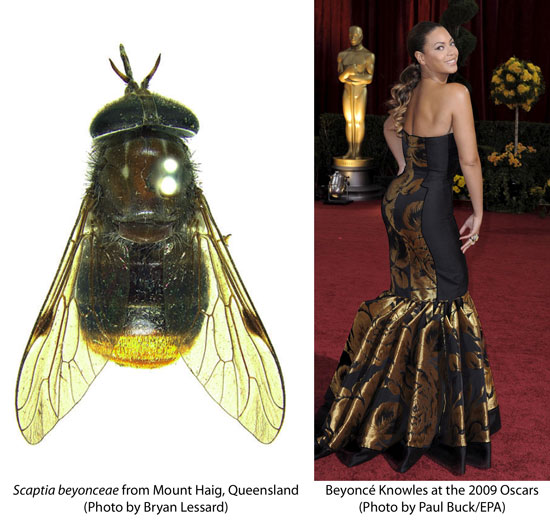
That’s right, Ms. Sasha Fierce has been bestowed with the taxonomic honour of patronymy by Australian dipterists Bryan Lessard and David Yeates.

Beyonce fly Scaptia beyonceae

Bryan was bedazzled by the golden rumped females of the newly described Scaptia beyonceae, a horse fly in the family Tabanidae, and decided to forever immortalize Beyoncé’s Bootylicious bottom. The species may have been a child of destiny, as the type specimen was collected in northern Australia shortly after Beyoncé’s birth, and has only been collected twice since. Nobody knows how this fly species would appear if it were a boy, as all known specimens are female.

I tried reaching Taylor Swift to learn when her own fly would be coming out, but was interrupted by Kanye West who apparently thinks this is one of the best flies of all time. No word yet when junior synonym Scaptia blueivyii will be described, but I’ll keep you updated!

(All kidding aside, Bryan is a cool guy who I met at ESA this past fall. He described another 4 species in the same paper, including one named for Dr. Leigh Nelson (Scaptia nelsonae) which isn’t receiving near the press for some reason…)

 
ResearchBlogging.orgBryan D Lessard, & David K Yeates (2011). New species of the Australian horse fly subgenus Scaptia (Plinthina) Walker 1850 (Diptera: Tabanidae), including species descriptions and a revised key Australian Journal of Entomology, 50 (3), 241-252 : DOI: 10.1111/j.1440-6055.2011.00809.x

Jan 042012
 

ResearchBlogging.orgIt’s not often that flies make headlines, and when they do it’s usually in a negative connotation (malaria, mosquitoes, black flies, etc). A new paper published Tuesday in PLoS ONE (Core et al, 2011) is certainly not helping this Detrimental Diptera Dillema (DDD), announcing that a species of scuttle fly (Phoridae) has been discovered parasitizing honey bees (Apis mellifera), one of the most loved insects on the planet.

Images of Apocephalus borealis and honey bees from Core et al., 2012

Fig. 2 - Images of Apocephalus borealis and honey bees from Core et al., 2012

Of course things attacking honey bees isn’t in itself news, especially in the age of Colony Collapse Disorder (CCD). The real news here is that the scuttle fly, Apocephalus borealis, has seemingly switched hosts, previously known to be parasitic in bumble bees, paper wasps, and even black widow spiders (Brown, 1993). Other Apocephalus flies are better known as ant-decapitating flies, who’s larvae will pupate in the dismembered heads of their ant hosts. As for A. borealis, it’s association with honey bees was thanks to a serendipitous natural history observation:

(John) Hafernik, who also serves as president of the California Academy of Sciences, didn’t set out to study the parasitized bees. In 2008, he was just looking for some insects to feed the praying mantis that he had brought back to SF State’s Hensill Hall after an entomology field trip. He scrounged the bees from underneath the light fixtures outside the biology building.

“But being an absent-minded professor,” Hafernik joked, “I left them in a vial on my desk and forgot about them. Then the next time I looked at the vial, there were all these fly pupae surrounding the bees.”

San Francisco State University Press Release, January 3, 2012

After further observation, a few behavioural trials and some interesting molecular techniques, the research team found that not only were these scuttle flies parasitizing honey bees in the San Francisco Bay area, but also in migratory bee colonies housed in the Central California Valley and South Dakota, and also that infected honey bees would leave their colonies at night to fly away and die (often congregating at man-made lights and acting strangely); that all of the parasitized bees had been exposed to Nosema ceranae (a fungus which can lead to death from diarrhea and malnourishment) and/or Deformed Wing Virus (a disease that can cause malformation of a bee’s thorax and wings during pupation); and that some of the flies had evidence of these bee pathogens in their systems.

This is a lot of really interesting information for one study, but it’s not hard to see where the authors were going next with their story: scuttle flies could be contributing to CCD and posed a “new threat” to honey bees. The authors proceeded to pose a long series of questions regarding future areas of research, and how all of their findings could be detrimental to honey bee populations and the potential role these flies play in CCD. Overall, this is a very cool piece of natural history research, with a bit too much CCD hype for my liking!

You can see why the media has fallen in love with this paper; it includes flies (which no one likes on principle), honey bees (which everyone likes on principle), CCD (which scares the daylights out of everyone) and zombies (which also scare the daylights out of everyone). At the time that I wrote this post (midnight-ish Wednesday morning), I found 13 major news outlets or blogs from around the world which had covered the story (see list below).

This is where we have a problem though. Of the 13 stories I looked at, 8 of them had errors in their reports, of varying severity. What’s worse, all of the erroneous accounts were in major reporting outlets, potentially misinforming thousands of readers! It’s not surprising however, to see that 7 of the 8 stories that got things 100% correct were all science-focused publications/blogs, while one was a small-market news affiliate:

The Good

KQED News – ‘Zombie’ Parasite Preys on Bay-Area Honeybees, by Lauren Sommer

Observations (Scientific American Blog Network) – “Zombie” Fly Parasite Killing Honeybees, by Katherine Harmon

New Scientist LifeParasitic fly could account for disappearing honeybees, by Andy Coghlan

Science NowParasitic Fly Dooms Bees to Death by Maggots, by Erik Stokstad

MyrmecosDid a parasitic fly cause Colony Collapse in bees?, by Alex Wild

Not Exactly Rocket ScienceParasitic fly spotted in honeybees, causes workers to abandon colonies, by Ed Yong

The Bad

MSNBC (WebCite copy) – Stated bees which foraged at night were more likely to be parasitized than bees that foraged during the day (misinterpretation of Fig. 3A of Core et al., 2012)

Mirror (WebCite copy) – Stated that the parasite “is similar to one being found in bumblebees” (it’s not just similar, it’s the same species)

Press Association (WebCite copy) – Title states that the flies are linked to bee losses (not true, the connection between fly parasitism and CCD is simply proposed by the authors); Implied that bees are immediately turned into light-seeking zombies after the female fly lays her eggs (it appears to take up to a week for this to happen)

Daily Mail Online (WebCite copy) – Title states link between flies and global decline of bees (see above); Didn’t italicize species names (minor I know, but it bugs me)

CBC News (WebCite copy) – Implies that bees which foraged at night were more likely to be parasitized than bees that foraged during the day (see MSNBC)

io9 (WebCite copy) – “This parasite is a likely culprit (in reference to CCD – MDJ) because it does indeed force bees to abandon their colony” (authors say the fly may contribute to CCD, not that it is the likely culprit)

Daily Express (caching not allowed) – Implies that bees are parasitized in their hives and that they immediately “abandon their hives in a crazed state” (the authors are unsure of where the flies attack, but they know it’s not in the hive, and see the Press Association above); didn’t italicize species names (argh)

While I doubt that heads will roll at these institutions because of these errors (sorry, a little Apocephalus humour there), the moral of this story is that the science content the majority of the public is exposed to is not exactly the best science content available! Hopefully, as scientists and science writers continue to use social media and blogs, the good stories I featured here will reach more of the people who would normally only see the “bad” versions, imparting a correct and positive experience with the fantastic research being done every day around the world!


Update (Jan. 07, 2012, 20:30) Brian Brown, a co-author on this study and the world’s expert on these flies, has expanded on the natural history and taxonomy of the flies involved in this research on his blog ‘flyobsession’. The remainder of the research team behind this study will be setting up a FAQ to help ‘clarify’ some of the errors I reported on above, and are also beginning a new citizen science project to begin understanding how far flung this parasitism is.

 
Core, A., Runckel, C., Ivers, J., Quock, C., Siapno, T., DeNault, S., Brown, B., DeRisi, J., Smith, C., & Hafernik, J. (2012). A New Threat to Honey Bees, the Parasitic Phorid Fly Apocephalus borealis PLoS ONE, 7 (1) DOI: 10.1371/journal.pone.0029639

BROWN, B. (1993). Taxonomy and preliminary phylogeny of the parasitic genus Apocephalus, subgenus Mesophora (Diptera: Phoridae) Systematic Entomology, 18 (3), 191-230 DOI: 10.1111/j.1365-3113.1993.tb00662.x PDF Available HERE

Dec 132011
 

Mendeley logoThe first step when starting any new research project is to become familiar with the past literature, and know who did what, and when. This is especially true for taxonomy, where each and every paper published in the past 250 years regarding the description of new species or discussion of the framework for the tree of life for any given taxon is relevant and needs to be examined. This can result in a huge library of publications to keep track of, for which there are a number of options available to the beginning biologist.

One in particular however, has something a little extra incorporated in it; a social network.

Mendeley was developed as a freely available, online, cloud-based reference manager, where individual users add citations & publications to a central repository, which in turn is accessible to all other users for building citation catalogs of their own. There are several benefits to this system, one of which is a recommendation of other publications which may be relevant to your field of research, some of which you may not have been previously aware of. The other benefit is of more use for evaluating the impact of a publication (including your own).

Mendeley Stats

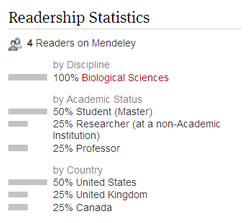
User statistics for Gibson et al, 2011

Because all 1 million current users are building citation lists from the same pool, it’s possible to obtain basic demographics of the people reading your work. Take for example a recent paper I collaborated on regarding PCR primers specific for Diptera phylogenetics. 3 people (other than myself) have added the paper to their Mendeley citation list, with 2 working in the US and one in the UK. While these aren’t groundbreaking numbers, nor the stats overly informative, it’s encouraging to see researchers are noticing the work we did. I would like it if you could see who exactly was reading your papers, as I think it could be useful for finding future collaborators or potential advisors for graduate or post-doctoral work, but I’ll take the simple gratification that our work is being read by 0.0003% of the Mendeley community!

Mendeley has also incorporated several other networking tools, including profiles where you can share your CV, publications, funding sources and contact information (similar to the tools available to LinkedIn users), as well as infrastructure  for sharing publications and holding discussions specific to your field of research in both public and private groups. Being based primarily online, it’s pretty simple to add references to your library using available web browser add-ons, and there are also desktop & mobile clients available which allow you to access your reference library anywhere or while on the go, although I’ve found them both to be a little buggy and prone to crashing (on my iPhone 4S and Windows XP PC).

The central citation database built by the community of users also holds the potential for some interesting data-mining projects, like Roderic Page’s goal of linking species names with the literature containing their original description. If you’re interested in cybertaxonomy, I’d recommend checking out Rod’s blog for more information (it’s pretty cool, but a little on the technical side).

Ultimately, Mendeley is attempting to streamline the accumulation and distribution of scientific literature for researchers. If you’re looking for a reference manager, or are interested in exploring some of it’s capabilities, feel free to look me up; who knows how we might connect!


Gibson, J. F., Kelso, S., Jackson, M. D., Kits, J. H., Miranda, G. F. G., & Skevington, J. H. (2011). Diptera-Specific Polymerase Chain Reaction Amplification Primers of Use in Molecular Phylogenetic Research. Annals of the Entomological Society of America, 104(5), 976-997. Available online (OPEN ACCESS)

Nov 292011
 

Ryan FleacrestIt’s been awhile since Tuesday Tunes featured a song about those beautiful bi-winged bugs the flies, so I think we’ll rectify that!

This isn’t the first time that Wire has been featured here on Biodiversity in Focus, with their song Outdoor Miner previously making the list. That song featured a relatively accurate depiction of a leaf miner fly, probably in the family Agromyzidae. Today’s song features flies a little closer to home, repeatedly talking about a fly in the ointment and flies causing more disease than fleas.Well, that and a divergent wasp dealing with plate-glass (side note: Flickr is fun).

So what might the flies be? Well I’m going to go with the common house fly (Musca domestica) for the fly in the ointment, just based on ubiquity and the odds of one ending up in someone’s moisturizer/tonic/soup. How about the flies causing more disease than fleas? Well, fleas are vectors for a number of diseases, with the big one being the Bubonic Plague. With an estimated 75 million people killed during the Black Death pandemic and another 12-15 million more killed in epi- and pandemics up until the mid 20th century, I think we can confidently put a back-of-the-napkin (BOTN) estimate of 100 million deaths attributable to fleas in recorded history. Tsetse flies (Glossinidae, 23 species total, 2 of which are of medical importance to humans) are vectors for the trypanosome that causes African Sleeping Sickness, which was listed as killing 48,000 people in 2008. A BOTN gives me an estimate of 100 million deaths in the last 2000 (50k x 2000 years, assuming smaller populations but higher mortality rates), so Tsetse flies are a possibility. Our next suspect might be the common house fly from earlier. Known to spread diseases such as typhoid (BOTN = 20 million deaths out of 450 million in past 2000 yrs), cholera (BOTN = 30 million deaths out of ~600 million in past 2000 yrs), and dysentery (BOTN = 50 million deaths out of 1.5 billion in past 200 yrs) among others, the house fly may be a dark horse in this race.

Of course, the best bet are the mosquitoes. With the genus Anopheles (the vector for Malaria) responsible for easily 100 million deaths in the past 200 years, not to mention the deaths attributable to Yellow Fever & Dengue Fever (Aedes aegypti) and “minor” diseases like West Nile Virus and Japanese Encephalitis (Culex). I think it’s pretty safe to say that mosquitoes are the most deadly insect known to man!

Anyways, that was a pretty morbid tangent from the song, so let’s just listen to some music shall we?


(All estimates based on conservative values found in Wikipedia. Some estimates may be horribly off, so best to do a more thorough literature check if you need more reliable numbers!)

This song is available on iTunes – I Am the Fly – Chairs Missing (Remastered)

Tuesday Tunes – All My Friends Are Insects – Weezer

 Fun Stuff, Insects, Pop Culture, Tongue in Cheek  Comments Off on Tuesday Tunes – All My Friends Are Insects – Weezer
Nov 152011
 

Ryan FleacrestSince I’m here at ESA 2011 and becoming reacquainted with old friends and meeting all sorts of new people interested in insects, I thought it was only fitting to share this short song from Weezer! We’ll forgive the slight transgression about earthworms being insects for now, but Rivers Cuomo best watch his taxonomy in the future!

Don’t be afraid to go out and make an insect/entomologist friend of your own this week!


This song is available on iTunes – All My Friends Are Insects (Bonus Track) – Hurley (Deluxe Version)

Tuesday Tunes – Fly on the Wall – AC/DC

 Blogosphere, Insects, Pop Culture, Tuesday Tunes  Comments Off on Tuesday Tunes – Fly on the Wall – AC/DC
Oct 042011
 

Ryan FleacrestHere we are at Tuesday again already. If you didn’t catch it last night, I finally got around to answering the ID challenge from August. Pretty depressing it took so long, but September was another busy month with papers submitted, friends defending their PhD’s, and of course NSERC applications coming due. I was little more than a fly on the blogosphere wall all month, but there was some fantastic things being posted by my fellow insect bloggers. Here are a few I’d highly recommend checking out:

The entomological blogging network has been rapidly expanding in recent months, providing me plenty of procrastination material coming into the conference season! And here’s a little something to help you put off starting your talk or poster, Fly on the Wall by AC/DC!

Oct 032011
 

Remember that last ID challenge I put to you? The one at the end of August which I’m only now getting around to answering? Ya, that one.

With the best turn out of commenters willing to wager on their IDs, I’m sorry it’s taken me so long to award those hard earned points. But no fear, that day is finally here!

It seems that Hippoboscidae have a face that more than it’s mother can love, as everyone correctly guessed the right family! I can’t say I blame the enthusiasm surrounding this fly, as their morphological adaptations for living on birds are pretty amazing!

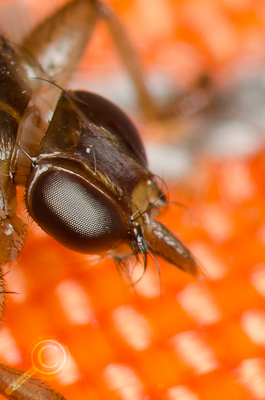
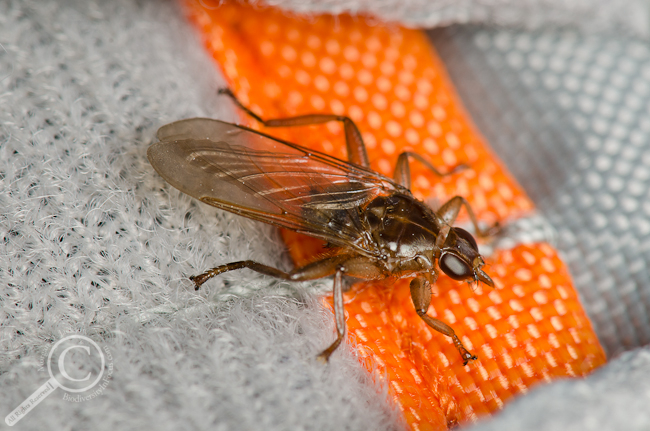
Icosta ardeae in a not-so-natural setting

Dorso-ventrally flattened to slide in amongst the feathers, plenty of thick setae on the thorax and abdomen which I assume are used for getting nestled in for the long haul, and trifurcated tarsal claws to hold onto their feathered hosts. Although I enjoy a morning bird watching from time to time, I’m not exactly a bird wrangler, so how did I come by this spectacular specimen? It seems my wife was putting out the bird vibes back in August while we were out hiking through Mono Cliffs Provincial Park (which is a fantastic hike by the way, definitely worth a visit if you’re in the area), and this fly latched on while we walked back to the parking lot.

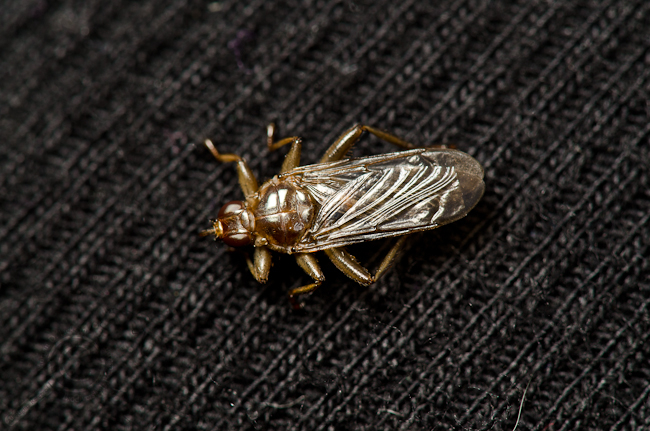
Icosta ardeae bird louse on shirt

Renee wasn’t all too impressed with her little hitchhiker, but I was ecstatic! I quickly scooped it off and put in my camera bag for a few snaps, all the while expecting it to get away. With these photos in hand, I threw it in my bag anticipating another opportunity to shoot it when I got home, but I guess all this excitement was too much, as it didn’t survive the car ride. Oh well, it found a good resting place in the Guelph Insect Collection, and also gave me a chance to identify it back in the lab.

Of course, that would prove more difficult than I had imagined, and I’m still not 100% confident in my final identification. The genus ID was relatively easy using the Manual of Nearctic Diptera, and I quickly had it keyed to the genus Icosta. That’s where the “fun” began however, as I tracked down the authoritative paper on Icosta taxonomy and biology published in 1969 by T.C. Maa of the Bishops Museum. Although the keys were well written and relatively well illustrated for a 1969 key, the characters needed for identification were anything but simple! I eventually ended up at Icosta ardeae (Macquart), although from what I could tell it was Icosta ardeae ardeae, a subspecies recorded from much of the Old World, ranging from the UK, down to South Africa and as far east as the Philippines and Australia! The other subspecies, Icosta ardeae botaurinorum, is listed as being known from North America, including Ontario, but the abdominal setae and wing shape illustrated just didn’t fit. Both species are known to choose herons as their preferred host, with I. a. botaurinorum breeding almost solely on American Bittern (Botaurus lentiginosus), which could very well have been lurking in the pond near the parking lot.

So what’s the deal; is it I. a. ardeae, or I. a. botaurinorum? I’m not a big believer in the idea of subspecies, so I’m happy simply calling it Icosta ardeae, but it speaks volumes about our understanding of the taxonomy of the family. Often found on birds (one of the best studied groups on earth), you would assume these flies would be as well studied and well collected as their avian counterparts, and yet I can’t get a definitive ID on one found 30 minutes from Toronto! Without any further taxonomic work since Maa’s 1969 revision, and with Maa leaving numerous species unnamed in his paper, simply calling them Icosta sp. “S” or sp. “N”, Icosta seems like a great project for someone interested in fly and bird taxonomy, and I could see a cool phylogenetic comparison between hippoboscid species and their avian hosts!

With that suggestion for the future, lets finish off the past and allocate some BioPoints! Chris scores a cool 15 points (3 for family, 4 for subfamily, 2 for being the first to answer and 6 for the review of hippoboscid larval biology), Laurie Knight picks up 8 (3 for family, 2 for picking a related species, and 3 for sharing her awesome photos of hippoboscid’s with mallophagan lice attached), Miles scores 3 points for his family ID, and Matt grabs 5 points (3 for family plus 2 for providing the morphological characters he used).

Thanks for playing once again everyone, and watch for more ID challenges in the near future (I mean it this time, I swear…)


All notes on taxonomy and biology of these flies was found in:

Maa, T.C. 1969. Revision of Icosta (=Lynchia Auctt.) with erection of a related genus Phthona. Pacific Insects Monograph 20: pg. 25-203.

Aug 302011
 

Ryan FleacrestAnother week, another tune! Sarah Brightman’s The Fly


It’s also time for another ID Challenge:


Time to earn some more BioPoints! Provide as many taxonomic or biological notes you can think of, and I’ll dole out the points! Good luck!

(I’m taking a page out of Ted’s book and turning on moderated comments so everyone has a chance at some points!)

Aug 162011
 

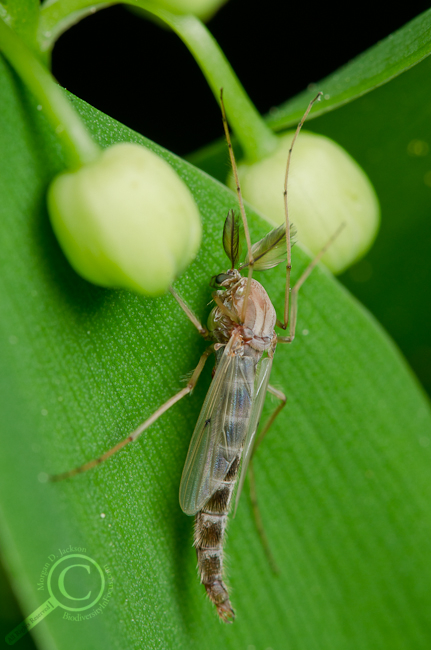
Ryan FleacrestA simple association for this Tuesday’s tune, and a reminder that flies are pretty ubiquitous, and can be found all around you! Take for example, this midge (Chironomidae: Chironominae) resting on a leaf at the Royal Botanical Gardens in Hamilton, Ontario:

Midge on leaf with flowers Chironomidae Chironominae


I visited the gardens with other things in mind, but seeing this large midge just hanging out, I couldn’t resist a shot or two!


Short and sweet this week, but stay tuned later this week as I hope to get back to a more frequent blogging schedule!


This song is available on iTunes – All Around Me – Flyleaf

P.S. – Midges are a pain to identify, especially from photos! If anyone has tips on their identification or a further guess on what genus this might be, I’d love to hear about it!

Aug 092011
 

Ryan FleacrestSomething a little different for this weeks Tuesday Tunes, as we trace a simple yet successful phrase through the annals of music history and touch on some of the entomological connections associated with it!

Our phrase of the week is “A Taste of Honey”, and it’s pretty obvious why it’s being featured as a Tuesday Tune. If we dig a little deeper however (and go on a tangent or two), we’ll uncover some rather interesting ties between some big names and entomology! Lets start at the beginning shall we?

A Taste of Honey was written by Bobby Scott & Ric Marlow in 1960 for the Broadway adaptation of a British play of the same name. This original version went on to win a Grammy for Best Instrumental Theme at the 1963 Grammy Awards. The instrumental version was soon covered by a band already featured on Tuesday Tunes, Herb Alpert & the Tijuana Brass, who made the song a commercial hit on their album Whipped Cream & Other Delights in 1965, and the song was subsequently awarded 3 more Grammy Awards (Record of the Year, Best Instrumental Arrangement, and Best Instrumental Performance).

There was another big name who was taking the 1966 Grammy Awards by storm – Barbra Streisand, who’s debut album My Name is Barbra (which won the Grammy for Best Vocal Performance, Female that year) featured a vocal rendition of a familiar song…

Strangely enough, Barbra Streisand wasn’t even nominated for Best New Artist that year, with the Grammy going to Tom Jones, who would cover A Taste of Honey the very next year. Time for Tangent #1 – Barbra Streisand would release an album titled ButterFly in 1974, with the cover art featuring a fly on a stick of butter. I must say I like this kind of ButterFly more than the traditional Lepidoptera…


Before we leave the red carpet, there’s one more link between the Grammy Awards and A Taste of Honey. This time the award goes to the band A Taste of Honey, who won the award for Best New Artist in 1978, largely on the success of their smash disco hit Boogie Oogie Oogie. It seems that the members of the band were such fans of Herb Alpert’s rendition of A Taste of Honey that they adopted it as their band name!

There’s one more big name who enjoyed A Taste of Honey in a big way; The Beatles! The Fab 4 included a version on their debut album Please Please Me in 1963, an album which shot to number 1 on the UK charts and which would ultimately pave the way for Beatlemania and the British Invasion.

Tangent #2 – the entomological Beatles is pretty obvious, but did you know that the origin of the band name is also entomological? The Beatles chose their name as a tribute to Buddy Holly and his band The Crickets for their influence over their music. This of course leads us to Tangent #3 (wait, can you have a tangent off of a tangent? Hmmm, geometry never was my strong suit) – Buddy Holly (along with J.P. “The Big Bopper” Richardson and Ritchie Valens) was tragically killed in a plane crash on The Day The Music Died, which just so happened to be 25 years to the day before a familiar entomologist was born – me!

To wrap things up, Tangent #4 (geometry be damned) is going to take us back to our original theme of A Taste of Honey. Also paying tribute to Buddy Holly, fellow British Invaders and recent Rock and Roll Hall of Fame inductees, The Hollies covered our song of the week in 1966 on their US album Beat Group! (which also featured Fifi the Flea on the B-side).

So there you go, a full round trip through musical history on the back of a simple phrase! I hope you’ve enjoyed this little web of insect-associated music, and remember to come back next week to find an all new song!

These songs are available on iTunes:

A Taste of Honey – Whipped Cream & Other Delights
A Taste of Honey – The Barbra Streisand Album
Boogie Oogie Oogie (Re-Recorded / Remastered) – 100 Hits – ’60s & ’70s (Re-Recorded / Remastered Versions)
A Taste of Honey – Please Please Me
American Pie – American Pie – Single
A Taste of Honey – The Clarke, Hicks & Nash Years – The Complete Hollies April 1963 – October 1968 (Remastered)