Good news! Field Guide to the Jewel Beetles of Northeastern North America is finally shipping! If you pre-ordered a copy of the book and you live in Canada, you should be receiving the book any day now (if you haven’t already). If you don’t live in Canada, don’t worry, we haven’t forgotten about you. To make sure that all Canadian orders are filled (including those in forestry research departments and industry), international shipments are being held back a couple of weeks, but should begin shipping by early June.
On Mother’s Day, many men pick up flowers or make breakfast in bed for their partners to show their appreciation for everything moms do. If you’re a taxonomist, you can go a step further and give the eternal gift of patronymy (or perhaps matronymy?) by naming a new species after the mother of your offspring!
In a recent Zootaxa paper, that’s exactly what Heron Huerta did, naming a new species of Mexican Scatopsidae Colobostema marielae, and earning extra brownie points in the etymology:
This new species is named after my wife, Mariela Trujillo De la Cruz, for her unconditional support, love and enthusiasm for my projects.
- Huerta, 2013
Scatopsidae are commonly referred to as minute black scavenger flies (or even less romantically, dung midges), and with larval habitats ranging from the decaying to the defecated, having something like this named for you may seem less like an honour and more like a thinly veiled insult. But when you consider your fly is 1 of only ~250 species known, that your fly’s relatives are found literally around the world and have been helping keep us out of the rot since the time of T. rex, and that, while not as flashy or well known as other organisms, someone has devoted their life to learning all there is to know about your fly and has decided that you are so important you should be forever immortalized as the namesake for this unique being, well, that’s a pretty powerful gift.
Happy Mother’s Day.

A Colobostema species from Alabama. Colobostema mariela apparently looks much like this, but with a uniquely constricted tergite 7 (you’ll just have to take Heron’s word on this one). Photo by Robert Lord Zimlich, used under CC BY-ND-NC 1.0 licence.
——–
Nominate this species for New Species of the Year!
HUERTA H. (2013). New species of the genus Colobostema Enderlein (Diptera: Scatopsidae) from Mexico, Zootaxa, 3619 (2) DOI: 10.11646/zootaxa.3619.2.6
The east coast is about to get a little more crowded, and whole lot louder, as Brood II of the 17-year cicada (which is actually a synchronized cohort of three different species: Magicicada septendecim, Magicicada cassini, & Magicicada septendecula) prepares to make its first appearance since 1996.
Conceived, laid and hatched while the Macarena was sweeping the globe, Brood II has since been biding it’s time underground in nymphal form, feeding off sap stolen from the roots of trees and counting down the years until it was time to make their grand appearance. But how DO they count down the years? 17 years is an incredibly long time, especially when you live more than a foot underground, insulated from traditional stimuli like photoperiod and temperature.
Richard Karban, who wrote that he’s dreamed of tricking periodical cicadas into emerging early for most of his adult life, had an idea, and designed an elegant experiment to see if he could confuse his cicadas by accelerating the life cycle of the trees they were dependent on.
Rather than making a poor graduate student sit and wait 17 years for a cicada to emerge, Karban dug up and transplanted 15-year old Brood V nymphs from Pennsylvania onto potted peach trees in his University of California, Davis lab, a difficult procedure that involves potatoes and a cross-country road trip with some unusual company, and which had failed the 3 previous times it was attempted. This time however, Karban successfully managed to transplant 13 nymphs, with 11 surviving on his accelerated-cycle trees which underwent 2 flowering cycles per year (bud-> leaf-> flower-> leaf drop-> dormancy-> bud-> leaf-> flower-> fruit-> leaf drop), and 2 surviving on his control trees which only underwent a single cycle per year (bud-> leaf-> flower-> fruit-> leaf drop-> dormancy).
Back in the wilds of Pennsylvania and on the control trees, Brood V adults were expected to emerge in the spring of 1999, which is exactly what they did. However, the ones who were feeding on the accelerated-cycle trees got the party started a full year early, with 8 of the 11 individuals emerging right when Karban hypothesized they would: spring 1998!
Karban realized his dream, having successfully fooled a few periodical cicadas into emerging early, and in the process showed that cicadas are able to count the seasonal cycles (or phenology) of their host trees to keep track of time rather than relying on other direct stimuli. The exact mechanism by which cicadas keep track of how many cycles have passed is still not well understood, although it’s probably safe to assume that the cyclic availability of tree sap & nutrients influences the development of the nymphs in some way. The fact that there are still such large pieces of the phenomenon still waiting to be understood is just as exciting as the prospect of millions of brightly coloured bugs emerging en masse to serenade you this summer.
So, if you happen to find yourself on the East Coast in the coming weeks, stop and take the opportunity to listen to a symphony 17 years in the making. And if you notice a subtle-but-catchy Latin beat to the buzz of periodical cicadas, just be glad it’ll only last a couple of weeks; those poor cicadas have been humming the Macarena to themselves for the past 17 years!

Photograph by C. Simon. doi:10.1371/journal.pone.0000892.g003. Creative Commons Attribution 2.5 License.
————-
Karban R., Black C.A. & Weinbaum S.A. (2000). How 17-year cicadas keep track of time, Ecology Letters, 3 (4) 253-256. DOI: 10.1046/j.1461-0248.2000.00164.x
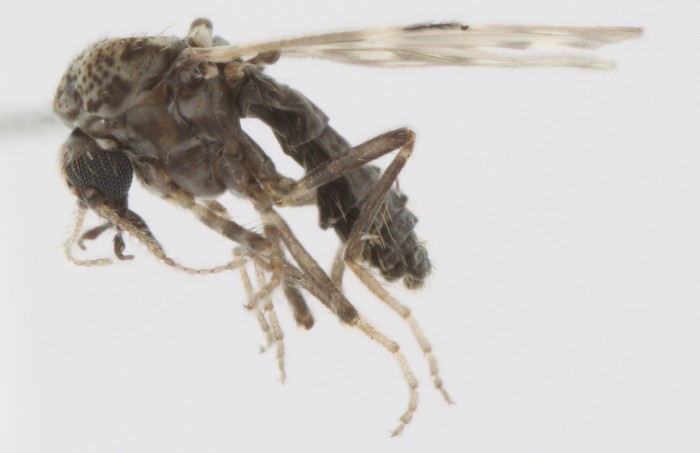
Stop me if you’ve heard this one, but what do you call a wingless fly? Apterous of course!
Proving once and for all that taxonomists do indeed have a sense of humour, meet Platypalpus apterus De Freitas & Ale-Rocha.
Winglessness has independently evolved more than a hundred times across the order Diptera, but as this dance fly (Hybotidae) illustrates, the results are anything but pedestrian. Like its fully-winged relatives, Platypalpus apterus is an active hunter, only in this case scouring beneath the bark of Polylepis trees for earthbound arthropods unable to escape its piercing beak.
Considering Platypalpus apterus‘ inability to fly, it’s poetic that it was collected high above the clouds in the Andean paramo of Ecuador, in an area that is as beautiful as it is barren. In fact, aptery is incredibly common at high altitudes, with many different fly families exhibiting high levels of wingless diversity on mountainous islands set amongst the sky. There are several theories on why it may be advantageous for flies to forego their wings, including as a defense against strong winds capable of carrying individuals away and colder, cloudier conditions at altitude impacting the flies’ ability to warm up their flight muscles.
——————-
Nominate this species for New Species of the Year!
De Freitas-Silva R.A.P. & Ale-Rocha R. (2013). A new apterous species of Platypalpus Macquart (Diptera: Hybotidae, Tachydromiinae) from Ecuador, Zootaxa, 3636 (4) 590-596. DOI: http://dx.doi.org/10.11646%2Fzootaxa.3636.4.6
Bring up flies in casual conversation and undoubtedly you’ll receive a look of disgust from your company, often followed shortly thereafter by the words “hate”, “disgusting” or “gross”. Thanks to the culturally unsavoury and occasionally deadly deeds of but a few, flies the world over are generally regarded as creatures to crush, worth more dead than alive.
Considering the media’s tendency to only get excited over new species that are fuzzy, feathered or fossilized, you could be forgiven for not realizing that more than a thousand new species of fly are described every year by taxonomists from around the world. Even other taxonomists rarely acknowledge how cool and extraordinary flies are, as they’re the only major insect order not to be selected as one of the Top 10 New Species of the Year by Arizona State University’s International Institute for Species Exploration (yet; I encourage you to nominate you’re favourite new species via the link I’ve included at the end of the post).
So welcome to what I hope will become a weekly feature, where I’ll highlight a newly described species of fly, sometimes sharing the nuances of biological nomenclature, sometimes the tireless work of taxonomists, but always the incredible diversity of Diptera. Because as Vincent Dethier concludes in his entomological exploration To Know a Fly:
To know the fly is to share a bit in the sublimity of Knowledge. That is the challenge and joy of science.
Dear io9,
I appreciate all the work you do to bring science news to a large and enthusiastic audience, and I’m a frequent reader myself, but as they say, with great power comes great responsibility. Unfortunately in a recent post one of your authors blew it in a big way.
In “Too many fly bites can lead to death by bug-spit poisoning”, Esther Inglis-Arkell repeatedly states that black flies inject their larvae into the bodies of the birds or people their feeding off of, and that humans are carriers of their young.
No. Just, no.
Black fly larvae are 100% aquatic, living in streams, rivers & flowing water all over the world. In some places — like northern Canada, so infamous for its black fly populations there have been songs sung about them — rivers and streams can be black with fly larvae attached to rocks and other material under the water (check out this post by Crystal Ernst to see just how many larvae can be found in the cold waters of the Great White North).
Yes, like most blood-feeding invertebrates, black flies employ anti-coagulant-laced saliva to keep the good times flowing, but there certainly aren’t fly babies in that spit. Some species of black fly in Africa and South America can transmit a nematode parasite through their saliva (Onchocerca volvulus, responsible for River Blindness, a non-fatal disease), and, as evidenced by the paper that inspired Inglis-Arkell’s post, too much fly saliva can be a bad thing, but to fear-monger that there could be fly larvae swimming in your blood isn’t cool.
Now, I recognize that Inglis-Arkell acknowledged her mistake in response to a commentor who also pointed out the error, but that acknowledgement is buried in the comments, and, unless a reader goes looking for it, will likely remain unread. Why not correct the post (preferably in a way that doesn’t hide a mistake was made) or at least add a footnote that clearly states the author’s mistake? That’s the great thing about web publishing: you can immediately clear up mistakes when they’re uncovered instead of waiting days to print a retraction or correction like in the olden days (i.e. less than 10 years ago). Your web stats show that more than 36,000 people have read articles by Ms. Inglis-Arkell today alone, meaning there are a huge number of people potentially leaving your site with a horribly inaccurate impression of black fly biology.
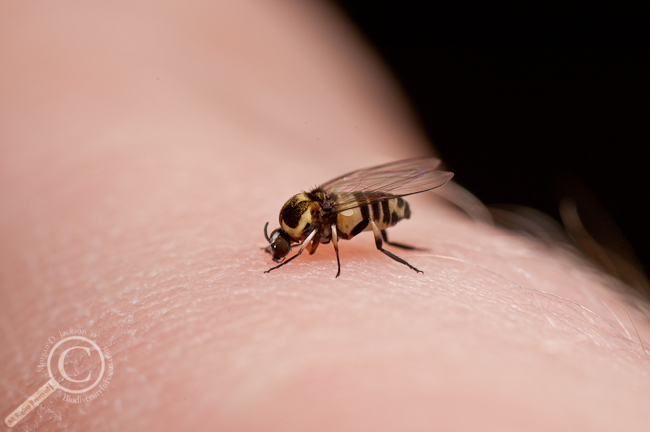
And that’s the real shame, because despite their bad reputation, black flies are fascinating creatures and are actually kind of cute, especially when they’re biting someone else.
UPDATE 2013-03-10 20:30: That was fast! Less than 15 minutes after I tweeted a link to this post, io9 responded saying they were correcting their original article, and included links to those who pointed out the problem! Well done io9, well done!
Insects make great teaching tools for a wide variety of lessons in evolution & biology, but their small size can limit what you can do if you don’t have a microscope set up. Lately I’ve been playing around with a 2 megapixel USB Microscope from EmCal Scientific Inc that I picked up at the 2011 Entomological Society of America meeting in Reno, Nevada. This little device cost ~$100, and provides magnification up to 200x life size! (Note: there are similar products available around the web for cheaper, but I can’t say how well they may or may not work.)
I’ve used it in a few lectures & labs to show specimens, structures and techniques, but honestly haven’t had much success, largely because the stand it came with is pretty well useless. Hand holding it isn’t an option either, as even the slightest movement at such high magnifications turns your demonstration into a bad example of the Harlem Shake.
Despite the problems I ran in to, I really wanted to use the camera in a couple of outreach events I’ll be participating in later this month, but I couldn’t afford to invest much in a solution. So, this afternoon I went to my local big box home improvement store and wandered around until I managed to design and piece together what I think will solve a lot of the issues I was having. Here’s a breakdown of what I used and how I put it all together for less than $30. Continue reading »
When I woke up Wednesday morning, I never could have guessed that I’d stumble across the most bizarre and terrifying fly-related idea I’d ever heard later that day. But then again, the internet is a weird and wacky place, so perhaps I should have known better.
While innocently looking for scanning electron micrographs of bot fly larvae (Diptera: Oestridae), I chanced upon Insecti-cure, a website promoting, among other things, a “treatment” for fat removal involving intentional bot fly infestations. Really.
Bot fly larvae are THE safest way for fat to be removed.
the maggots are planted next to the stomach, and will eat around the organs, the treatment, is of course painless, after you have had your injection of morphine and you will only be there for 8hrs, you will be subject to 300 larvae which have antiseptic saliva, to literaly eat the fat away, before this operation you wil need to contact us 3 weeks before in order for us to get our orders ready and don’t worry after the morphine you wont be able to remember anything, even if you are squeemish!
I’m currently sitting in a nearly deserted terminal at Toronto’s Pearson International Airport waiting to make the first leg of my trip to the ScienceOnline conference in Raleigh, North Carolina. To say I’m excited would be an understatement (I’ve been up since 2:15 this morning and am banking on some serious adrenaline today…), as I’ve been looking forward to getting a chance to attend this conference since I first heard of it 2 years ago.
Why am I so excited? ScienceOnline has become the place for people who are passionate about science communication to get together, geek out, and come up with all kinds of new projects to help share exciting science with the world. As far as I can tell, it’s like if the Manhattan Project collided with Woodstock, but without the risk of total annihilation or psychotropic acid (I hope). I followed along remotely last year, and got really excited about all the cool stuff being discussed, so when registration opened this fall, I knew I had to try and make it (and luckily for me I managed to register in the first lottery window)!
While I’m excited, I’m also incredibly nervous. A lot of the people who will be attending the meeting are people who I look up to in the community, and to get the chance to hang out and talk to them about science is going to be amazing. To me, being a part of this conference will be like taking batting practice with Mickey Mantle, or jamming with The Beatles. Yet, while I tend to be on the quiet/shy side of the spectrum in real-world interactions, I already feel like I’m meeting old friends, in part because I’ve interacted with many of them via social media, but largely because the organizers and participants strive so hard to make it a welcoming environment where everyone is on equal footing, with no special distinctions separating science communicating giants from n00bs like me.
That doesn’t mean I won’t turn into a total fanboy when I meet people for the first time (David Quammen! Ed Yong! Bora!! SO MANY OTHERS!) or even people who I’ve met before (they’re all freaking awesome), but I’m going to do my best to “Keep Calm and Carry On”. So for anyone attending ScienceOnline this week, I apologize in advance for the starry-eyed gazes and toe shuffling when we first meet, but I’ll channel that excitement into discussing all things science as quickly as possible!
Anyways, my plane is about to start boarding, but I’ll be trying to post highlights and various observations/epiphanies here throughout the week, as well as on Twitter and Instagram (morgandjackson). I’ll also be taping a special episode of Breaking Bio so that I can share the experience with everyone. And if you’re intrigued by the whole thing, follow along and participate from home with #Scio13 on Twitter!
Tonight on CBC (8pm local time across Canada) The Nature of Things with David Suzuki is showing ZAPPED: The Buzz About Mosquitoes, a documentary all about mosquitoes in Canada, the rising potential for mosquito-vectored disease thanks to climate change, and the ways in which Canadian scientists are working hard to stay ahead of them.
Featuring great macrovideography (which you can learn more about with the behind the scences feature on the ZAPPED website), ZAPPED has great potential to spread information and awareness about mosquitoes in Canada.
I’ll be live-tweeting the program tonight @ 8pm EST using the hashtag #CBCZapped, and I hope that if you live in Canada you’ll join me in learning more about the flies people love to hate!