My apologies for delaying this final post. Better late than never I suppose!
 

The final 2 days of ESA 2011 were a flurry of activity, with dozens of interesting talks, multiple social events, and plenty more to keep me completely tied up both days.

I started Tuesday off learning about the massive Beetle Tree of Life (similar in nature to the Fly Tree of Life I talked about last spring) presented by Ainsley Seago (@americanbeetles). Unlike the fly tree, this presentation was about the morphological work undertaken, and featured one of the largest phylogenies I’ve ever seen. Ainsley did a great job of showing a tree that was about 5 times too large for the screen by having it scroll, which really showed off the immense number of taxa the team included. The paper can be found here, although it isn’t open access. Ainsley was handing out PDFs after her talk, so perhaps if you ask really nice she’ll help you out and email you a PDF.

From there I went and sat in on the Web-Based Digital Insect Identification: Our Progress, Challenges, and Opportunities symposium, and got a preview of a lot of cool insect identification aids being prepared. From the utility of AntWeb and the construction of a matrix key to the invasive ants of North America to the development of wood-boring beetle identification tools full of gorgeous images, this symposium had a lot of interesting content. It wasn’t all about new tools however, with Clifford Keil making an impassioned plea for greater web publishing of Neotropical identification tools, and relating some of the problems he has identifying the insects of Ecuador. There are a lot of factors working against the inventorying of insects in Latin American countries like Ecuador, from habitat destruction to limited access to the resources and publications needed, but perhaps the most damaging is the paranoia and protectionism of “biological assets” by government bureaucracies. Cliff told tales of valuable specimens he was shipping to collaborators in Europe being destroyed by Ecuadorian border agents, even with the correct paperwork filled out. As an entomologist who studies insect diversity specifically in these biodiverse regions, I am all too aware of the headache-inducing paperwork associated with collecting and export permits, and to hear that even researchers “on the inside” are hitting major roadblocks is troubling.

This symposium had one major dark spot however; a close-minded, elitist presentation by a “traditional” taxonomist on the future of digital insect identification tools. While I’ll leave the presenter unnamed, I will say his presentation left me quite upset. I should have known it was coming when he started his talk by saying he wasn’t aware of some of the good work that’s been done (red flag #1) and then had someone else advancing his PowerPoint presentation because he apparently didn’t know how (red flag #2), but going in I was expecting an excitement about the potential for reaching new audiences, sharing new tools and identification aids, and inspiring new ideas. I couldn’t have been more wrong. For the next 20 minutes he lectured on how digital insect identification won’t help in the near future, and probably won’t work in the long term, going so far as to state that taxonomy and the creation of digital identification aids shouldn’t be undertaken by anyone other than professional taxonomists with decades of experience, because anyone else will just mess it up! I’m not sure when he managed to get any work done while he was building his ivory tower, but from his lofty vantage point all projects relating to taxonomy were best left to him and his equally aged colleagues (and I suppose he was born with the gift of perfect taxonomy and didn’t start out at the bottom). Can we all just agree that this is a messed up, bullshit stance to be clinging to in this day and age? While developing identification aids takes time, it’s not that hard, and no person should EVER be told they can’t do so! “Experts” shouldn’t be discouraging interested individuals, but rather partnering with them to transfer their acquired knowledge! Why on earth this man was invited to speak in this symposium is beyond me, but I assume the organizers weren’t expecting the antiquated tirade he unleashed!

After calming down, I explored the regular member poster session and vendors, grabbed some lunch, and then headed into an afternoon of entomologists utilizing social media, starting with Holly Menninger (@DrHolly) discussing her non-standard career path. It was a nice eye-opener that there are other ways to make a living working with insects in academia, and as expected, she did a great job sharing her experiences! You can also catch a brief interview with Holly on the ESA YouTube channel.

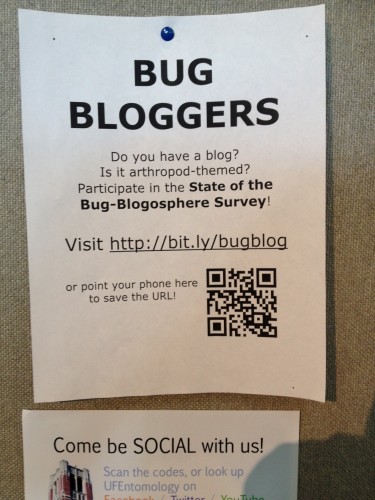
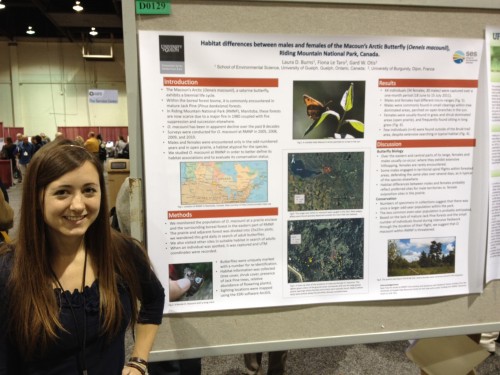
The rest of my day was spent in the Interaction and Education in a Brave New World of Social Media and Online Resources symposium. To be perfectly honest, I was pretty disappointed with the majority of presentations here, in large part because the projects weren’t really social. Sure they were online or on cell phones, but they didn’t really inspire discussion with their users, and were largely digital data collection projects. There were some providing resources, such as the Bugwood.org database of images, video and teaching tools, but even then there is no real network for corresponding with users. There were a few exceptions which I greatly enjoyed, such as Blake Bextine explaining how he engages his students through Facebook discussions as an extension of the classroom. While many people may see Facebook as a potential disaster where students and professors/researchers shouldn’t mix, I think that with some intelligent guidelines and privacy settings, there is no reason why it can’t be used professionally, and Bextine’s use of private, administrated groups seems like a good idea to me. The symposium was finalized by a great talk from the often-imitated-but-never-duplicated, blue-haired-blog-queen Bug Girl, who did a great job raising the profile of insect blogging! You should go watch her presentation right now, and also be sure to check out her interview by Guelph grad student Laura Burns for more reasons to blog!

Tuesday is generally the pub/social gathering night at ESA, and this year I tried to make appearances at 3 different events (“appearances”, ha! Like I’m some sort of celebrity). I say tried, as I missed out on the Dipterists Pub while hanging out with the Citizen Scientist group and a bunch of very friendly Lepidopterists & parasitic Hymenopterists at a house party on the western outskirts of Reno (a story that I won’t go into, but suffice to say I had my share of awkward I-don’t-know-anybody small talk). After getting back to the hotel, I met up with a small group of bug bloggers/bug blog readers and enjoyed a beer or two while talking about a wide range of entomological and social issues (also, Bug Girl is just as funny in real life as she is online). It was a great finish to a very full day!

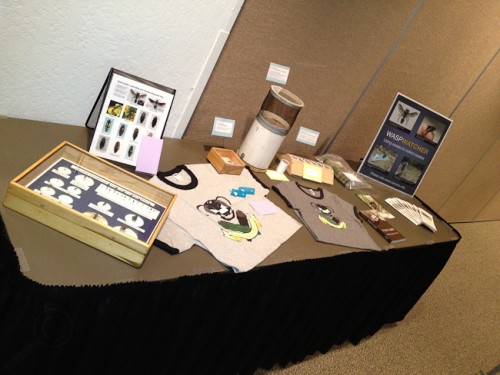
Wednesday was the final day of the conference, and I unfortunately missed most of the morning sessions while checking out of the hotel and picking up a rental car in preparation for a quick post-conference road trip (more on that to come). Wednesday afternoon was spent in the Biosurveillance symposium, where a group of extremely passionate entomologists discussed their successes and challenges with using Cerceris fumipennis (a wasp in the family Crabronidae) to scout for Emerald Ash Borer (Agrilus planipennis). This is a project that got it’s start here in the University of Guelph Insect Collection and which has been adopted and expanded by a great group of people throughout the eastern US in a relatively short period of time. Talks ranged from the development of mobile wasp colonies to selectively search areas to the study of Cerceris biology/chemistry/behaviour and even to the citizen scientist initiative being implented. I suggest you visit Cerceris.info for much more information on the project, and to learn how you can volunteer to become a Wasp Watcher! My final talk of the conference was right near the end of the symposium, and everyone seemed quite excited about the field guide to jewel beetles we’re developing.

With that, ESA 2011 came to a close for another year. While I always enjoy entomological conferences, this one will certainly stand out as one my favourites, featuring a great diversity of high-quality talks, dozens of new friends and contacts, and more than enough information and inspiration to keep me going through the long, Canadian winter! I’d like to thank everyone who followed along here and on Twitter, and especially the symposia organizers who invited me to speak in their programs. I had a great time, and I can hardly wait for ESA 2012 in Knoxville, TN! Hope to see you there!

Share

Today was a bit of an oddity for a large meeting; the morning was chalk full of talks and poster presentations, but absolutely no scientific content all afternoon, but rather full of societal business meetings. This means I ran around like mad all morning and then sat on my hands all afternoon, so it’ll be a bit of a light review today.

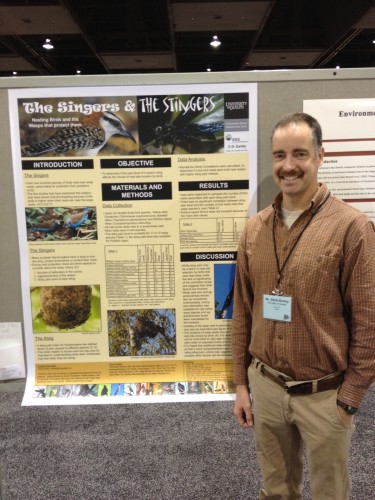
As I mentioned, all of the student talks were this morning in order for the President’s Prizes to be awarded this evening. I ended up sitting in on 9 or 10 talks as well as exploring the poster session, so I was able to get a pretty good feel for the level of proficiency displayed, and was it ever high! I don’t think I went to a single talk or saw a single poster which I wasn’t inspired or awed by! Everyone seems to be doing fantastic research, whether revising Neotropical cicada taxonomy, studying the evolution of eusociality in carpenter bees, or exploring the relationships of Australian horse flies, every talk I sat in on had me entertained and curious about the hypotheses they were working on! Not only were the talks well presented, but the slides were well designed, and the research given in an understandable medium, immersing the audience in the project at hand. There was even a student describing the puparium of a North American Neriid fly (a group of flies very closely related to the Micropezidae I study)! I couldn’t have asked for a better morning of talks!

I just wanted to mention how great the new ESA Ento-2011 iPhone App is! It has allowed me to easily keep track of when and where I want to be, who’s speaking and what their talk number is, which I found to be a good way to keep track of citations on Twitter. Normally I’d need to fumble around with my big book of titles, switching pages and losing my spot while wasting valuable talk time, but the app has done an amazing job of keeping me on track and in the right room. Kudos to the ESA for developing and sharing a great tool!

Over lunch I took in the vendor displays again now that there weren’t as many people hanging around, and then looked into the ESA Career Center to see what sort of positions were available. Turns out that it’s not a good time to be looking for an entomological job or graduate position, as there were very few advertisements this year! The last time I was at ESA the binders were stuffed full of job, faculty and graduate postings, but this year there may have been 2 dozen total, with very few looking for ecologists and none interested in taxonomy. Whether this is a normal pattern and we’re in a lull, or whether this is a delayed effect of the economic downturn, I’m not sure, but it was a little disheartening. I suppose it can only get better from here, right?

After finishing up the slides for my last talk, I met with Ignasi Bartomeus (@ibartomeus), a pollination ecology post-doc at Rutgers who I’ve been corresponding with on Twitter since Sunday, to have a beer and talk insects. We had a great discussion about the value of social media for public outreach and the value of natural history collections to ecologists. It was enlightening conversation for me, and one that wouldn’t have happened had I not traveled to Reno, or hadn’t been using Twitter! Social Media for the Win again!

Finally, I met with the rest of the Cerceris fumipennis research crew for a brainstorming session on how to continue the work and discuss Wednesday’s symposium. We ended up crashing the Arkansas/Auburn/Clemson/Tennessee Alumni Reception (shh, don’t tell) and sat in the corner discussing new ideas for the next field season. If you want to see some passionate, dedicated entomologists committed to a research project they fully believe in, then you should come out Wednesday afternoon in room A12 for the Biosurveillance symposium!

Tomorrow is an extremely full day, with talks in almost every slot that I am looking forward to seeing! I’ll be taking plenty of notes, that’s for sure!

Share

Normally when I go to these large, multi-room conferences I stand at the back of the room so I can sneak out between talks to see plenty of different presentations, usually at the other end of the building. Today was a little different however, as I sat in one seat for the entire morning, and then did the exact same thing for the entire afternoon! And they weren’t even Diptera symposia!

This morning was the Citizen Science symposium, and featured talks by a number of different programs that are reaching out to the public to help with data collection. Projects ranged in scope from an amateur Orthopterist studying katydid biology and taxonomy in her free time, to multi-site sampling projects trying to understand the complicated interactions of caterpillar/plant/parasite communities in North America, Costa Rica and Ecuador! The number of people willing to help out with these projects, including travel to exotic locations, all on their own dime is pretty amazing. Lee Dyer of the University of Nevada, Reno even told stories of participants who became so entranced by the research they helped with, they went back to school and ended up earning advanced degrees in entomology! Also, one of them got the caterpillar she was tasked with studying permanently tattooed on her return home! That’s dedication! Overall it was a really great group of talks, and there was quite a bit of interest in my talk about how the Canadian Journal of Arthropod Identification can contribute to their projects (my talk went pretty well I think, only one major coughing fit on my behalf from this stupid cold I keep dragging around). Here are the different projects, with links when available:

EarthWatch Caterpillar/Parasitoid Life History and Tritrophic foodweb

Monarch Larva Monitoring Project

Lost Ladybug Project

BeeSpotter

BugGuide.net

John C. Carlson – Passive surveillance in medical entomology using BugGuide

Mark Fox, Tulane University – Using internet images to track a new species of Caloptilia (Lepidoptera: Gracillaridae) specializing on Chinese tallow


After a quick lunch with the Citizen Science crew, I headed back to the conference centre and took in the Myths, Misconceptions and Mental Modifications symposium. Designed to help dispel some of the myths surrounding insects by encouraging greater public outreach, this symposium was full of entertaining speakers who taught me all sorts of new things to put to use here on the blog! Marianne Shockley Robinette (@DrBugAppetit on Twitter) started it off with a great talk highlighting some common insect myths people should be forgetting, and included a whole range of cool insects in pop culture. Next, Martha Lutz held a really interesting little seminar complete with handouts and group discussion on how to help change people’s preconceptions about insects, using a technique she called the “criticism sandwich” – tell the person something good about what they think, correct the part they were incorrect about, and then finish with more encouragement for something they were right about. She also suggested using metaphors for explaining complex insect biology, like the effect temperature has on insect growth and development, by comparing to humans. For the temperature example, she would explain that if humans reacted to temperature like insects, you could heat up a 2 year old to get through those terrible twos more quickly, cool them down when they reach the fun stage where they listen to you and are interested in what you do so it lasts longer, then throw that temperature way up when they hit their teens and think they know more than their parents to get them out of the house in a hurry! Pretty brilliant way to relate a complex phenomenon in terms any parent could understand!

Richard Hellmich was next and discussed how media-induced hoopla can hamper research programs, specifically with regards to genetically modified plants. It’s really unfortunate that a few uninformed media instigators can have such a detrimental effect on public perception, but that is the reality we live in and something that all entomologists should be on the lookout for, no matter what their research may be on! My talk on using social media to perform and promote entomology research seemed to go over well, and I was pleasantly surprised to see a large number of people in the audience already using social media!

The final 3 speakers provided some really fantastic information on dealing with the media, and how to be an effective outreach researcher. Michael Raupp, who’s appeared countless times on national TV and radio segments, shared a bunch of tips on dealing with the media, and how to get your message across in an entertaining fashion. He was followed by Holly Menninger (@DrHolly on Twitter) who shared even more great tips on how to prepare for a media engagement and getting your message out there without getting lost in the dazzle of pseudo-celebrity! One of the more important points I took away from her talk were her 5Ps for dealing with the media: Prior Planning Prevents Poor Performance! That pretty well goes for any aspect of academia I suppose, but most of the time your poor performance because of poor planning isn’t immediately showcased to the public the moment it happens! Finally, Richard Levine got up and talked about dealing with difficult situations in the media and with the public. With his experience as media consultant for the ESA, he had plenty of examples on how to deal with rogue journalists (see Tucker “Douche Bag” Carlson hijack Anthony Cognato of the Michigan State Entomological Collection and read his response) or misinformed citizens. Overall it was a great conference, and if I hear of the talks being collated and posted anywhere, I’ll be sure to pass along that info!

This evening I took in the Opening Mixer for the free food and an uninterrupted perusal of the vendors was pretty good. Check out some of the photos below, including a rather embarrassing taxonomy fail considering where I am… Overall, it was great start to the conference, and I can’t wait to see what the rest of the week has in store for me!

Share

As they say, better late than never, but man, this one is really late. The annual general meeting of the Entomological Society of Ontario was held October 15-17 2010 and as usual, it was a great meeting!

I look forward to the ESO meeting every fall, as it gives me a chance to catch up with other grad students from around the province, learn something new, and become inspired going into the dark winter months! The diversity of entomological graduate research being done throughout Ontario never ceases to amaze me, with students presenting on topics ranging from agricultural pest control to freeze-tolerance biology, and from taxonomy to forest ecology, representing 6 Ontario universities. I’ll come back to the student talks a little later, but they were certainly one of the highlights.

Before the official start of the meeting, I attended my first board meeting for the Society as the new webmaster. This was quite the experience, and provided my first look into the inner workings of how things get done in academia. Plenty of lively debate and many great ideas for the future of the society made the 5 hour meeting a breeze!

Following the board meeting was the obligatory ESO Mixer, a chance for students and researchers to meet, greet, and enjoy a beverage or two before the meeting gets underway!

Entomology graduate students at the ESO mixer 2010Entomologists attending the ESO mixer 2010

The next morning started with the plenary session, featuring talks by Dr. Sherah VanLaerhoven of the University of Windsor and Dr. Amanda Moehring from the University of Western Ontario. Dr. VanLaerhoven is a forensic entomologist, making this the second time this year I’ve been faced with graphic imagery from depressing stories less than an hour after breakfast. Sherah related her work on the Steven Truscott case, and this being a scientific conference, held nothing back about the case, displaying actual crime scene and autopsy photos while explaining the significance of the entomological evidence gathered by the coroner. It’s hard to remain objective and detached when shown photos of an abused and murdered young girl, and I commend all those in law enforcement who deal with these sights in person; it’s certainly not a job that I could do. The mood was considerably lightened by Dr. Moehring’s talk on sex and genetics in Drosophila, and everyone was well prepared for the beginning of the student talks following her energetic presentation.

Dr. Sherah VanLaerhovenDr. Amanda Moehring

As I mentioned earlier, the student talks are the real highlight of ESO, and this year didn’t disappoint. A wide diversity of topics kept the audience mentally on edge as they heard all about the breakthroughs made by Ontario students. Although all of the talks were well presented and full of excellent research, I personally found blog-reader Miles Zhang’s talk on host shifts in gall wasps (Cynipidae) and their associated parasitoids from a native rose to a recently introduced rose to be one of the most exciting discoveries. A textbook example of the evolutionary pressures imposed by parasitism and the way hosts are constantly looking for an edge! I hope that he’ll agree to share this fantastic story here once he’s published his findings (hint, hint)! Check out the ESO Meeting program for a full list of student presentations, and the President’s Prize winners are listed on the ESO Website.

As part of the meeting package, all the food was provided, and that included the excellent banquet on Saturday night. With plenty of food, wine and fellowship, everyone appeared to be having a great time. Dr. Nusha Keyghobadi shared her research in the field of Lepidopteran landscape genetics during dessert, and after a couple of trips to the pie cart, the grad students organized an impromptu student mixer! It was a great chance to unwind after presentations and discuss some of the shared issues of grad work and life, and carried on well into the night.

Entomologists at the ESO 2010 Banquet DinnerDr. Nusha Keyghobadi

Sunday saw the final student talks, and a few regular member talks before the awarding of ESO Fellowships and the passing of the “Roach & Gavel” to the incoming president.

2010 ESO Fellows - Dr. Freeman McEwen (L) & Dr. Bernard Philogene (R)Past-President Dr. Gary Umphrey passing the Roach & Gavel to President Dr. Hannah Fraser

Overall, ESO 2010 was a great success, and more than enough to get me through until the spring and fresh insects! If you’re in the area next year, ESO 2011 will be hosted by Brock University in St. Catharines, Ontario; mark your calendar and start getting that data analyzed!

Share

Beto & Patricia - El Copal Reserve OwnersWhat started as an unproductive sugar cane and cattle farm has been transformed into a leading ecolodge and biological reserve. The El Copal Biological Reserve is the result of a decade’s hard work and determination by Beto and Patricia Chavez; owners, operators, and advocates for sustainable sources of income in rural Costa Rica.

Continue reading »

Share

I’m back from Costa Rica, and largely caught up on research, photos, and everyday life, so it’s time to post answers to all of the bug of the day quizzes and award BioPoints to those correct answers!

Fly from Costa Rica Continue reading »

Share

After last night’s escapade, I took the opportunity to sleep in, and ended up missing breakfast. I’ve had enough rice, beans and eggs to last me awhile so I wasn’t too upset. My feet were in no shape to be shoved back into rubber boots, so I took what was left of the morning off from collecting and worked inside. I wish I could have explored one last area, a meadow that was over-filled with mantisflies (Mantispidae), but I just couldn’t bring myself to do it this time. After lunch everyone prepared to leave, and before we knew it, we were pulling away from the ACG and headed back to San Jose. Our luxury bus was a nice ride, and it wasn’t long until we pulled into Puntarenas for dinner, meeting up with another group of dipterists who traveled to Monteverde while we were at ACG. Our dinner wasn’t too bad, but the stray cat wandering around the restaurant created a strange ambiance. Another hour and a half and we were back at the Adventure Inn in San Jose. A quick repacking of gear for our flight home, and it was time for bed one last time in Costa Rica.

Our travel day started bright and early at 5:30 in order to grab our complementary breakfast before heading off to the airport. We were pleasantly surprised to find no lines throughout the airport, and we breezed through exit taxes, check-in, and security without any significant waiting. A quick stop in the airport gift shop, and soon we were ready to board our flight back to Dallas. For whatever reason our flight was chosen for a secondary security check, including bag searches for everyone and pat downs for an unlucky few. An uneventful flight gave me the chance to start and finish a new book (Generation A by Douglas Coupland, watch for a review in the near future) and before I knew it we were descending into Dallas. Due to some complications with our export permits, Gil (who is traveling on a student visa to start with) was tasked with carrying all of our specimens into the country, and since our final flight destination was Detroit, we were all a little unsure how customs and agriculture would react to our insects. Our fretting was compounded slightly by a short lay-over (<2hr) and the long line out of the baggage area had us all slightly concerned. Luckily none of us ran into any prolonged issues, including Gil, and everyone made it to the gate in time for our next flight (which was ultimately delayed 30 minutes anyways). Dinner was a Big Mac that tasted like filet mignon (a guilty pleasure of mine after every trip to the tropics) and our flight into Detroit was fast and comfortable. A late night drive back to Guelph and after 2.5 weeks I was back home.

Although no longer than any of my previous Neotropical trips, this trip felt like I was away for months. My theory is the multiple locations we traveled to combined with a heavily intellectual load at the congress created this illusion, but the trip still stands as one of my more memorable adventures. The number of kind, generous people we met, both locals around Costa Rica and dipterists from around the globe, was fantastic and was definitely the leading factor in the success of the trip. Costa Rica lived up to all that I had heard of it, with beautiful habitats, fantastic infrastructure, and friendly smiling people. The photos and memories I brought home with me all add to the experience, and I know that this won’t be my last trip to Costa Rica!

Share

With a full day’s collecting (as unproductive as it was) already under my belt, I’m ready for some dinner, and the cook staff at ACG provides the best meal of our visit; fried fish and purple salad, plus the ubiquitous rice and beans I take out of pure hunger. I finish my dinner in a hurry, as our next adventure will be beginning shortly; a trip to the beach searching for nesting sea turtles. Although the chances are low that we’ll actually witness an arribada, the opportunity to explore another region of this conservation area was all I needed to sign up. We’ve been warned that the rainy season is not the best time of  year to even get to the beach, and it was pointed out that most surfers don’t bother trying to get there this time of year. I see this as an added bonus, the opportunity to get to an area almost devoid of human presence, a stark contrast to today’s “tourist trail”.

Continue reading »

Share

“Life’s a journey, not a destination”  Aerosmith

I awake in time for a hurried breakfast before the bus departs for Rincon de la Veija, our destination for the day. Rice, beans and scrambled eggs again, so I choose some toast and cereal and sit off on my own to gain a moment of solitude before another long day. We soon load onto the school bus that’s delivered many a generation of child and which will hopefully last one more trip with us aboard. Settling into my seat, or what’s left of it, and enjoying the scenery of jungles, pastures, and forested volcanoes rising up to the clouds, I ignore the growing discomfort settling in my back from the aged seat. It seems the seats are not the only components lacking functionality, with each rock and bump being translated directly from the road to my body with little dampening as we turn onto the winding road up the mountain. The grasses introduced from Africa for cattle pasture roll on and on along the sides of the volcanoes, with vultures, iguanas, and flycatchers each choosing a fence post to admire the morning sun from. As I readjust in my seat to find a scrap of padding for the umpteenth time, the bus pulls to a halt and the driver jumps out without a word. As I watch from my seat while he looks under the bus and then down the road with a puzzled look, I decide that perhaps today marks the end for this decrepit vehicle. Apparently the transport boss and our local coordinator feel the same way and it isn’t long before they’ve joined the driver looking back down the road with concerned faces. Information trickles in now that the battery has fallen out of the bus somewhere along the road, but not to worry because we’ll keep on driving. A few turns more and the bus decides that in fact we won’t keep driving, coming to a silent stop and then rolling back down the mountain before the driver applies the brakes. I can’t help but laugh at the situation, but also wonder what happens next. It seems we’re within a short walk to the outer edges of the conservation property and that a new bus will be brought in shortly to take us up to our true destination. In the meantime, they say, we can collect and explore the stream meandering its way down the volcano, a welcome and unexpected break from the mechanical chiropractor misaligning my back.

Broken bus Costa Rica Continue reading »

Share

I think the long days are starting to catch up with me, I couldn’t bring myself to get out of bed to go birdwatching this morning! The extra hour of sleep was well worth it though, and I enjoyed a simpler breakfast today of PB on toast and some cereal. We had the day to explore around the main ACG station, so myself, Joel G, Joel K, Andrew and Jeff journeyed to a picturesque overlook that also happens to be a nice, open hilltop. Of course it’s taped off for safety’s sake (the ladder up the side of the building seems to be falling out of the wall) but we didn’t attempt the full climb and just stuck around the base. The sun was fighting for some space today, but we had some pretty good luck when it did break through. Something that I hadn’t seen before was huge congregations of dragonflies floating up above where the flies and other insects were looking for a mate, seemingly feasting on the buffet of bugs. Easily 100 dragonflies were visible at any given time! Really the only exciting Diptera finds were some large robber flies (Asilidae), which were gladly claimed by the group of asilidologists back at camp, and a few rather large grasshoppers. Of course, by rather large I actually mean the length of my pointer finger…

Costa Rica Giant Grasshopper green brown

Click to Enlarge

It wasn’t just insects at the top of the hill though, as we saw some soaring raptors, and had a visit from a large troop of white-headed capuchin monkeys (Cebus capucinus)…

White-headed Capuchin (Cebus capucinus) Costa Rica

The rain chased us off the hill shortly after, and we had a long, rainy afternoon to pin insects and rest up. After dinner a small group of us decided to go on a “short” night walk with the hopes of finding a snake or two. We didn’t find any snakes, but we did see a possum, a few nightjars, and a spectacled owl! It was pretty fun calling in the owl and patiently scanning the trees in the dark for signs of movement. Ultimately it sat right out in the open for us and I was even able to get a few record shots of it. A pair of Pacific screech owls back at the station, and we called it a night!

MTC…

Share
© 2012 Biodiversity in Focus Blog Suffusion theme by Sayontan Sinha