Jul 232011
 

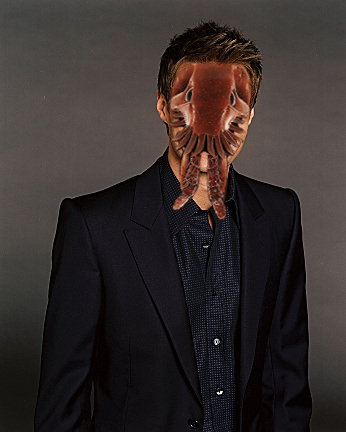
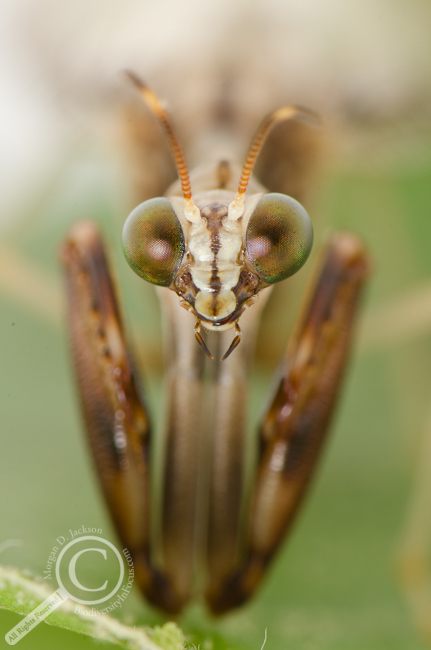
Yes, this is my best Canadian moth photo...

This week saw the publication of one of the broadest identification aids yet in the Canadian Journal of Arthropod Identification; A Matrix Key to Families, Subfamilies and Tribes of Lepidoptera of Canada by Jason Dombroskie.

Arguably the most popular insects, butterflies, skippers and large, showy moths have had many a field guide written about them, and are generally easy to identify simply by comparison to photographs. However, the large majority of Lepidoptera are small, obscure and have traditionally been difficult to identify. By using simplified characters (including morpho-metric ratios), Jason has created an open-ended, user-friendly matrix key which aims to streamline the identification of even the most minuscule moths. Each subfamily/tribe covered includes a representative photo, notes on biology and taxonomy, and citations for further information.

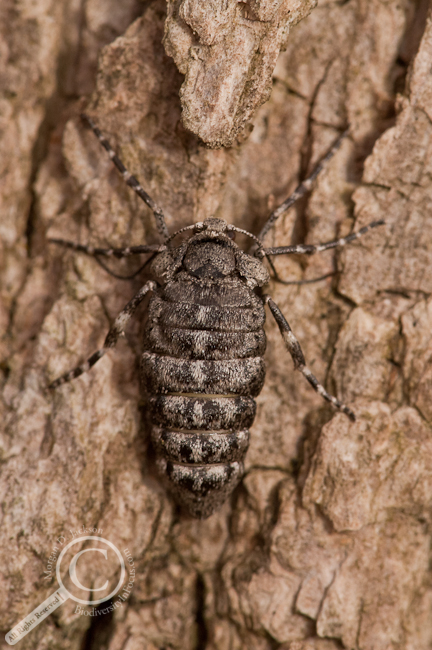
The key is designed to be used in the lab with a dissecting microscope, but I decided to see how it worked for identifying photos. Using my only 2 photos of Lepidoptera from Canada (I’m not a fan of leps, what can I say), I ran them through the key to get a feel for how the matrix worked. First up was the photo of a female Fall Cankerworm (Alsophila pometaria; Geometridae) pictured above; wingless and not very moth-looking, I thought it’d be an easy ID. I thought wrong. After going through every character included in the key which I could confidently see in my series of photos, I was left with 4 possible tribes in 3 different families (one of which was correct). Unfortunately a photo of a wingless female wasn’t the representative for the taxon page, so I was unable to confidently assign an identification via this key; a shame considering how conspicuous this large, wingless moth is! My second attempt was with a photo of a European Skipper (Thymelicus lineola; Hesperiidae), and again I was stymied by a multitude of possible end taxa. While I have no doubt that this key will be invaluable for identifying micro-moths under a microscope, I’ll be sticking to traditional field guides if I happen to photograph other lepidopteran megafauna.

It’s also important to note that the key is run in a third-party program (XID), which is currently Windows-exclusive (although I hear there is an Android app in the works…). So if you’re a Mac user, you’ll need to borrow someone’s PC to identify your moths!

Despite some compatibility issues and my ineptitude with Lepidoptera, this is another extremely valuable paper which will certainly make the identifications of those tiny Tineidae and other micro-moths a much simpler task!


ResearchBlogging.orgDombroskie, J. (2011). A Matrix Key to Families, Subfamilies and Tribes of Lepidoptera of Canada Canadian Journal of Arthropod Identification, 17 DOI: 10.3752/cjai.2011.17 OPEN ACCESS
Jul 192011
 

Ryan FleacrestThis week’s song enjoys fresh ceviche eaten by candlelight near the sea, puppies, and long walks on the beach. Please give a warm welcome to Herb Albert and the Tijuana Brass with their signature piece, Spaniiiiish Flea!

A song instantly recognizable thanks to The Dating Game (and several Simpson’s episodes), Spanish Flea is one of those songs that will be stuck in your head for the remainder of the day (you’re welcome). Try to not whistle this little diddy while you walk down the hall, work on your computer, or fall off  to sleep this evening!


Yep, we here at Biodiversity in Focus like to make sure insects and their related music are always on your mind! Speaking of on your mind, last week’s tune came with an ID challenge which still has plenty of BioPts up for grabs. Since it’s the summer and you’ve likely been playing outdoors looking for insects (you have haven’t you?), I’ll leave the insect a mystery for another week, giving you a chance to relax in the air conditioning and figure out what it may be. Until next time, I’m Ryan Fleacrest!


This song is available on iTunes – Spanish Flea – Herb Alpert & The Tijuana Brass

Jul 122011
 

Ryan FleacrestAlmost forgot about Tuesday Tunes this week! Been a busy summer so far, and this one just about slipped through the cracks. Today’s song has very little to do with insects besides the title, but the song is an old favourite of mine, so it’ll work for this last minute edition!


As consolation for being kind of lame with the song and write up, here’s some cooler “bug” eyes, and I’ll put some BioPoints up for the identification! 2 pts for order, 3 pts for family, and 5 pts each for genus & species. Remember, with 200 BioPts, I’ll send you a framed photo of your choice from my archives! Enjoy!


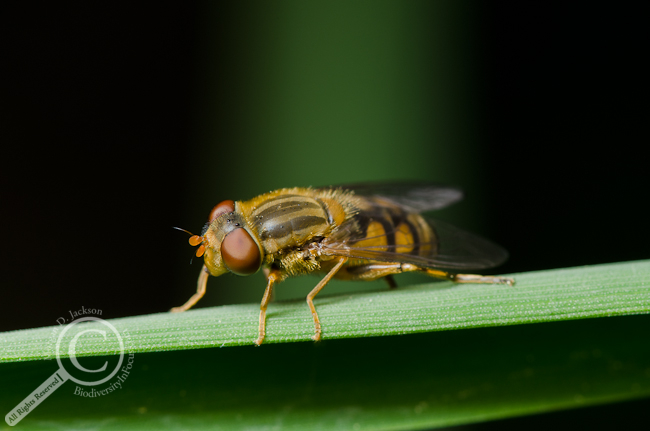
Bug-eyed Beast


This song is available on iTunes – Bug Eyes – Catch Without Arms

Jul 092011
 

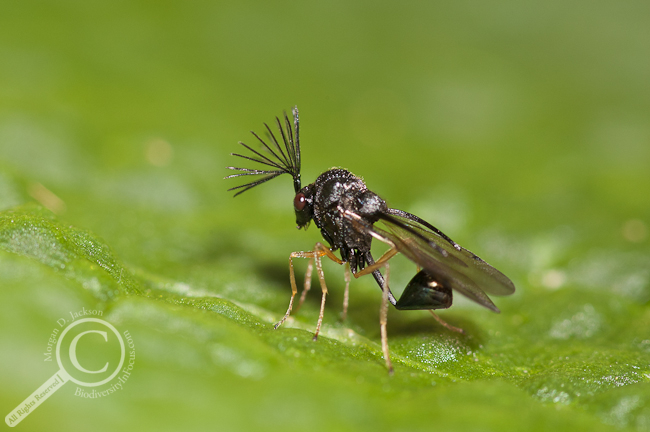
Chalcidoid wasp from Ecuador


What’s this antlered little wasp you may be asking yourself? To be honest, I have no clue! Probably something in the Chalcidoidea, but really, I have no idea.

What I do know is there’s somewhere I could go to learn all about these endearing little wasps, as well as their larger yet equally diverse parasitic brethren. That place? The HYM Course, offered by a collaboration of top hymenopterists from around the USA. This course was designed to teach you how to identify parasitic Hymenoptera, and provide information on the phylogenetic relationships between groups, as well as the behaviour, biology and host interactions which make these wasps fascinating.

The course is being held August 14-20 at the Humboldt Field Research Institute in beautiful coastal Maine, and looks to be a good time, with lessons taught in the field, in the lab, and in the classroom. The enrollment is limited to 14 people (with 5 instructors, that promises plenty of 1-on-1 interaction), and there are still several spaces available from what I’ve been told. If you’re a naturalist, insect photographer, graduate student or professional entomologist who wants or needs to learn more about parasitic Hymenoptera, then this course is a steal for gaining valuable knowledge and making important connections with some of the world’s leading taxonomists!
For more information, and to find out how you can enroll and begin exploring the Parasitica, check out the promotional PDF. Contact any of the instructors listed at the bottom of the flyer to enroll or to receive additional details!

Jul 052011
 

Ryan FleacrestToday marks the birthday of one of the most influential and important insect authors; Robert Evans Snodgrass (1875-1962). Snodgrass’ special interest was insect morphology, especially within an evolutionary context, as he sought to not only understand how insects are put together, but also how those structures contributed to the evolutionary history of species. His 1935 opus, Principles of Insect Morphology, is still relevant in many regards (my 4th year Insect Physiology professor referred to it several times throughout the semester), and can be considered one of the most important entomology texts of the 20th century.

Being a morphologist, Snodgrass would be an expert in insect dissection in order to examine the intricacies of insect muscles, nerves and exoskeletons. That being said, I’m sure his techniques were pretty refined and not quite comparable to ripping out the wings of a butterfly, but unfortunately there isn’t a song title “Careful Dissection of the Flight Apparatus of Lepidoptera”, so we’ll stick to some hard rock!

If you’re interested in learning more about PIM (instead of HIM), check out this post by Trichoptera grad student Zach Burington on his excellent blog, Trichopterology!


This song is available on iTunes – Wings of a Butterfly – Wings of a Butterfly – Single

Jul 042011
 

Science 3.0 Blog Winner IconJust a quick post to relay some exciting news. I recently entered a number of my scientific paper reviews in the Science 3.0 #Bugs Blog Contest, which ran for the month of June, and just today found out that my post discussing the Fly Tree of Life project was chosen as the winning contribution!
My effort was but a single post, and there are a bunch of great entomological entrants that you should go and check out immediately. It’s great to see so many people interested in the science of insects and relaying their excitement via blogging. Thanks to the group over at Science 3.0 for running the contest and for the first place honours, and congratulations to all the entrants for their great work!

This month’s contest is centered around Dinosaurs, so be sure to watch for some spectacular posts on giants of the past! Also, check out the advertisement, featuring art work by the talented Torontonian, Glendon Mellow!

The winning post can be found here if you’d like to give it a read – The Fly Tree of Life – Big Science, Big Results?

Jul 012011
 

T.G.I.Formicidae is a new occasional feature here on the blog, and this inaugural edition features some collusion between Alex Wild, Ted MacRae and myself. Alex normally features beetles on Fridays, and Ted and I thought it might be fun to continue the trend, with Ted blogging flies today while I cover ants to complete the triad of major insect groups! Make sure to check out their blogs to see what fantastic Friday finds they have to share!

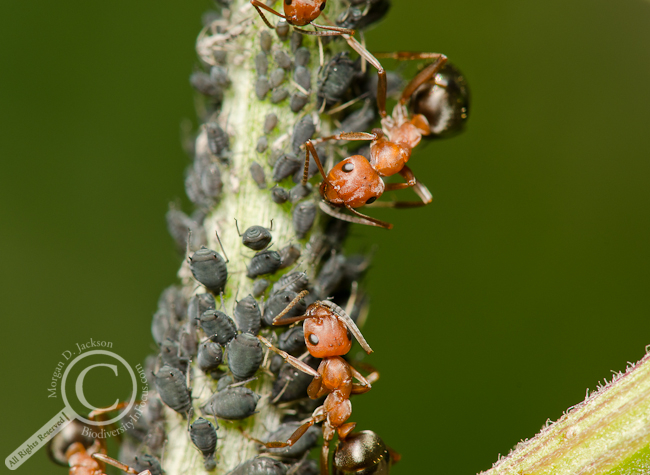
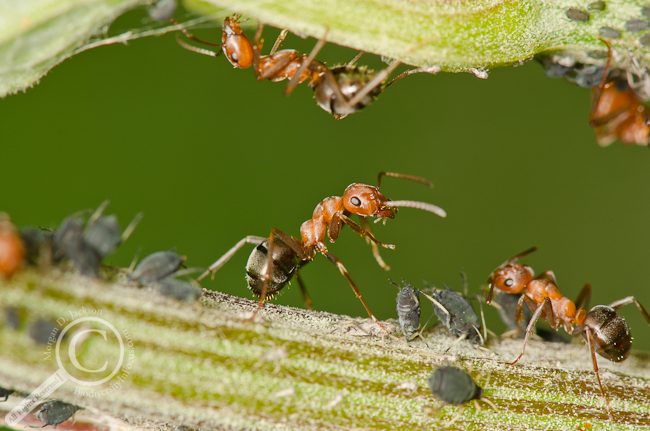
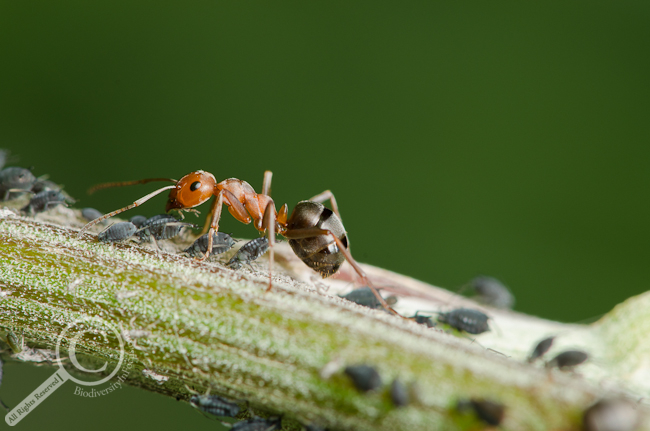
In a last minute rush to produce some ant photos to compliment the fine photographs of Ted’s and Alex’s, I ran back to the Dairy Bush on the University of Guelph campus with hopes of finding some interesting ants to shoot. Luckily for me, I happened across what I believe are Camponotus Formica ants tending to masses of aphids. Ant mutualism with aphids was one of the first insect interactions I can remember learning about in my intro entomology courses, and I can’t resist watching and photographing these tiny ranchers whenever I come across them!

Camponotus ant tending aphids on a plant


Two Camponotus ants tending an aphid herd


Camponotus ant seemingly dancing with the aphids it is tending


Jun 292011
 

About lowly human parking laws at least!

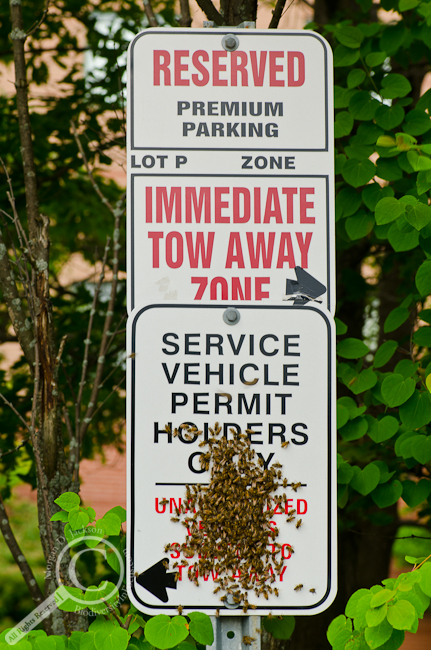
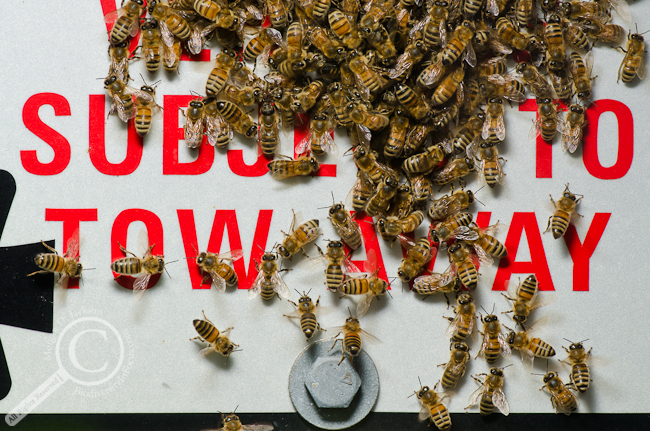
Honey Bee swarm on No Parking Sign

Honey Bee Don't Care!

Yep, a honey bee swarm decided that this parking sign in our department’s parking lot was as good a place as any to settle down for the evening. Lucky for them, the parking authority goes home at 5…

Honey bees on parking sign with text saying Subject to Tow Away

We're going to need a smaller truck!


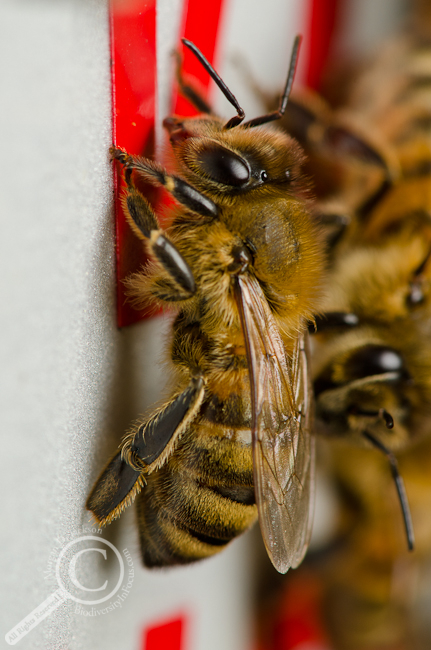
Honey bee on parking sign lateral

One of the offenders


Jun 282011
 

Ryan FleacrestThis Friday is Canada Day, and what better entomological representation of Canada than the scourge of the Great White North, the black fly! Well, I suppose grylloblattids are a better choice, but so far no one has written a song about them, so black flies will have to do! (The Grylloblattidae are a group of rare insects first discovered on a glacier in western Canada, and are the mascot of the Entomological Society of Canada)

Along with our igloos and friendship with Charlie from Thunder Bay, swarms of black flies waiting to bleed unlucky Canadians dry is one of the more common misconceptions about Canada. Luckily, most of southern Canada is relatively free of black flies, but once you get into cottage country, the woods do indeed belong to the bikojisi, as they are known to the Ojibwe. The clouds of black flies present in the back country of Northern Canada have been known to instill fear in even the most adventurous outdoorsman (or outdoorswoman), and those required to work outdoors during the spring in Boreal Canada can undoubtedly sympathize with this weeks artist, Wade Hemsworth as he sings about his experiences with black flies while working for Hydro Ontario!


Incidentally, this short film by Christopher Hinton was nominated for an Academy Award in 1992 for Best Animated Short (it lost to this entertaining cartoon unfortunately). Pretty good for an insect loathed by most Canadians eh?

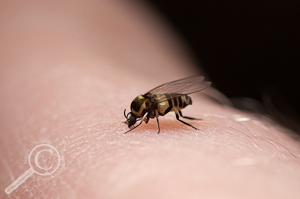
Black Fly - Simuliidae - Ecuador

This black fly may be from Ecuador, but that arm is 100% Canadian!

H/T to Bug Girl for sharing this song!

This song is available on iTunes – The Blackfly Song – Folk Songs of the Canadian North Woods

Jun 212011
 

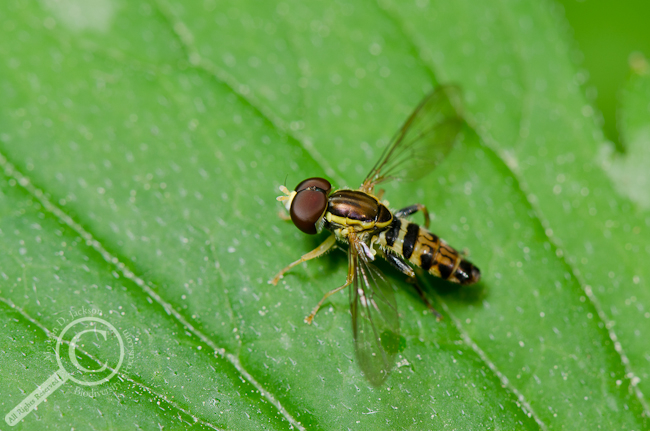
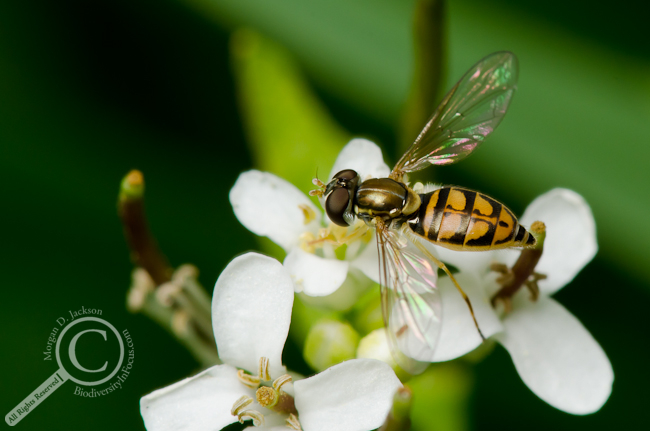
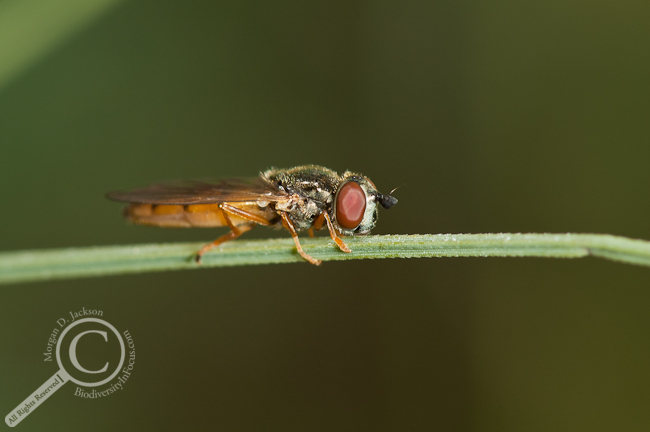
Ryan FleacrestIt’s National Pollinator Week in the US, and although Canada doesn’t have their own celebration of insect-facilitated sex, that doesn’t mean I can’t promote some sexy fly pollinators! Honey bees and their hymenopteran brethren get most of the credit for pollination, but flies are likely just as powerful pollinators, only underappreciated and understudied thus far. Some of the world’s most vital crops (i.e. chocolate) depend on flies for pollination (in this case a biting midge of the family Ceratopogonidae), while countless other plants find themselves in a veritable orgy of Diptera deliveries. Some of the more striking of these include the Syrphidae, conveniently known as flower flies for their propensity to visit flowers for pollen and nectar.

Parhelophilus laetus Syrphidae

Parhelophilus laetus

Toxomerus geminatus Syrphidae

Toxomerus geminatus


Toxomerus marginatus Syrphidae on flower

Toxomerus marginatus

While these 3 species are pollinators of compound flowers (like the ones in the last photo being visited by Toxomerus marginatus), some flower flies are specialists on plants which were typically thought to be wind pollinated, such as grasses.

Platycheirus sp. Syrphidae on grass

Platycheirus sp.


With around 900 species of Syrphidae in North America (and more than 6000 species around the world), not to mention the countless other fly families which visit flowers, there are plenty of flies available to act as plant escorts. You might say that fly pollinators do a little dance of love on behalf of the flowers. I can imagine these fast-flying flower phallus’ bumping and grinding to something a little like this…


The next time you stop to smell the flowers, don’t forget what it is you’re smelling, the sultry perfume of a flower looking for a little fly action!


This song is available on iTunes – Pollinator (Gary Beck Remix) – Global Underground – Tom Novy

If you’d like some more insect sexiness, check out Bug Girl’s excellent, innuendo filled explanation of pollination!