Morgan Jackson

Dec 022010
 

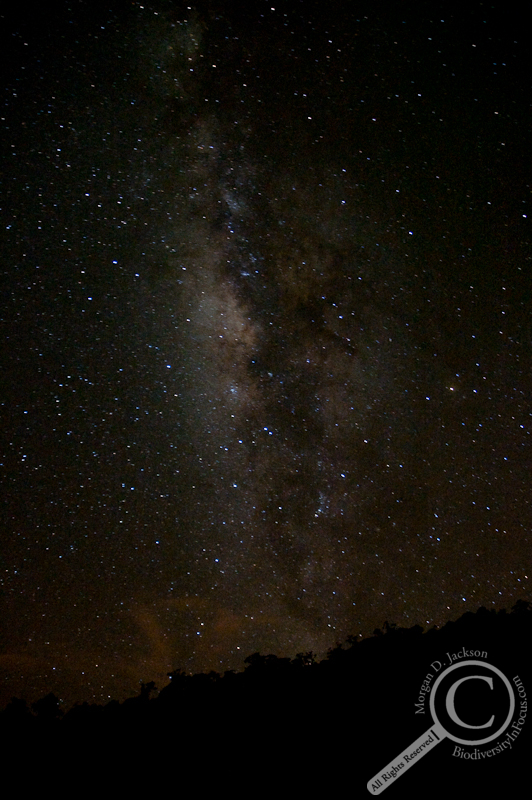
Milky Way Galaxy over the jungles of Costa RicaNASA has called a big news conference for this afternoon to discuss a new discovery in the field of Astrobiology (the science of extraterrestrial life) for this afternoon at 2pm. Leaked stories are reporting that NASA scientists have discovered a new life form in Mono Lake, California. Reportedly this life form is arsenic-based, unlike every other animal, plant, fungi and bacteria on the planet which is phosphorous-based. Tune in here to watch along.

The implications of such a find are beyond huge, if true! Does this mean life on Earth has arisen twice in 2 totally different ways (take that ecology and niche partitioning)? Is it extraterrestrial seeding (is the truth really out there)? Either way, phylogenetics and the taxonomic structure as we currently know it (Domain, Kingdom, Phylum, etc) has no room for independently derived life forms, necessitating an entirely new and parallel taxonomic lineage. Not to mention the fact that if it’s happened here there is no reason to assume that it hasn’t happened someplace else in the universe!

I’ll be live-blogging throughout the news conference and trying to provide insights into what this means for taxonomy and science in general. Stay tuned as the world learns of this new life! I encourage everyone to join the discussion below in the comments! Until then, live long and prosper and let the force be with you! (You knew the geek quotes were coming at some point didn’t you?)

Update (1:30pm, Dec 2, 2010): The cat’s out of the bag, and it’s certainly not the white tiger it was made out to be. While the early media reports I read ranged from the extremes of NASA actually finding life on other planets to the story I reported above, in actuality researchers did not discover a new arsenic-based life form, but rather forced an extremo-phile bacteria from Mono Lake to survive on arsenic rather than phosphorous. Even then there are conflicting reports on how much arsenic the bacteria are actually incorporating into their biochemistry. Needless to say I’m fairly disappointed, but I’ll leave that for a more in depth discussion later this afternoon. I’ll still be reading the paper and watching the news conference in case there is something interesting to report, but don’t expect a new taxonomic hierarchy this week!

Update (2:30pm, Dec 2, 2010): Well, that confirms it. The bacterial strain in question (GFAJ-1) was found to live in the mud of Mono Lake, where the concentration of arsenic is higher than most other aquatic habitats, and the researchers decided to see how far they can push the bacterium’s flexibility in accepting arsenic. By slowly weaning bacterium cultures from high phosphorous-content growth medium to low phosphorous-content they found the bacteria could survive and incorporate arsenic into the different cellular and molecular components necessary for life (nucleic acids, proteins, etc).

Update (2:35pm, Dec 2, 2010): I’m going to be candid here, and point out that the lead researcher, Felisa Wolfe-Simon, is coming across as really condescending. I imagine she’s trying to relate her results in a way that laypeople can easily understand (including referring to these bacteria as “bugs”… science fail) but her inflection and attitude is coming across as condescending in my mind.

Update (2:45pm, Dec 2, 2010): They’ve brought a phosphorous expert in who is going on and on about the potential for using arsenic-based life forms to solve the impending phosphorous shortages caused by the agricultural revolution. Not sure how he expects to incorporate arsenic-laden plants into our diet, seeing as it’s extremely toxic as repeatedly stated throughout the news conference. That’s also assuming that you could get non-arsenic adapted plants to accept it in the first place (remember, toxic).

Update (2:50pm, Dec 2, 2010): That was patriotic. She just made clear that all this research was done by Americans, on American soil, and using American dollars. I wonder if she’s worried about US congress criticizing her work on astrobiology like ant workers were criticized for working on ants from outside of the US of A!

Update (3:00pm, Dec 2, 2010): I believe it was USA Today that just phoned in and called out the research team of over-hyping their research and the reaction of the readers looking for proof of alternate life or aliens! I’ve got to agree with them on that (and I’ll bring that up when this circus is over). The researcher’s reply even included a plot line from Star Trek to explain how, although they didn’t find aliens, they now have more options when searching for life.

Final Update and Opinions: That brings this underwhelming scientific discovery to a close. When I first came across the story this morning, I was in awe that perhaps we’d have definitive proof of independently evolved life (whether native to Earth or elsewhere) and all of the implications I outlined originally. As more and more of the research was made available however, I couldn’t help but become frustrated and disappointed, not only with the media (which I expect to sensationalize news to garner attention), but especially with the scientists who allowed and, in some sense, promoted this wild speculation to increase their exposure. Is it any wonder that a large portion of the general public is dubious of science and it’s “wild” and “exaggerated” claims on climate change, extinctions, and now life? Perhaps it’s because I come from a scientific field that is largely ignored by the populace, but grandstanding with big claims and minor results seems like a waste of everyone’s time. Sure there are pressures on young researchers to establish a reputation for themselves, but at who’s expense? Their colleagues? The media? Or worst of all, the public? I’m of the firm belief that your science should speak for itself, without needing to resort to wild media campaigns, vague releases promising big results, or the fall back of “this has so much future potential”.

With that rant aside, I do think that this research is exciting (in a different way than originally), especially if they are able to back up their claims on the full integration of arsenic into biological systems. I’ve long been a believer that there is life in the universe beyond Earth, and have always been confused by astrobiologists saying that finding the exact conditions believed to be necessary for life (oxygen, phosphorous, liquid water, etc) are like a needle in a haystack. Why can’t something evolve to exploit a silicon environment where the mean daily temperature is 100°C? It’s often said that nature abhors a vacuum, so why provide limits on what conditions you believe are required for life to survive? This research lays the groundwork that these alternate hypotheses on the origins of life are feasible and that although alien life is still a matter for science fiction, the day is quickly approaching when we’ll be able to accept an independently evolved life form as scientific fact.
Nov 242010
 

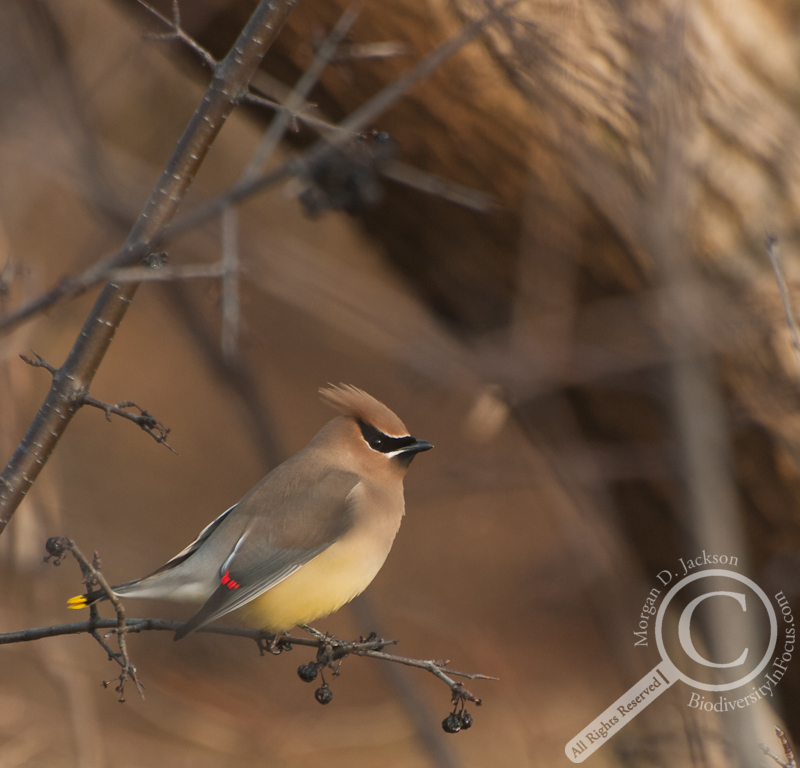
Cedar Waxwing in berry tree in Spring

This isn’t an insect you say? You’re right; I’m using this Cedar Waxwing to distract you from the recent lack of posts. I’ve been juggling several pressing issues (thesis writing, ESO business, deadlines for external projects, you know the deal) and the blog has been the ball that got bobbled lately. Don’t worry though, I’ve got a couple of important topics lined up to discuss in the near future! Until then, enjoy this symbol of urban Canadian winters, and check back soon for an examination of Canadian Biodiversity Science!

Nov 052010
 
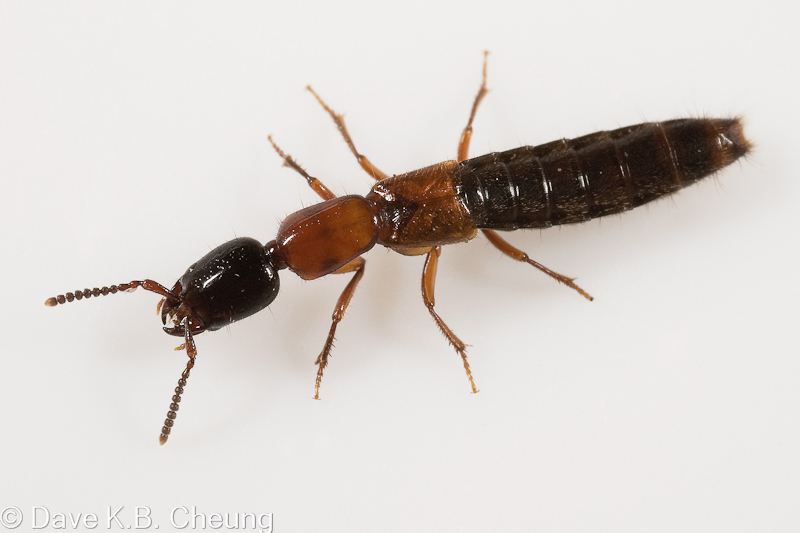
I’d like to welcome Adam Brunke to Biodiversity in Focus as a special guest blogger today. Adam is a graduate student at the University of Guelph, and studies the diversity and agroecology of rove beetles (Staphylinidae) in Ontario.

North America’s insect fauna is changing rapidly. Many of us, however, are completely unaware of this: flies still land on our food, mosquitoes continue to feed on us and carpenter ants show up every year in our kitchens looking for something to eat. The truth is, something strange is happening to the insect communities in our backyards. So many foreign invaders have become established on this continent that it’s becoming a challenge in some places to find native species. In my experience this is especially apparent for beetles: firstly because there are so many exotic species here now; secondly because this is the group that I specialize in. If you casually surveyed your neighborhood for beetles, and sent the sample 100 years into the past to a taxonomist working in North America, they would probably complement you on your excellent reference collection of European Coleoptera!

Xantholinus elegans by Dave Cheung Staphylinidae Insect Beetle

Photo by Dave K.B. Cheung

Continue reading »

Oct 312010
 

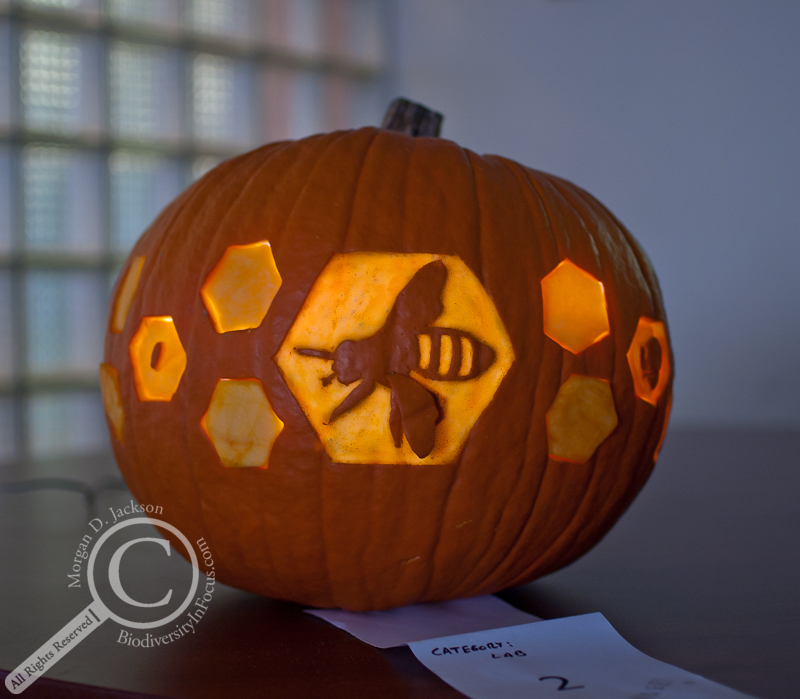
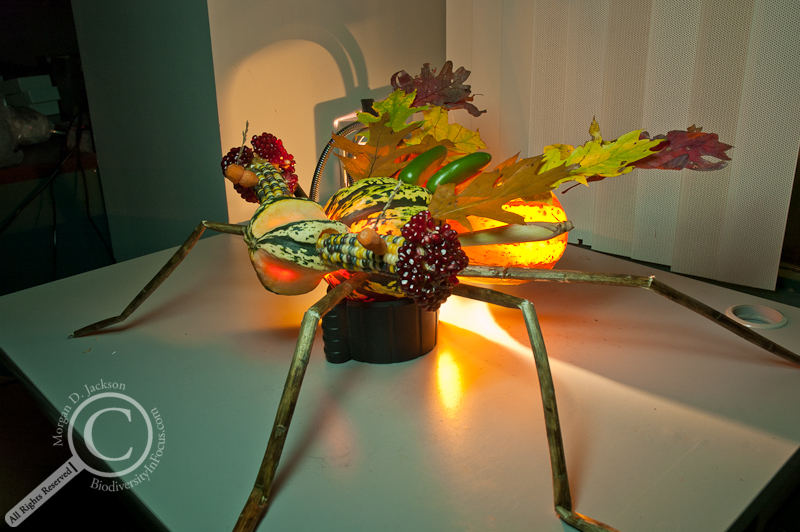
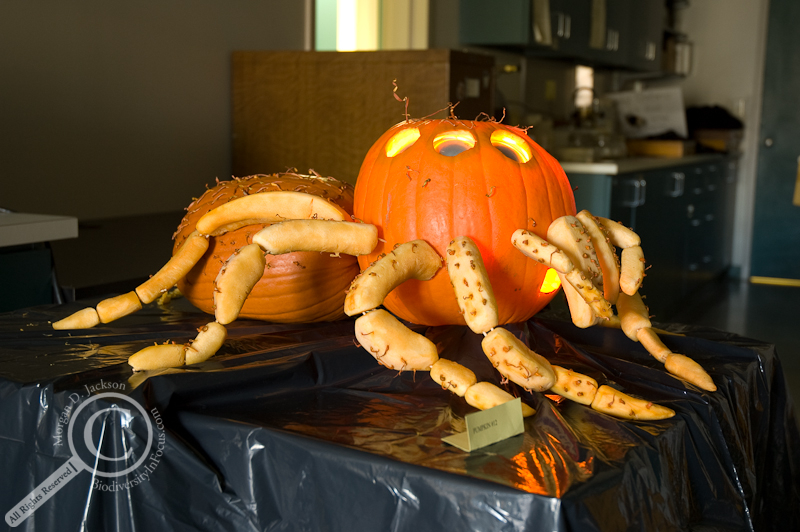
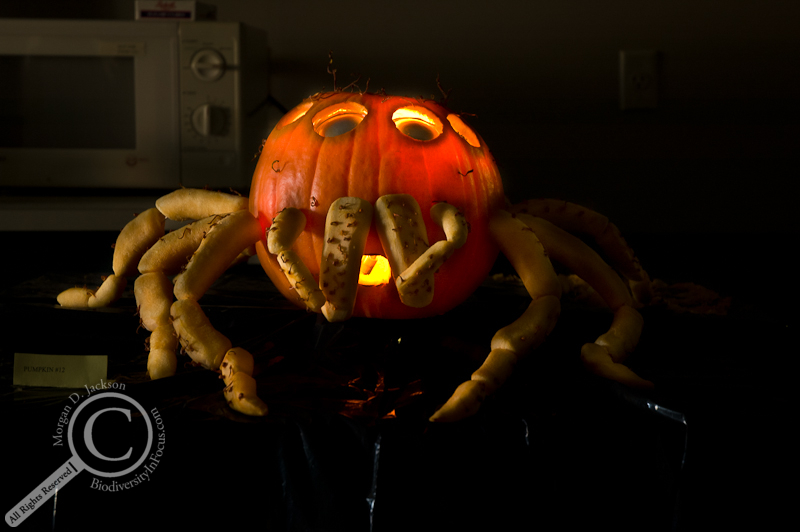
Although we had a good time carving our various insects Thursday night, we still had to come up with a new pumpkin design for our department’s contest Friday afternoon. With a pumpkin supplied by the graduate student council and 2 hours to carve our winning design, the pressure was on to uphold our title as pumpkin champions! After a strategy session over coffee, we decided to bee proactive and get busy.

Bee Pumpkin Jack-o-Lantern

Continue reading »

Oct 272010
 

Having found success with our jumping spider, we ventured further into the realm of morphological correctness, and constructed an ode to our advisor, Dr. Steve Marshall:

Sphaeroceridae Pumpkin Carving Jack-o-Lantern Fly Insect

Photo courtesy of Matt Bergeron

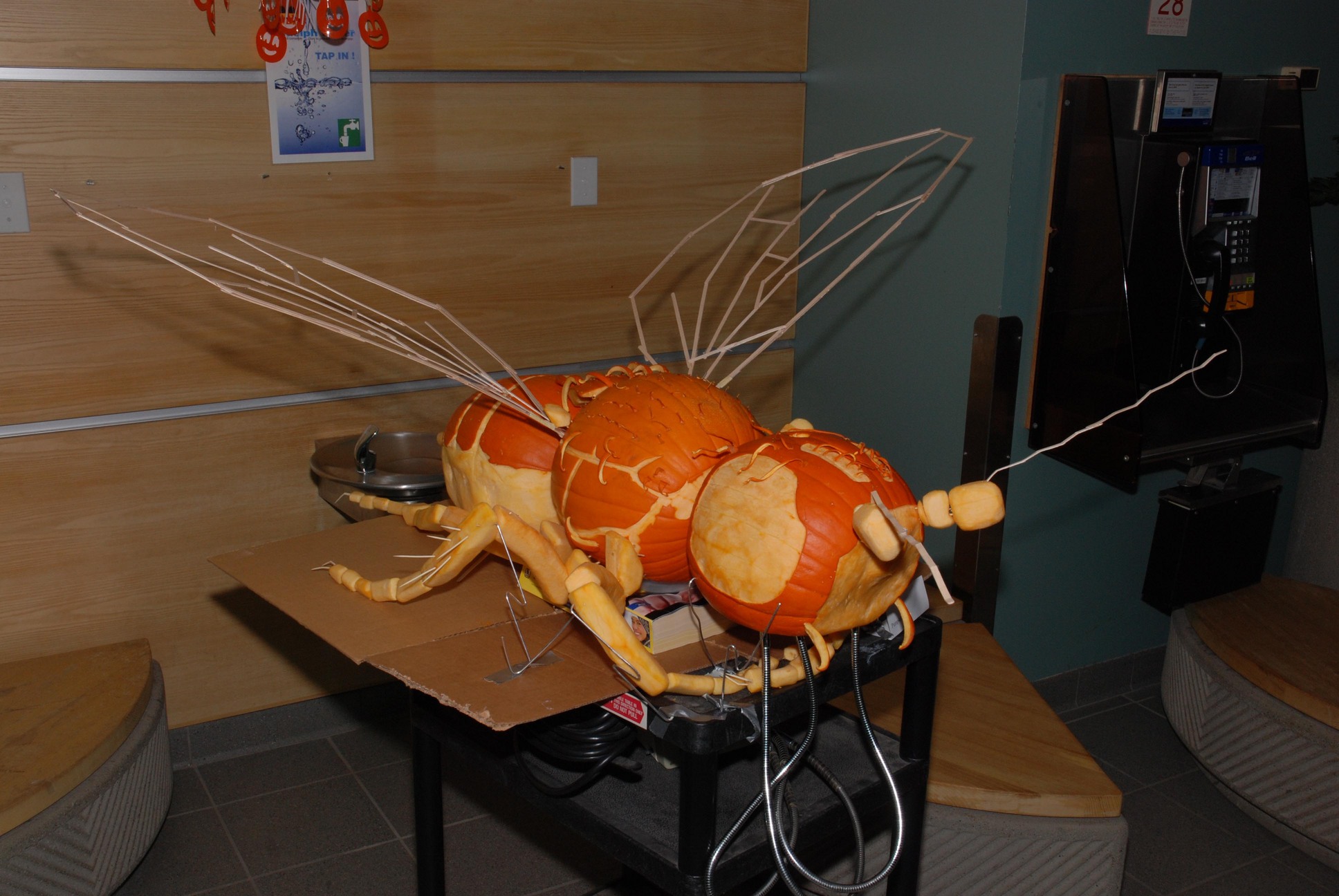
This lovely creature is a morphologically correct Sphaerocerid fly, right down to wing venation and the square rear basitarsus (hard to see in this picture, but it’s there, trust me). I was working in Ottawa at the time so I can’t claim any credit for this, but I believe it was another 8+ hours of work between 3-4 grad students. The sculptors incorporated a range of materials, including a wire frame for leg and head support, toothpicks for bristles and tarsal claws, and popsicle stick wing veins. As per the jumping spider, we use fiberoptic microscope lights to illuminate our creations (the silver tubes sticking out from below the head). Unfortunately there are no images of the fly lit up, but I hear it was pretty spectacular!

Oct 252010
 

Leading up to Halloween, I thought I’d share some of the pumpkin creations that our lab creates for our annual departmental pumpkin carving contest. We’re lucky to belong to a department full of competitive and talented pumpkin carvers, so we’ve needed to up our game every year, resulting in some pretty cool pumpkin designs. We generally make an evening of it, with all the available grad students, undergrad volunteers, post-docs, lab managers, etc joining in and making some ent-o-lanterns!

2007 was my first Halloween as a grad student, and the pumpkin carving really started to take off:

Jack-o-Lantern of Jumping Spider Pumpkin Insect

Jumping Spider Jack-o-Lantern Pumpkin Insect

Composed of 3 pumpkins (one each for the cephalothorax and abdomen, and one carved into legs), we used the bottoms of popcans to recreate the globular shining eyes, and small peelings of pumpkin skin embedded into the parts for bristles. The “bristles” actually dried out over night, curling and appearing more life-like. Time for completion? 8+hours with 5 grad students.

Oct 242010
 

Well, October is all but finished, and I can hardly believe where the time has gone. Well, I know where the last week has gone at least, and that’s been busy transcribing old Hennig papers in German. This is one of the greatest challenges to the science of taxonomy in my mind, needing to critically review all prior information on the taxa of interest. Getting the papers in the first place is often an issue, especially when they’re published in obscure journals from the 1800’s, but once you have them, the real work begins trying to decipher the text. Not only is the obvious language barrier standing in the way, but also the obscure entomological terms that most translators can’t catch and, with the older papers, old lexicon which also isn’t always easily translated. With that in mind, I thought I’d share some of the resources I use for translating these papers (from languages including French, German, Portugese and Spanish).

Google Translate Logo

As with most things on the internet these days, Google is my first choice, and in this case, Google Translate. I’ve found that the translations from Google are much better (when reading the results back in English, not doing a direct translation comparison) than say Yahoo’s Babel Fish (is there a trend here between search engine popularity and translation success? Hmmmm…). Even some complicated German compound words are easily readable after a quick run through Google Translate. Other pros for Google? Real-time translation, allowing you to break up those long compound words which confound the software, and the ability to upload entire Word documents to be translated at once. I find typing accented letters in a word processor much easier than online, speeding up the process in many cases (and also allowing you to save your transcribed files for later instead of evapourating into the ether of the web). I’d say that 95% of my translating needs are met with Google Translate. Another added benefit? Google recently added Latin translation, allowing you to check the etymology of taxon names, or invent your own!

Woxicon Free Online Dictionary

Sometimes when you read over your translated text, you’ll come across a word or term that doesn’t seem to fit or make sense. In these cases I turn to the Woxikon Online Dictionary, which provides a list of synonyms for translated words. This website is only for individual words and not mass blocks of text, but it has helped me make sense of some rather odd sentences! Woxicon works for a bevy of languages (although not as extensive as Google) covering most of the languages in classic taxonomic papers.

Of course, neither of these sites are much good with detailed morphological terms, although in many instances I find I can guess the correct structure based on similarity to English, or by comparing to specimens (i.e. looking for the red sclerite on the thorax, and then determining that was the katepisternum).

Now my question to all you taxonomists (and anyone else dealing with similar linguistics issues): how do you go about translating papers? Do you have access to a multi-lingual colleague in your department, speak multiple languages yourself, or have other resources for this sort of thing? Leave your solutions below in the comments!

UPDATE: After finally finishing transcribing Hennig, I found that Google Translate had some issues translating the entire document (26 pages) and took a few tries to translate the whole thing. After finally getting everything translated, I found I couldn’t download the text, and copy & pasting resulted in both the English and German versions getting transferred in a mixed format. The solution? I uploaded my Word document to Google Docs, used the translation service (again needing 3 tries to perform the entire translation) and then downloaded the file back to my computer for reading later. Overall, easy to do (other than the need to translate it multiple times) and with pretty decent results.

Oct 152010
 

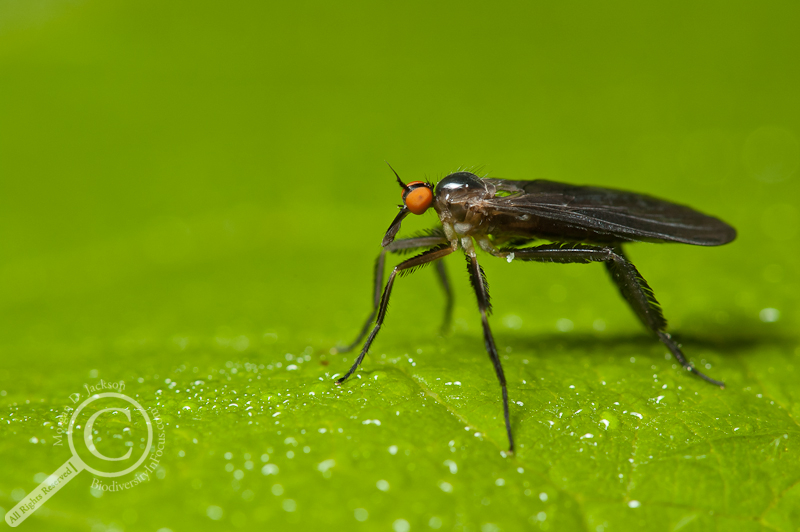
Empididae dance fly on green leaf with water droplets

Water, water everywhere, and not a fly in sight! Well, not actually, because the vast majority of flies could be considered aquatics. I’m not just talking about those flies that actually are aquatic at some stage of their life (like chironomid midge larvae, or black fly larvae; I’ll discuss them later), but rather how even those considered “terrestrial” require extremely moist habitats. Take for example, larve of the Xylophagidae, which in North America live in the humidor of rotting bark on downed trees. Or fruit flies (both the true fruit flies {Tephritidae} and the household “Drosophila” melanogaster), which develop in live fruits, stems, flower heads, and leaves for the former, and rotting fruits in the latter. A decaying body is a wet place, and harbours plenty of maggots, usually of Calliphoridae. A live body is also a wet place, and can be colonized by a number of families (termed myiasis) including the infamous bot fly (Oestridae). In fact, very few flies come to mind that don’t spend at least a part of their life in a humid/moist/wet environment.

Besides the vast diversity of “aquatic” flies, flies that are truly aquatic as larvae have been found to be important bioindicators of the health of their watery homes. Phantom midges (Chaoboridae) and their larvae have been used to monitor heavy metals such as nickel in northern Ontario lakes. Black fly larval diversity and species composition has been used to evaluate the health of rivers, especially in northern Canada (imagine that field work, ouch).

Finally, there are some flies which defy convention and dive headlong into the water (skip to 4:40 to see the flies, taken from The Future is Wild series):