The final 2 days of ESA 2011 were a flurry of activity, with dozens of interesting talks, multiple social events, and plenty more to keep me completely tied up both days.
I started Tuesday off learning about the massive Beetle Tree of Life (similar in nature to the Fly Tree of Life I talked about last spring) presented by Ainsley Seago (@americanbeetles). Unlike the fly tree, this presentation was about the morphological work undertaken, and featured one of the largest phylogenies I’ve ever seen. Ainsley did a great job of showing a tree that was about 5 times too large for the screen by having it scroll, which really showed off the immense number of taxa the team included. The paper can be found here, although it isn’t open access. Ainsley was handing out PDFs after her talk, so perhaps if you ask really nice she’ll help you out and email you a PDF.
From there I went and sat in on the Web-Based Digital Insect Identification: Our Progress, Challenges, and Opportunities symposium, and got a preview of a lot of cool insect identification aids being prepared. From the utility of AntWeb and the construction of a matrix key to the invasive ants of North America to the development of wood-boring beetle identification tools full of gorgeous images, this symposium had a lot of interesting content. It wasn’t all about new tools however, with Clifford Keil making an impassioned plea for greater web publishing of Neotropical identification tools, and relating some of the problems he has identifying the insects of Ecuador. There are a lot of factors working against the inventorying of insects in Latin American countries like Ecuador, from habitat destruction to limited access to the resources and publications needed, but perhaps the most damaging is the paranoia and protectionism of “biological assets” by government bureaucracies. Cliff told tales of valuable specimens he was shipping to collaborators in Europe being destroyed by Ecuadorian border agents, even with the correct paperwork filled out. As an entomologist who studies insect diversity specifically in these biodiverse regions, I am all too aware of the headache-inducing paperwork associated with collecting and export permits, and to hear that even researchers “on the inside” are hitting major roadblocks is troubling.
This symposium had one major dark spot however; a close-minded, elitist presentation by a “traditional” taxonomist on the future of digital insect identification tools. While I’ll leave the presenter unnamed, I will say his presentation left me quite upset. I should have known it was coming when he started his talk by saying he wasn’t aware of some of the good work that’s been done (red flag #1) and then had someone else advancing his PowerPoint presentation because he apparently didn’t know how (red flag #2), but going in I was expecting an excitement about the potential for reaching new audiences, sharing new tools and identification aids, and inspiring new ideas. I couldn’t have been more wrong. For the next 20 minutes he lectured on how digital insect identification won’t help in the near future, and probably won’t work in the long term, going so far as to state that taxonomy and the creation of digital identification aids shouldn’t be undertaken by anyone other than professional taxonomists with decades of experience, because anyone else will just mess it up! I’m not sure when he managed to get any work done while he was building his ivory tower, but from his lofty vantage point all projects relating to taxonomy were best left to him and his equally aged colleagues (and I suppose he was born with the gift of perfect taxonomy and didn’t start out at the bottom). Can we all just agree that this is a messed up, bullshit stance to be clinging to in this day and age? While developing identification aids takes time, it’s not that hard, and no person should EVER be told they can’t do so! “Experts” shouldn’t be discouraging interested individuals, but rather partnering with them to transfer their acquired knowledge! Why on earth this man was invited to speak in this symposium is beyond me, but I assume the organizers weren’t expecting the antiquated tirade he unleashed!
After calming down, I explored the regular member poster session and vendors, grabbed some lunch, and then headed into an afternoon of entomologists utilizing social media, starting with Holly Menninger (@DrHolly) discussing her non-standard career path. It was a nice eye-opener that there are other ways to make a living working with insects in academia, and as expected, she did a great job sharing her experiences! You can also catch a brief interview with Holly on the ESA YouTube channel.
The rest of my day was spent in the Interaction and Education in a Brave New World of Social Media and Online Resources symposium. To be perfectly honest, I was pretty disappointed with the majority of presentations here, in large part because the projects weren’t really social. Sure they were online or on cell phones, but they didn’t really inspire discussion with their users, and were largely digital data collection projects. There were some providing resources, such as the Bugwood.org database of images, video and teaching tools, but even then there is no real network for corresponding with users. There were a few exceptions which I greatly enjoyed, such as Blake Bextine explaining how he engages his students through Facebook discussions as an extension of the classroom. While many people may see Facebook as a potential disaster where students and professors/researchers shouldn’t mix, I think that with some intelligent guidelines and privacy settings, there is no reason why it can’t be used professionally, and Bextine’s use of private, administrated groups seems like a good idea to me. The symposium was finalized by a great talk from the often-imitated-but-never-duplicated, blue-haired-blog-queen Bug Girl, who did a great job raising the profile of insect blogging! You should go watch her presentation right now, and also be sure to check out her interview by Guelph grad student Laura Burns for more reasons to blog!
Tuesday is generally the pub/social gathering night at ESA, and this year I tried to make appearances at 3 different events (“appearances”, ha! Like I’m some sort of celebrity). I say tried, as I missed out on the Dipterists Pub while hanging out with the Citizen Scientist group and a bunch of very friendly Lepidopterists & parasitic Hymenopterists at a house party on the western outskirts of Reno (a story that I won’t go into, but suffice to say I had my share of awkward I-don’t-know-anybody small talk). After getting back to the hotel, I met up with a small group of bug bloggers/bug blog readers and enjoyed a beer or two while talking about a wide range of entomological and social issues (also, Bug Girl is just as funny in real life as she is online). It was a great finish to a very full day!
Wednesday was the final day of the conference, and I unfortunately missed most of the morning sessions while checking out of the hotel and picking up a rental car in preparation for a quick post-conference road trip (more on that to come). Wednesday afternoon was spent in the Biosurveillance symposium, where a group of extremely passionate entomologists discussed their successes and challenges with using Cerceris fumipennis (a wasp in the family Crabronidae) to scout for Emerald Ash Borer (Agrilus planipennis). This is a project that got it’s start here in the University of Guelph Insect Collection and which has been adopted and expanded by a great group of people throughout the eastern US in a relatively short period of time. Talks ranged from the development of mobile wasp colonies to selectively search areas to the study of Cerceris biology/chemistry/behaviour and even to the citizen scientist initiative being implented. I suggest you visit Cerceris.info for much more information on the project, and to learn how you can volunteer to become a Wasp Watcher! My final talk of the conference was right near the end of the symposium, and everyone seemed quite excited about the field guide to jewel beetles we’re developing.
With that, ESA 2011 came to a close for another year. While I always enjoy entomological conferences, this one will certainly stand out as one my favourites, featuring a great diversity of high-quality talks, dozens of new friends and contacts, and more than enough information and inspiration to keep me going through the long, Canadian winter! I’d like to thank everyone who followed along here and on Twitter, and especially the symposia organizers who invited me to speak in their programs. I had a great time, and I can hardly wait for ESA 2012 in Knoxville, TN! Hope to see you there!
-
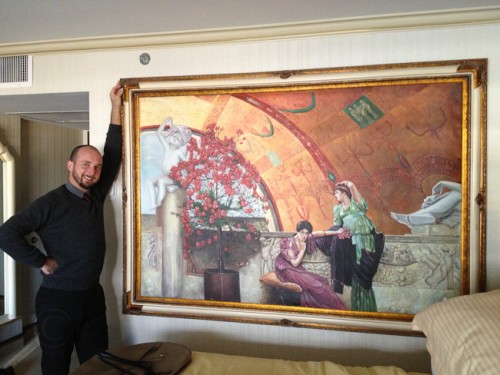
- Imagine waking up to that hideous thing every morning! (The painting, not Phil!)
-
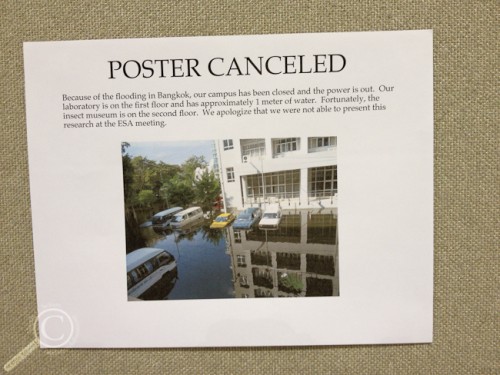
- A reminder that things can be a lot worse in your lab!
-
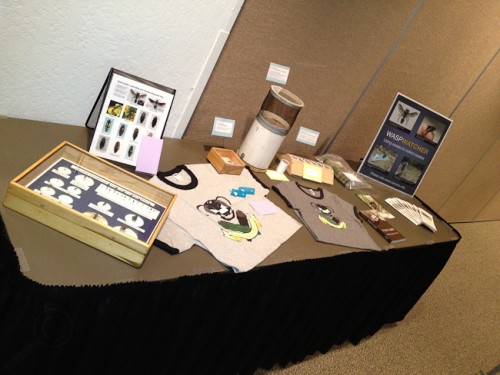
- How many symposia have an interpretive station? Biosurveillance did!
-
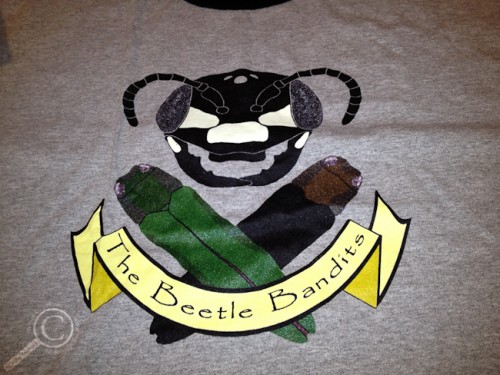
- How about a team T-Shirt and Logo?