Apr 132011
 

My MSc Defense Poster


The Quest for the Master’s Degree is nearing it’s conclusion! If you’ll be in the Guelph area on Monday, I invite you to stop in and see what I’ve been up to for the past 3.5 years. I can promise plenty of taxonomic discussion (hopefully well defended by yours truly), plenty of pictures and diagrams, and the world premiere of 3 species new to science! There will be Timbits and coffee for those who require further encouragement/bribes.

The last month has been all over the place, with periods of extremely long days full of final revisions and paperwork, and an eerie academic Limbo without needing to work on my thesis for the first time in years. There’s always work to be done however, and I’ve been preparing the chapters for peer-reviewed publication. Once everything is said and done, I’ll be doing a series of posts reflecting back on my first graduate degree; the highs, the lows, and some tips for those considering doing graduate work in taxonomy. Until then, have a good weekend, and I’ll see you on the other side!

Apr 112011
 

This post is going to be longer and a little more technical than normal; feel free to jump in and out, or just check out some of the photos on your way to the conclusions. Although I may come across as critical and occasionally cynical at times, I’m not picking on anyone just to be a thorn, but rather to promote scientific discussion; I fully encourage you to join the discussion in the comments section. Finally, in the spirit of full disclosure, a portion of my graduate research was funded via the NSF Tree of Life grant behind this paper (although neither myself nor my research contributed to this project in any manner that I’m aware of), and one of my academic advisors is a co-author on the paper.

Asilidae with Prey - Ecuador

Robber Fly with Prey - Asilidae - Ecuador

Despite my best efforts here at Biodiversity in Focus, research on flies very rarely makes the mainstream media (besides mosquitoes, malaria and Drosophila of course), so when one of the most important papers on fly evolution was released and started making the science blog circuit, I was excited to see people taking an interest in Dipterology! There was one problem however, which is not limited to the blogosphere and this paper, but has been an increasingly common trend in insect systematics: the blind acceptance and assumption that a new phylogeny is the definitive answer because the researchers used an ever increasing number of genes. One influential blogger, who’s also an evolutionary entomologist, summarized the results of the Diptera tree of life as such:

But they’re solid results, since they’re based on lots of molecular data and the branch positions are well supported.   — Jerry A. Coyne, Ph.D

Similarly, the research team who published the tree are encouraging the idea that their results are infallible by labeling their work the “New Periodic Table of Flies”. A bold statement, and one that many taxonomists might be hesitant to make as it implies that they don’t expect future studies to return different relationships, much as the periodic table of chemical elements is not about to change. An analogy like this requires a strong body of evidence to support it, so let’s take a look at what they did and how the Diptera family tree looks!

Continue reading »

Tuesday Tunes – Outdoor Miner – Wire

 Fun Stuff, Insects, Pop Culture, Tuesday Tunes  Comments Off on Tuesday Tunes – Outdoor Miner – Wire
Mar 292011
 

Ryan FleacrestMany artists write their music about the insects which are commonly encountered; ladybeetles, butterflies, the occasional ant or dragonfly. Very few go that extra step and talk about relatively obscure insects of modest economic importance. When it’s not a beetle but rather a fly, well, that’s like icing on the cake.

Today I bring you a song by the British band Wire. Now, this is where it gets a little ironic, as the fly featured in the song Outdoor Miner is the serpentine leaf miner (Liriomyza brassicae), which although one of the most cosmopolitan Agromyzidae (Leafminer Flies), isn’t found in Britain (as of 2007, 29 years after the song was released). The serpentine leaf miner doesn’t generally result in large crop losses, but can create cosmetic damage which makes roadside sale more difficult. Wire has managed to record the life history of the fly through their lyrics, describing the leaf mining patterns indicative of the fly as well as the pupation behaviour (dropping from the leaf to pupate in the soil, and being born again figuratively speaking). Seems like an awful lot of biology for one song eh?


Maybe I’m over-interpreting the lyrics a little, but even the lowly silverfish gets the nod! Wire must have had an entomologist on the payroll; excellent! Fleacrest, out!

This song is available on iTunes – Outdoor Miner – Chairs Missing (Remastered)

Tuesday Tunes – Mardi Gras Special

 Fun Stuff, Insects, Pop Culture, Tuesday Tunes  Comments Off on Tuesday Tunes – Mardi Gras Special
Mar 082011
 

Ryan FleacrestIt’s party time down in The Big Easy, with eusocial gatherings in the streets, plenty of ethanol being wasted (i.e. not being used for insect preservation) and females displaying mammary glands for petroleum-based jewelery (or so I’ve heard). In celebration, here’s the Dukes of Dixieland playing the entomological fight song, “When the Ants go Marching In”!


Wait, you mean it’s actually about SAINTS, not ants? And it’s a traditional funeral song? Shit. Well, in that case, enjoy EL-P featuring New Orleans resident (and Academy Award Winner) Trent Reznor – Flyentology (I think I might start referring to myself as a Flyentologist now…)


I’m off to eat some pancakes and pączki with some Jack Daniels Syrup. Fleacrest out!

These songs are available on iTunes – When the Saints Go Marching In – Timeless, The Classic Collection

Flyentology (Cassettes Won’t Listen Remix) – Single – El-P

Feb 172011
 

It’s a been a busy period for the Canadian Journal of Arthropod Identification, and today I bring you lucky #13, the final volume chronicling the horse & deer flies of Canada east of the Rockies. Although Canadian tabanids were relatively recently treated by H.G. Teskey (1990),  Anthony Thomas has now updated the distributions for these flies, and has greatly increased the number of illustrations, simplifying the identification of these beautiful brachycerans.

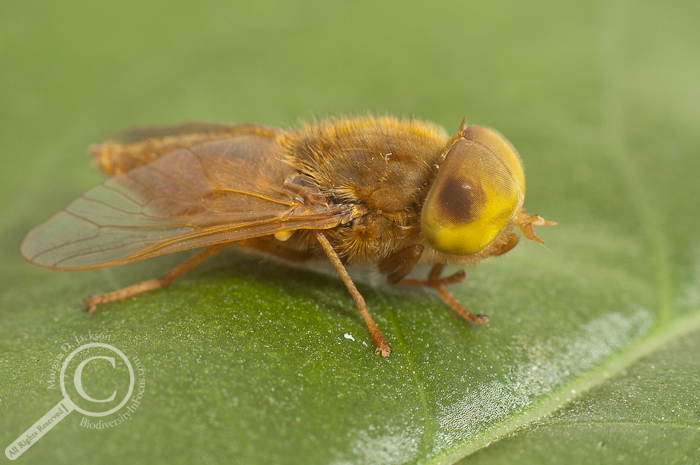
Atylotus bicolor Tabanidae horse fly

Atylotus bicolor (Wiedemann)

Continue reading »

Feb 152011
 

Ryan FleacrestWelcome to a special Valentine’s-Day-Hangover Tuesday Tunes! You know the Valentine’s Hangover: the sugar crash from too many cinnamon hearts and boxed chocolates, itchy eyes and throat from all that unseasonal flower pollen, and don’t forget the sore back from sleeping on the couch because you innocently thought your significant other was lusting for another insect net! Everyone knows the best cure for a regular hangover is to keep on drinking*, so today I bring you the Valentine’s day equivalent: sickly-sweet pop music!

Some may consider the Jonas Brothers a plague upon their ears, but today’s musical selection is equally annoying for those living in the southern USA. That’s right, the springtime scourge of motorists, the Lovebug! Not truly a “bug” in the entomological sense, Lovebugs (Plecia nearctica) are in fact flies in the family Bibionidae. These flies emerge on mass in the spring and late summer, immediately begin swarming looking for a mate, and can remain in copula for hours when they find that special someone (hence, the common name). These swarms can reach overwhelming proportions, obscuring windshields, clogging air intakes, and their acidic bodies can ruin vintage car body work if their dead bodies are left to dry. There’s even an urban legend that University of Florida researchers created these “pests” and unleashed them on the public (note this isn’t much different from the origins of the Jonas Brothers…)

That song certainly contains more cheese than last night’s fondue, but I think we’re all over our Valentine’s Day hangover!

I can’t say I planned on featuring both of Disney’s poster children in the first few weeks of this series, so I think the next few weeks will be devoted to some music that will rock the sickly sweet detox program! Fleacrest, out!

If you still need more hangover relief, this song is available on iTunes – Lovebug – A Little Bit Longer (Deluxe Version)

* – Biodiversity in Focus and Ryan Fleacrest urge you to drink responsibly. More alcohol is not actually a cure for a hangover.

Jan 272011
 

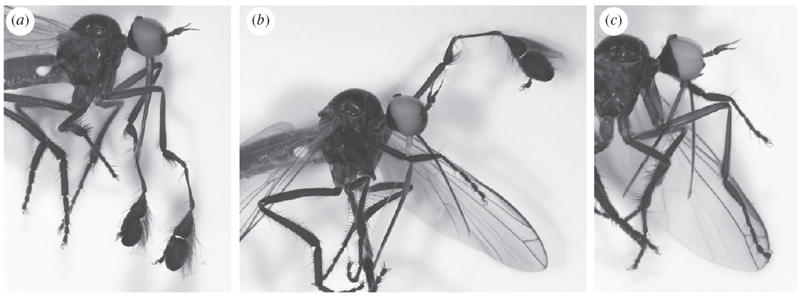
Flies are cool. You might even say they’re phat (I know, I’m pretty fly for a white guy). But a newly described dance fly species (Empididae) from Japan takes the term “phat” to an all new level. Meet Empis jaschhoforum:

Empis jaschhoforum male morphs from Daugeron et al. 2011

Figures 1a-c from Daugeron et al., 2011

Continue reading »

Jan 182011
 

Ryan FleacrestWhat’s the sound of POP (other than the most unfortunate of insects underfoot)? None other than the Queen of Teen, Miley Cyrus! Although the screams of adoring preteen fans may confuse passing cicadas, this week we’re sharing a song with the most noble of insects in a position that many of those preteens would love to be: Fly On The Wall.

Who wouldn’t want to have the ability to latch onto a wall with their tarsal claws and empodia like a fly? Who needs a seat at the rock show when you can attach to the stage itself, providing a unique vantage point right in the midst of the show? Of course many flies wouldn’t be able to actually hear the music (lacking a timpanic organ and all), but that’s beside the point! While I’d personally prefer not to be a fly on the wall of a Miley Cyrus concert, I salute her for bringing some Diptera love to the next generation of entomologists!

Thanks for tuning in, and if you’ve got a favourite ento-song, drop a request in the comments! Fleacrest, out!

This song is available for download from iTunes – Fly On the Wall – Breakout

Jan 112011
 

The Canadian Journal of Arthropod Identification has just published it’s 11th edition and features the blow flies (Calliphoridae) of eastern Canada. This new paper includes richly illustrated keys to the adults of all genera found in eastern North America and the species found in eastern Canada (excluding the cluster flies (Polleniinae), and the rare, mollusk-parasitizing Melanomyinae). Additionally, two species are newly recorded in Canada (or eastern Canada), and Stephen Marshall has populated the paper with his world-class photographs.

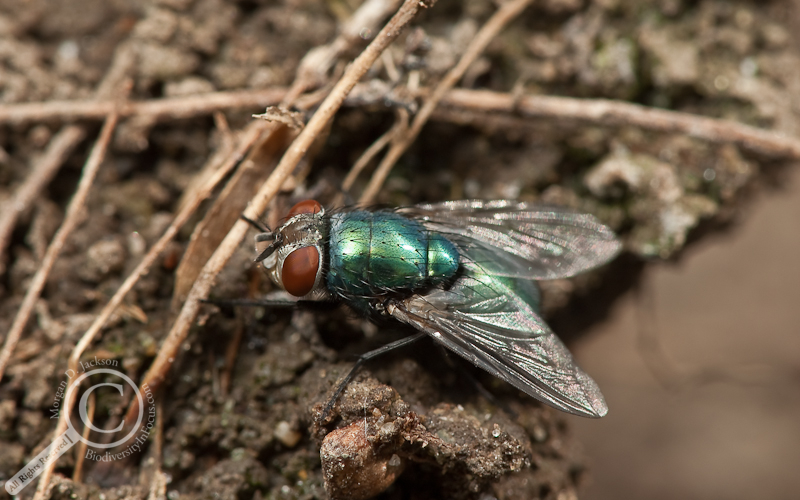
Lucilia sericata Calliphoridae Blow Fly Common Green Bottle Fly

Lucilia sericata, the common green bottle fly

The Calliphoridae are important for a number of reasons, and unlike many insects, correct identifications can quite literally be a life or death choice. These flies are a keystone in forensic entomology, and knowing which species colonize a victim’s body, and when, can mean the difference between catching a killer and convicting the wrong person. The importance of Ontario Calliphoridae is perfectly illustrated in the case of Steven Truscott. Sentenced to death by hanging at the age of 14 for the murder of Lynne Harper in rural Ontario, Truscott’s sentence was commuted to life in prison in 1959. Truscott served his 25 year sentence behind bars, and lived with the stigma of a being a convicted murderer for nearly 50 years. It wasn’t until an appeal before the Ontario Court of Appeal in 2006 that entomological evidence collected at the time of the murder was analysed and presented by Dr. Sherah VanLaerhoven of the University of Windsor. This entomological evidence, largely composed of blow fly maggots, helped to overturn Truscott’s conviction, and led to his acquittal. Sure, forensic entomology wasn’t even on the radar in 1959 (although the coroner at the time had the presence of mind to collect and catalog maggots from on and around the body), but forensic entomologists today are called to hundreds of crime scenes every year to help develop a timeline of events to be used in criminal prosecution.

The majority of people using this paper will not be making these life or death decisions, but being able to identify the species you find on your backyard flowers (because blow flies are also major pollinators) is equally important. Plus, if you choose to play CSI on that dead squirrel under the deck, now you can!