Jun 112010
 

This morning, undergraduate worker and entomologist-in-training Stephen Luk brought in a special little creature that he found in his backyard (click to enlarge):
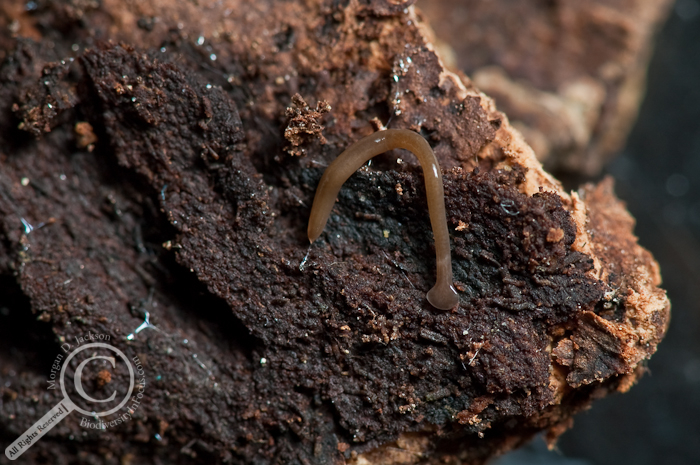

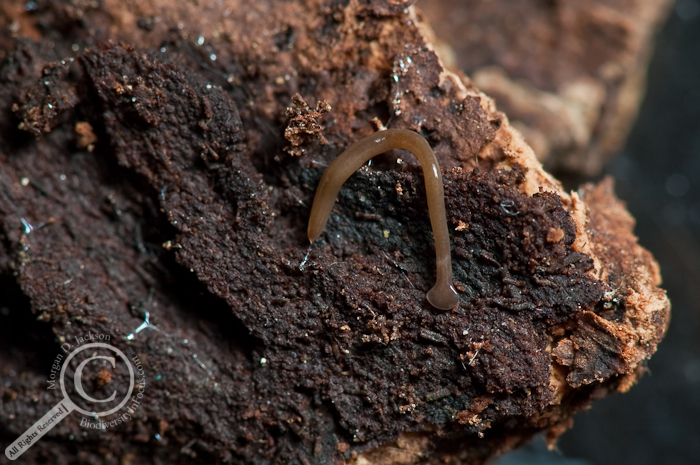
Hammerhead flatworm on wood Bipalium Planaria

Neat, but what is it you ask? It’s a hammerhead flatworm (Bipaliidae) which he found under some bark. Although I’m not 100% confident about what species it is, I’m fairly certain it is the introduced Bipalium adventitium. These little carnivores are predators of another introduced invertebrate, earthworms. Dindal (1970) reported that once Bipalium latches onto its prey, it sucks away with its pharynx (mouth-like structure) and liquefies large sections of the earthworms integument before ingesting its victim section by section.
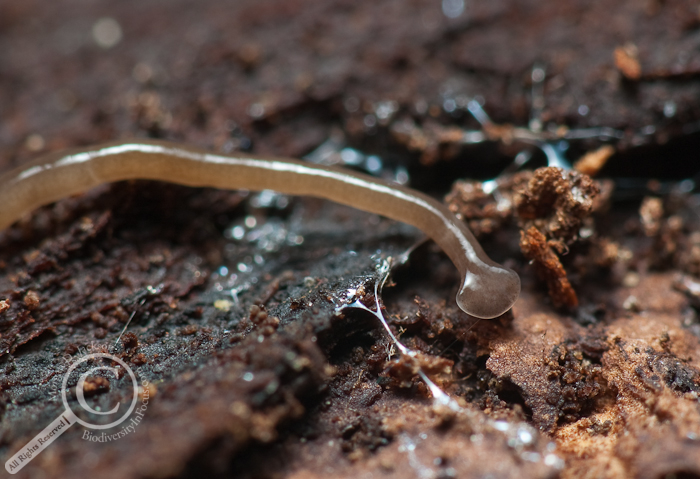
Hammerhead flatworm hunting along bark

This individual was about a 1.5 cm long and constantly on the move, making for a tricky photo shoot! The first image was taken with only the Nikon 105mm VR lens and SB-800 speedlight, but to gain some added magnification I shot the remaining images with extension tubes. Generally when I’m shooting macro subjects with limited depth of field, I strive to have the eyes in focus to allow the viewer to “connect” with the subject. But what about a creature that doesn’t have eyes in the traditional sense? Well, I went for what I believe are light-sensing sensilli (larger crop of above photo):
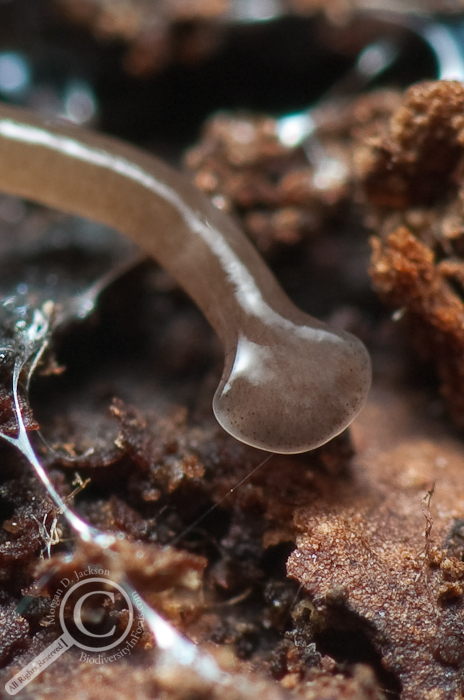
Close up photo of the head of Bipalium showing eye spots

It took quite a few tries to get a good shot with the small depth of field provided by the extension tubes, but it was worth the effort to see such a special little invert up close and personal!
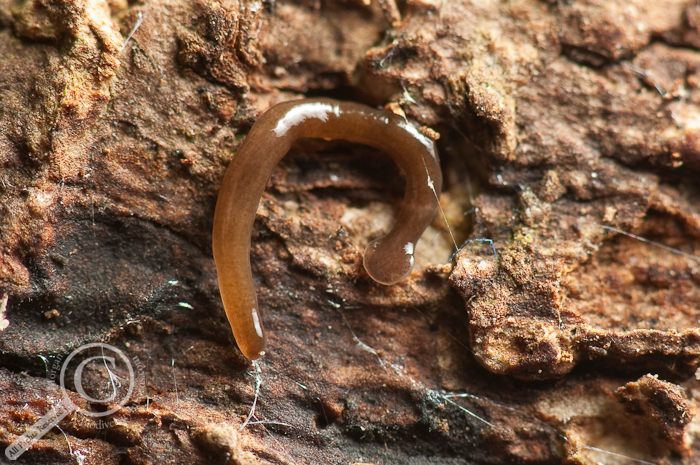
Biparium sp. curled up on bark Planaria

References: Dindal, D. L. 1970. Feeding Behavior of a Terrestrial Turbellarian Bipalium adventitium. American Midland Naturalist 83 (2): 635-637

Feeding Behavior of a Terrestrial Turbellarian Bipalium adventitium

May 272010
 

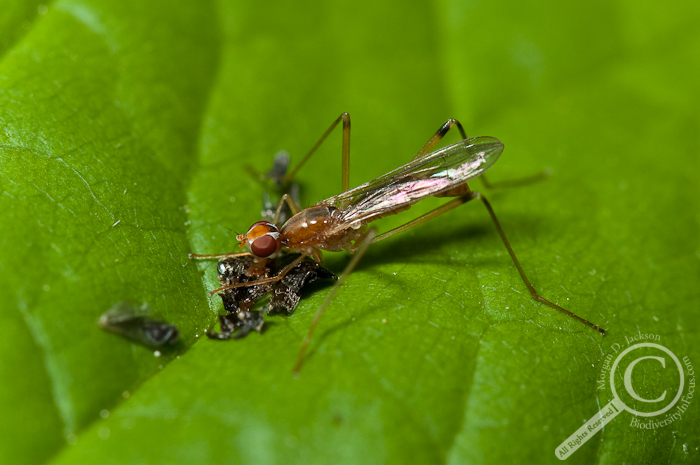
I took a short break this morning to clear my head and get back into this photography thing, so I headed over to the University of Guelph Arboretum and went looking for flies. It became readily apparent that not picking up a camera for 8 months was going to make it a learning process all over again! And the first lesson? Charge your flash batteries! One shot into the day and I realize my SB-800 is dead in the water. Crap… luckily my shooting buddy also uses Nikon equipment, so while he was shooting I was collecting, and vice versa. Problems solved right? Well, lesson 2 quickly became apparent; check your settings! I had switched to shooting JPEG this winter for a family function! Crap… a quick switch back to RAW format with hope those first few shots were ok and won’t need much editing (JPEG files don’t handle heavy editing well) and back to work I go.

Compsobata univitta (Micropezidae) on green leaf

Well, at least something worked out! (Click to enlarge)

The rest of the morning was spent finding the body control and breathing necessary for macro work, and by lunch time I was feeling almost back into the swing of things! I definitely need to make the time to go out more regularly this summer, and remember, check, double check, and triple check your equipment each time you go out!

May 212010
 

Thought I’d pass along this golden egg, the Entomological Society of Canada has recently been given permission to scan and publish all 3 volumes of the Manual of Nearctic Diptera on their website, and it’s 100% free! The “Manual”, as it’s referred to, is as close to a Bible for North American dipterists as you can get, and includes keys to all* the genera of flies found north of Mexico! It’s been out of print for awhile now and bound copies are hard to come by (I just recently received a full like-new set this winter, and I’ve been searching for 4 years), which makes a digital (and searchable) version a real plus!

Here’s a quick breakdown of what’s in each richly illustrated volume:

Vol. 1 – Morphology and Terminology (great reference), Key to Families (adults and larvae), Keys to genera for all Nematocera (Culicidae – mosquitoes, Tipulidae – crane flies, Simuliidae – black flies, etc) and Orthorrhapha (Stratiomyidae – soldier flies, Tabanidae – deer and horse flies, Asilidae – robber flies, Bombyliidae – bee flies, Empididae – dance flies, etc)

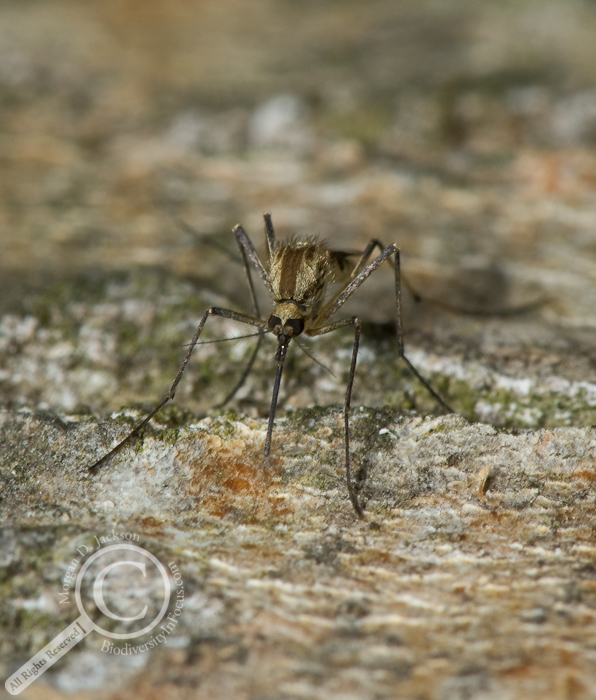
Mosquito sitting on log in Ontario

Time to start ID'ing my Nematocerans, like this Mosquito (Culicidae)

Vol. 2 – Keys to genera for each of the following; Aschiza (Syrphidae – flower flies, Phoridae – scuttle flies, Pipunculidae – big-headed flies, etc), Calyptratae (Muscidae – house flies, Calliphoridae – blowflies, Tachinidae, Sarcophagidae – flesh flies), and most importantly the Acalyptratae (Micropezidae – stilt-legged flies, Tephritidae – fruit flies, Drosophilidae – vinegar flies, Sphaeroceridae – lesser dung flies, Ephydridae – shore flies, etc)

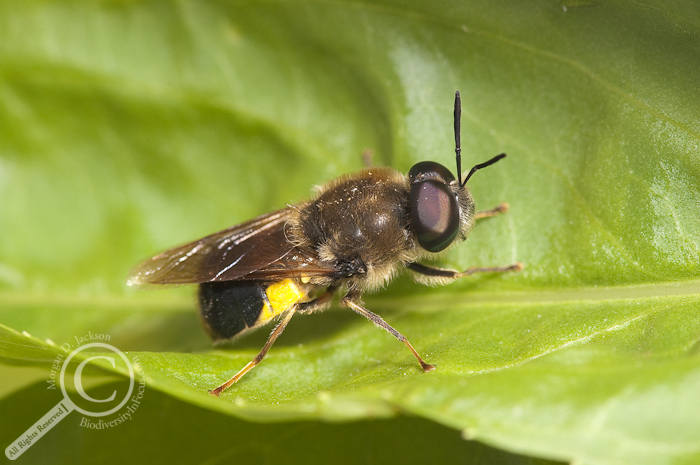
Soldier flies are your's to discover, like this <i>Stratiomys adelpha</i>

Soldier flies (Stratiomyidae) are your's to discover, like this Stratiomys adelpha

Vol. 3 – Phylogeny and classification of the Diptera

You can download your copy of the Manual here, and while you’re there check out some of the other titles that have been made available as well, including most of the Canadian Handbook Series, detailing some of the major insect and spider groups found in Canada! Thanks to the folks at Agriculture and Agri-Food Canada and the Canadian National Collection of Insects, Spiders, and Nematodes, and the Entomological Society of Canada for making this possible!

* – all genera as of the late 1980’s that is, there have been a few changes since then, but this will still give you a great headstart

Migration time!

 Nature, Photography  Comments Off on Migration time!
May 052010
 

Well, it’s the spring, and that means the birds start to come back to Ontario, and start showing off their finery!

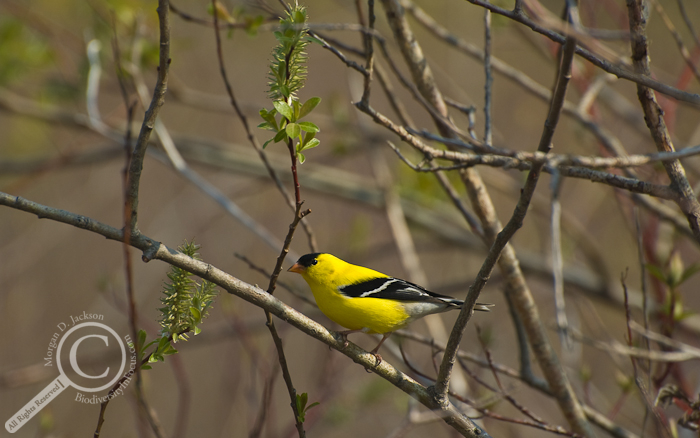
American Goldfinch at Long Point Provincial Park

Although not one of the major migrators in the area, this American Goldfinch (Spinus tristis) was exploring Long Point Provincial Park

Hopefully this season doesn’t go by as fast as the winter seemed to!

Apr 272010
 

The blog is likely going to be pretty quiet in the coming weeks as I finish writing my Master’s thesis and prepare to defend. I’ll try and make a few simple posts throughout the process, but more detailed posts likely won’t happen until I have some extra spare time! Until then, I hope you’ll enjoy some of my photos from the archives, and stay tuned for plenty of new content this summer!

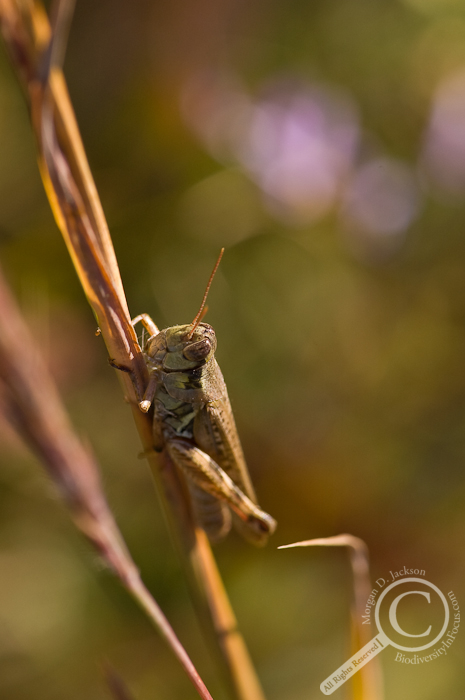
Acrididae grasshopper on dead grass stem with purple flowers behind

This Melanoplus sp. (I think) was hanging out in the Alderville Prairie (Click to enlarge)

Apr 212010
 

Although slightly modified from what E.O. Wilson actually said (birds, blogs, same thing right?), the title is most certainly true! Yesterday I introduced you to my blogosphere project, where I began looking at how insect blogs are related. Today, you’ll see the piece de resistance, and we’ll talk a little about what we see! Hold on tight and get ready for a bloggy family reunion!

Drum roll please…. dadadadadadadadada….

Continue reading »

Apr 202010
 

After my post about the blogs that I check daily, Alex Wild commented that someone should map out the connections between the bug blog community, and I thought what better way to do so then to apply some phylogenetic systematics to the blogging community! It was also good timing for this project, as Willi Hennig’s birthday is April 20, and I thought it’d be an interesting tribute to the man who revolutionized the field of taxonomy and systematics. So without further ado, I present to you something that I’m sure will be gracing the cover of Nature in the near future and which will set me up for the first Nobel Prize awarded to a blog:

A Phylogenetic Analysis of Entomology Blogs: A Blogosphere tribute to Willi Hennig

Willi Hennig - The Father of Modern Phylogenetic Systematics

Courtesy of Wikipedia.org

Continue reading »

Apr 092010
 

Yesterday you got the best of my blogroll, and now you’re ready for more? Well then, today I’ll share a couple of resources for you to find other blogs that might interest you!

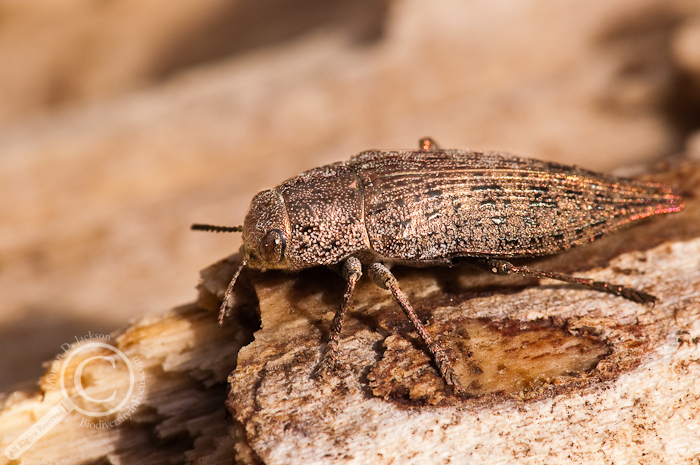
Dicerca divaricata (Buprestidae) on sunny log

For a dipterist, I've been featuring a lot of beetles lately....

To start, I would go through the list of  blogs at the Nature Blog Network. You can find any nature related topic you could ever want with a multiple authors to choose from in each. Insects, photography, birding, conservation, and marine biology are only a few of the topics that you can peruse at your leisure!

Nature not your thing? A lot of mainstream topics can be found through AllTop. This is essentially a blog aggregator, but rather than you getting to choose which blogs show up, you can see a selection for a given buzz word and go from there. A little clunky at times, but none the less a lot of high profile blogs to check out, from politics to food and beyond!

Do you subscribe to monthly magazines? Why not browse some of the blog carnivals that float around the ‘net! These are essentially periodicals of related blog entries from a bunch of different authors. Some of the larger ones that I’m aware of include the Carnival of Evolution (featuring some of the best science bloggers online), An Inordinate Fondness (for all the beetley goodness), and House of Herps (snakes, turtles, frogs, crocs, and all the other reptiles and amphibians are featured here).

Still need more? Google it, and all will be revealed! Also, bloggers are full of community spirit and often link to all sorts of interesting topics, so join the community and dive in to the blogging world!

Apr 082010
 

Now that you know how to start following someone’s blog, all you need is someone to follow! I’ve compiled some of the blog’s that I check daily, and which cover a variety of different topics!

As always, click on photos to see them larger
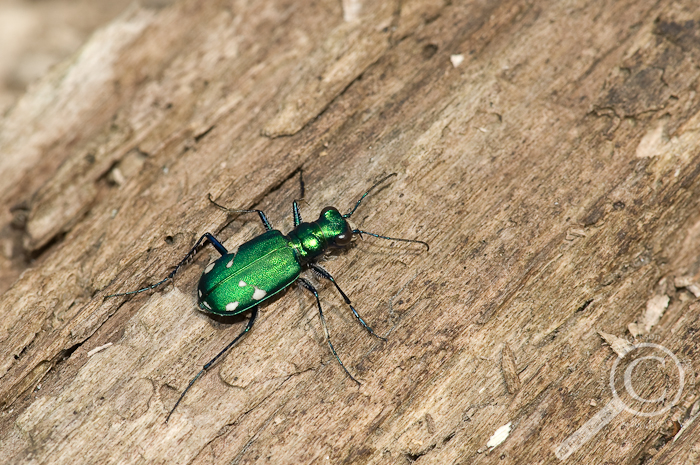
Tiger beetle Cicindela sexguttata sitting on a log

Six-spotted Tiger Beetle, ready for sunny spring days!

Continue reading »

Apr 062010
 

As I sat here writing my thesis this afternoon, my mind began to wonder (as it’s apt to do when I force myself to do things for long periods of time), and I started wondering how many people are frequent blog readers. Personally, I begin everyday checking in to see if anyone has put some new information out there for me to ingest (I’m an information-addict). But how many other people do something similar? Sure, people check their Facebook to see how their friend’s date went, or check in on Twitter to find out what Ashton Kutcher is eating for breakfast, but what about starting the day learning something new and related to your work/hobby?

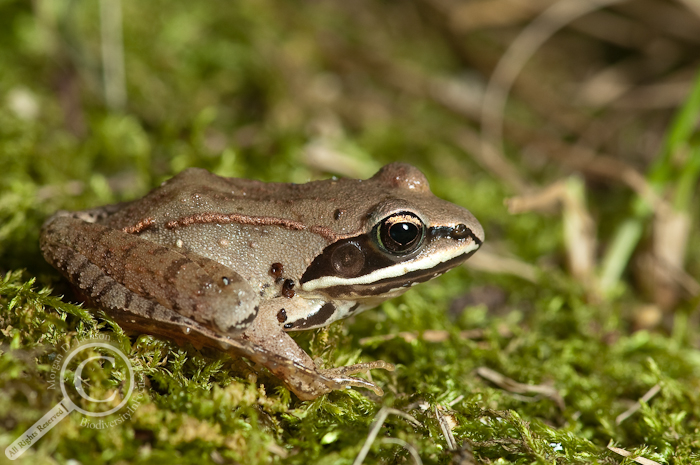
Wood Frog Lithobates sylvatica sitting on grass

Have spring fever but stuck inside? Blogs may be the answer!

Continue reading »