Oct 252011
 

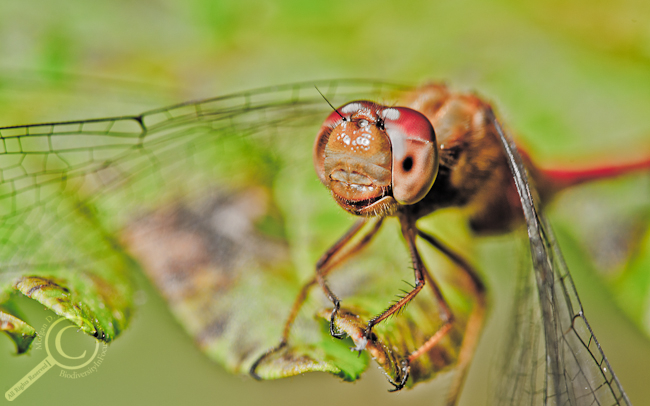
Ryan FleacrestWhen I first found today’s song, I immediately thought of this dragonfly photo I took while on vacation a few weeks ago:

Dragonfly Dreams


That is, until I finished watching the music video and realized the video director and the artist might not realize the difference between a butterfly and a dragonfly…


If you’re keeping track at home, that’s a Taxonomy Fail Index of 57.8, and quite frankly, one of the least imaginable given the general popularity of both orders! Perhaps that was an artistic choice of some manner…


This song is available on iTunes – Dragonfly – Bring Me the Workhorse

Tuesday Tunes – Mississippi Bo Weevil Blues – Charley Patton

 Entomology, Fun Stuff, Natural History, Pop Culture, Tuesday Tunes  Comments Off on Tuesday Tunes – Mississippi Bo Weevil Blues – Charley Patton
Oct 182011
 

Ryan FleacrestWhen it comes to insect pests, few have been so devastating yet controlled and managed as the Boll Weevil (Anthonomus grandis). An introduced pest of US cotton in the early 20th century, the Boll Weevil has largely been eradicated thanks to a massive effort by the USDA (which  might explain why there are only 4 photos of this beetle on BugGuide).

It’s not often that a major insect pest is praised, yet in Enterprise, Alabama, they’ve erected a statue in its honour! Why? Because it so devastated the local cotton plantations that farmers switched to peanut farms, where they found great commercial success! Enterprise, AL is definitely on my dream roadtrip schedule now!


View Larger Map


Of course, Boll Weevils aren’t the only entomologically related statues in the US; Mormon crickets (Anabrus simplex) were also immortalized, sort of. In this case, it was their demise by California Gull which is being remembered, but still, an insect-related statue is an insect-related statue!


As you may have noticed, I didn’t get around to answering last week’s photo challenge; imagine that… There are still plenty of points up for grabs and not many guesses, so why not take a stab at what it might be. Hopefully I’ll get time to post the full story next week, but given my track record with sticking to schedules, best not hold your breath!


This song is available on iTunes – Mississippi Boll Weevil Blues – Complete Recordings, CD A

Oct 112011
 

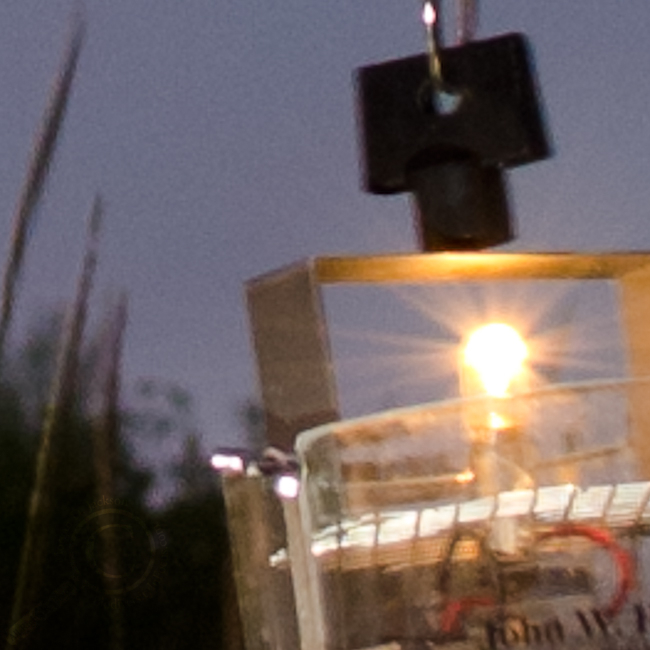
Ryan FleacrestTime to earn some BioPoints; what is this, what was it designed to do, and how does it work? I’ll be providing the answers and doling out the points next Monday, and I’ll keep comments moderated until then so everyone has an opportunity to win. Remember, humor and accuracy will both earn you points!

No Hints Here


Alright, you can have a clue since it’s Tuesday:

Good luck!

Tuesday Tunes – Fly on the Wall – AC/DC

 Blogosphere, Insects, Pop Culture, Tuesday Tunes  Comments Off on Tuesday Tunes – Fly on the Wall – AC/DC
Oct 042011
 

Ryan FleacrestHere we are at Tuesday again already. If you didn’t catch it last night, I finally got around to answering the ID challenge from August. Pretty depressing it took so long, but September was another busy month with papers submitted, friends defending their PhD’s, and of course NSERC applications coming due. I was little more than a fly on the blogosphere wall all month, but there was some fantastic things being posted by my fellow insect bloggers. Here are a few I’d highly recommend checking out:

The entomological blogging network has been rapidly expanding in recent months, providing me plenty of procrastination material coming into the conference season! And here’s a little something to help you put off starting your talk or poster, Fly on the Wall by AC/DC!

Oct 032011
 

Remember that last ID challenge I put to you? The one at the end of August which I’m only now getting around to answering? Ya, that one.
With the best turn out of commenters willing to wager on their IDs, I’m sorry it’s taken me so long to award those hard earned points. But no fear, that day is finally here!

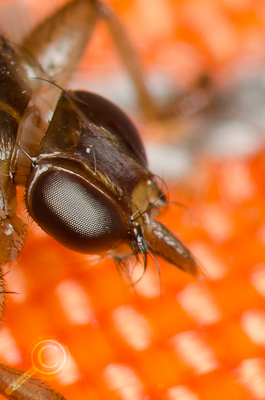
It seems that Hippoboscidae have a face that more than it’s mother can love, as everyone correctly guessed the right family! I can’t say I blame the enthusiasm surrounding this fly, as their morphological adaptations for living on birds are pretty amazing!
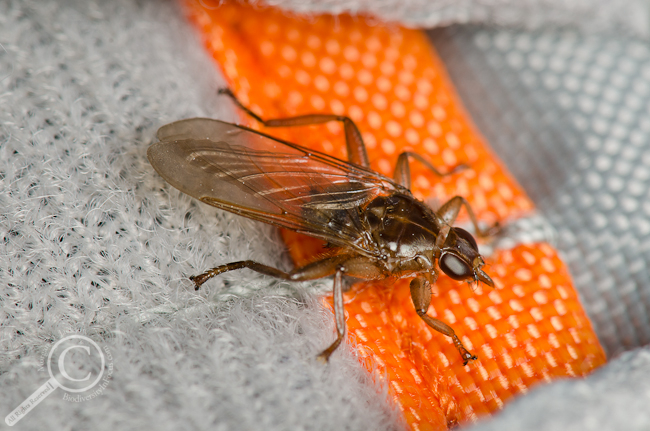
Icosta ardeae in a not-so-natural setting

Dorso-ventrally flattened to slide in amongst the feathers, plenty of thick setae on the thorax and abdomen which I assume are used for getting nestled in for the long haul, and trifurcated tarsal claws to hold onto their feathered hosts. Although I enjoy a morning bird watching from time to time, I’m not exactly a bird wrangler, so how did I come by this spectacular specimen? It seems my wife was putting out the bird vibes back in August while we were out hiking through Mono Cliffs Provincial Park (which is a fantastic hike by the way, definitely worth a visit if you’re in the area), and this fly latched on while we walked back to the parking lot.
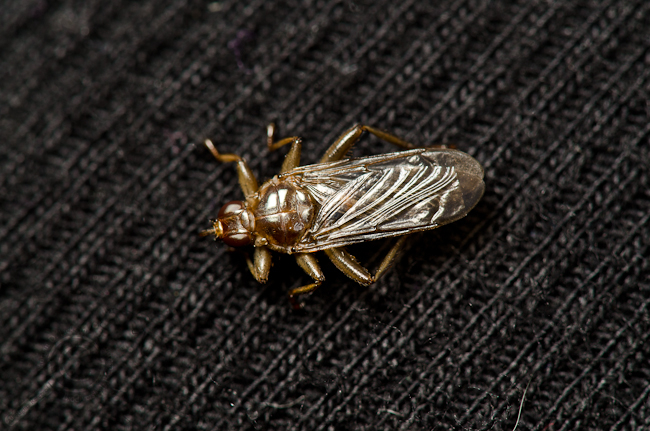
Icosta ardeae bird louse on shirt

Renee wasn’t all too impressed with her little hitchhiker, but I was ecstatic! I quickly scooped it off and put in my camera bag for a few snaps, all the while expecting it to get away. With these photos in hand, I threw it in my bag anticipating another opportunity to shoot it when I got home, but I guess all this excitement was too much, as it didn’t survive the car ride. Oh well, it found a good resting place in the Guelph Insect Collection, and also gave me a chance to identify it back in the lab.

Of course, that would prove more difficult than I had imagined, and I’m still not 100% confident in my final identification. The genus ID was relatively easy using the Manual of Nearctic Diptera, and I quickly had it keyed to the genus Icosta. That’s where the “fun” began however, as I tracked down the authoritative paper on Icosta taxonomy and biology published in 1969 by T.C. Maa of the Bishops Museum. Although the keys were well written and relatively well illustrated for a 1969 key, the characters needed for identification were anything but simple! I eventually ended up at Icosta ardeae (Macquart), although from what I could tell it was Icosta ardeae ardeae, a subspecies recorded from much of the Old World, ranging from the UK, down to South Africa and as far east as the Philippines and Australia! The other subspecies, Icosta ardeae botaurinorum, is listed as being known from North America, including Ontario, but the abdominal setae and wing shape illustrated just didn’t fit. Both species are known to choose herons as their preferred host, with I. a. botaurinorum breeding almost solely on American Bittern (Botaurus lentiginosus), which could very well have been lurking in the pond near the parking lot.

So what’s the deal; is it I. a. ardeae, or I. a. botaurinorum? I’m not a big believer in the idea of subspecies, so I’m happy simply calling it Icosta ardeae, but it speaks volumes about our understanding of the taxonomy of the family. Often found on birds (one of the best studied groups on earth), you would assume these flies would be as well studied and well collected as their avian counterparts, and yet I can’t get a definitive ID on one found 30 minutes from Toronto! Without any further taxonomic work since Maa’s 1969 revision, and with Maa leaving numerous species unnamed in his paper, simply calling them Icosta sp. “S” or sp. “N”, Icosta seems like a great project for someone interested in fly and bird taxonomy, and I could see a cool phylogenetic comparison between hippoboscid species and their avian hosts!

With that suggestion for the future, lets finish off the past and allocate some BioPoints! Chris scores a cool 15 points (3 for family, 4 for subfamily, 2 for being the first to answer and 6 for the review of hippoboscid larval biology), Laurie Knight picks up 8 (3 for family, 2 for picking a related species, and 3 for sharing her awesome photos of hippoboscid’s with mallophagan lice attached), Miles scores 3 points for his family ID, and Matt grabs 5 points (3 for family plus 2 for providing the morphological characters he used).

Thanks for playing once again everyone, and watch for more ID challenges in the near future (I mean it this time, I swear…)


All notes on taxonomy and biology of these flies was found in:

Maa, T.C. 1969. Revision of Icosta (=Lynchia Auctt.) with erection of a related genus Phthona. Pacific Insects Monograph 20: pg. 25-203.


Sep 272011
 

Ryan FleacrestOf all the insects that someone could write a song about, I would never have thought that crabs would be one of them. But I suppose some artists just need to scratch that itch!

Crabs (Phthirus pubis), also known as pubic lice, generally find new dance partners during the horizontal hokey pokey, so be warned that this post is heading towards the gutter…

Have no fear, taxonomy and phylogenetics to the rescue! The human pubic louse has but a single sister species, Phthirus gorillae. As you might be able to guess, P. gorillae is found on gorillas, and these two species last shared a common ancestor roughly 3-4 million years ago (Reed et al., 2007). For the record, gorillas and humans last shared a common ancestor ~7 million years ago. So our pubic lice and the gorilla louse didn’t diverge when we did, but at some later point while we were on our way to becoming human and pre-gorilla’s were getting more gorilla-like. Anyone else sensing some weird hanky panky going on here? Clearly a speciation event took place, and it seems that our ancestors (perhaps members of Australopithecus, of Lucy fame) were colonized by a louse native to pre-gorilla pubes. Although there are some rather tame theories on how we first contracted our own crotch crickets (gorilla’s being hunted, us sleeping in old gorilla nests, blah blah blah), it must be considered that perhaps there was a little “Jungle Love” going on back in the day…

Anyways, back to present day musical crabs!

In case you’re concerned, the crabs in that video weren’t the crabs I’m talking about (or the ones Rivers Cuomo was singing about), and earns a Myrmecos Taxonomy Fail Index number of 75.

All this talk about crabs reminds me that Bug Girl wrote an awesome piece on whether Brazilian waxing is taxing pubic louse populations (loss of habitat don’tcha know). Definitely worth a read.

And speaking of Brazilians, I’d like to wish our resident Brazilian (nationality, not hairdo) a fond farewell! After 4 long years of teasing from his lab mates, Gil Miranda successfully defended his PhD dissertation and is headed back to Brazil to begin what will surely be a long and successful career! Must… resist… crab… jokes…

This song is available on iTunes – Crab – Weezer (Green Album)

 
ResearchBlogging.orgReed, D., Light, J., Allen, J., & Kirchman, J. (2007). Pair of lice lost or parasites regained: the evolutionary history of anthropoid primate lice BMC Biology, 5 (1) DOI: 10.1186/1741-7007-5-7 OPEN ACCESS
 

Tuesday Tunes – Escapism (Gettin’ Free) – Digable Planets

 Fun Stuff, Insects, Pop Culture, Tuesday Tunes  Comments Off on Tuesday Tunes – Escapism (Gettin’ Free) – Digable Planets
Sep 202011
 

Ryan FleacrestWell, I’m back from a relaxing vacation with my wife at the family cottage, well-rested, recharged, and ready to dive back into my work with fresh eyes and new ideas! That goes for the blog as well, with inspiration for bigger posts and a themed week or two to come in the future!

Generally when you go on vacation it’s to escape from the stress and workload that comes with day to day life, so it’s somewhat fitting that today’s song is titled Escapism (Gettin’ Free). That’s not really entomological, and neither is the band name, Digable Planets, at first glance. But sometimes the sum of the parts are greater than whole, and Digable Planets is made up of Ishmael “Butterfly” Butler, Mary Ann “Ladybug Mecca” Vieira and Craig “Doodlebug” Irving! A triple threat of entomological nomenclature!

I’m a fan of nicknames, finding them considerably easier to remember (a task I’m normally horrible at), but how the 2 male members of the trio managed to acquire “Butterfly” and “Doodlebug” as their nicknames has got to be an interesting story…


This song is available on iTunes – Escapism (Gettin’ Free) – Reachin’ (A New Refutation of Time & Space)

Tuesday Tunes – Butterflies & Hurricanes – Muse

 Entomology, Environment, Pop Culture, Tuesday Tunes  Comments Off on Tuesday Tunes – Butterflies & Hurricanes – Muse
Sep 062011
 

Ryan FleacrestAs hurricane season arrives and dangerous storms approach the east coast of North America, it’s worth considering what causes these deadly cyclones. Not necessarily the warm waters off of Africa, but perhaps a butterfly on the other side of the world, whose flapping wings have set off an unpredictable set of events. Although the butterfly effect (as it relates to chaos theory, not that questionable Ashton Kutcher movie) may not be totally responsible for storms causing billions of dollars damage annually, the idea that simple atmospheric changes made by a flying butterfly can impact the total world is quite astounding.

Now to make you really think: as species become threatened with extinction thanks to human activity, how might a reduction or lack of these small atmospheric changes affect future weather patterns and civilization? Fewer storms? More? Who knows.

All joking and theorizing aside, if you or those you know live in places prone to hurricane or cyclone activity, please be safe in the coming weeks.

This song is available on iTunes – Butterflies and Hurricanes – Absolution

Aug 302011
 

Ryan FleacrestAnother week, another tune! Sarah Brightman’s The Fly


It’s also time for another ID Challenge:


Time to earn some more BioPoints! Provide as many taxonomic or biological notes you can think of, and I’ll dole out the points! Good luck!

(I’m taking a page out of Ted’s book and turning on moderated comments so everyone has a chance at some points!)