As I mentioned yesterday on Tuesday Tunes, I’m heading West this weekend to partake in the Entomological Society of America Annual Meeting in Reno, Nevada. Besides marking my first time in the Pacific Time Zone, this conference will also be the first time I’ve given a triplet of talks at a conference, as I’ve been invited to give 3 talks in 3 different symposia! Chronologically, here’s my talk schedule:
Sunday Nov. 13 — Citizen Scientists in Entomology Research (Room A2, First Floor)
11:35-11:55 — “CJAI & citizen science – putting the “public” in publication” – M.D. Jackson & S.A. Marshall
 Abstract: The Canadian Journal of Arthropod Identification (CJAI) is dedicated to providing high- quality, peer-reviewed identification aids to allow naturalists of all levels access to North America’s biodiversity. With papers published by both funded and unfunded professionals and shared online as 100% open access, CJAI has been referenced by scientists around the world, and has assisted countless “amateurs” in identifying specimens and photos. In the information age, CJAI unlocks the gate to biodiversity and democratizes the identification of insects and arthropods around us. Examples of published and upcoming publications and the impact they are expected to have will be presented.
Here’s a little announcement for you; I’m the new Technical Editor for the Canadian Journal of Arthropod Identification, where I’ll be taking over from Dave Cheung as he moves on to a new job in Copenhagen! He’s left some pretty big shoes to fill, but I’m really looking forward to contributing to the running of the journal, and will be discussing how CJAI is a great resource for citizen science projects. Also, expect plenty more info on CJAI coming up in the near future here on the blog!
 Sunday Nov. 13 — Myths, Misconceptions, and Mental Modifications: Identify, Clarify and Speak Out about Entomology (Room A13, First Floor)
14:50-15:05 — “The Social Entomologist: How connecting with social media can benefit your research program” – M.D. Jackson
This is a similar talk to the one I gave at the Entomological Society of Ontario AGM a few weeks ago (which was a great meeting and something I’ll write about soon), where I’ll be discussing the power of social media for entomology research and discussing how you can incorporate social media into your project. This is a topic which I find really interesting, and hope to do a week-long series of posts shortly after my return from Reno to share and expand on some ideas I have!
 Wednesday Nov. 16 — Biosurveillance: Using a Native Wasp Cerceris fumipennis to Find Emerald Ash Borer and Other Species of Buprestidae (Room A12, First Floor)
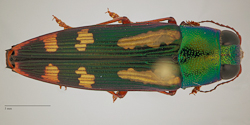
16:30-16:50 — “A Field Guide to Northeastern Jewel Beetles: Identifying the prey of Cerceris fumipennis including both native and invasive species of Buprestidae” – M.D. Jackson, S.M. Paiero, & A. Jewiss-Gaines
This is a project I’ve been working on for over a year now and which I’ve been unable to publicly discuss until now. Myself, Steve Paiero and Adam Jewiss-Gaines, in collaboration with the Canadian Food Inspection Agency, are putting the final touches on a massive field guide to the Buprestidae of Northeastern North America, which should be in print in early 2012! With over 450 pages of colour illustrations, this field guide is designed to allow forestry professionals, border inspection agents, researchers and naturalists alike to recognize these beautiful yet economically important beetles, and features some stunning images and identification resources which I’m very proud to be a part of! Again, I’ll be sharing plenty more information here on the blog regarding the field guide, and hope to start showcasing some of these beautiful beetles which are found in our own backyards!
Between my talks I’ll be running around like a mad man trying to take in as many presentations, posters and other events as I can. Here are a couple I’m especially looking forward to:
Mon. Nov. 14 – 11:03-11:15 — Descriptions of Glyphidops flavifrons (Bigot) (Diptera: Neriidae) – Charity G. Owings
Tue. Nov. 15 – 9:40-10:00 — Design and development of web-based identification tools for wood boring beetles: a case study – Eugenio H. Nearns
Tue. Nov. 15 – 10:00-10:20 — A traditional taxonomists view on modern web-based insect identification — Charles O’Brien
Tue. Nov. 15 – 15:35-15:50 — Sharing the wonderful world of insects via the internet – Brett R. Blaauw
Tue. Nov. 15 – 17:05-17:20 — Operation global insect media domination: the adventures of Bug Girl – Bug G. Membracid
When I find a moment to breathe I’ll be checking on the multiple poster sessions (there are a bunch of Guelph students sharing their work this year) as well as scoping out the vendors, job bank and pretty well anything else I happen to wander into! And guess what! I’m taking you all with me, digitally speaking. I’ll be doing much the same as I did for my trip to Costa Rica last summer, providing a nightly report of the day’s activities, but I also hope to tweet my way through the conference as well, sharing all sorts of interesting insect news and science with you! If you’ve considered joining Twitter, perhaps this would be a good time to do so, just don’t forget to follow me @BioInFocus!
After the meeting concludes, a friend and I are going to take a mini road trip to do some exploring, so hopefully I’ll have plenty of new photos to share on my return.
It’s shaping up to be a crazy week, but I’m excited to take it all in, and I if you’ll be in Reno make sure to say hello!