ESA Day 3 – The Student Sessions

 Cool Science, Entomology, Life as a Grad Student, Meeting, Trip Report  Comments Off on ESA Day 3 – The Student Sessions
Nov 152011
 

Today was a bit of an oddity for a large meeting; the morning was chalk full of talks and poster presentations, but absolutely no scientific content all afternoon, but rather full of societal business meetings. This means I ran around like mad all morning and then sat on my hands all afternoon, so it’ll be a bit of a light review today.

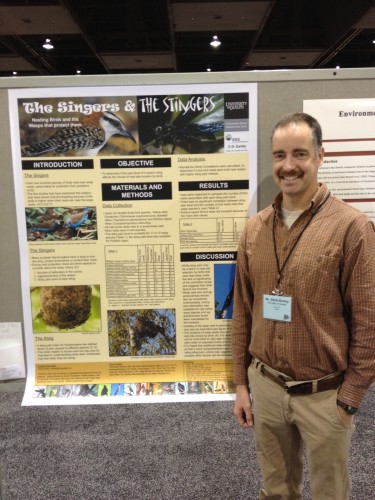
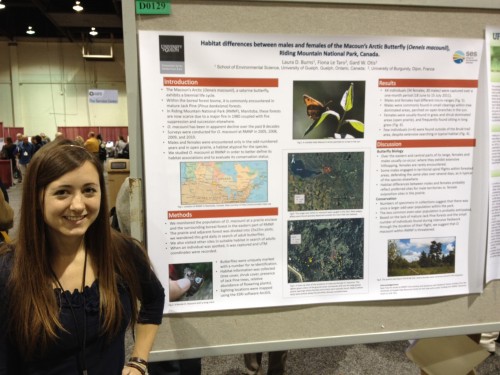
As I mentioned, all of the student talks were this morning in order for the President’s Prizes to be awarded this evening. I ended up sitting in on 9 or 10 talks as well as exploring the poster session, so I was able to get a pretty good feel for the level of proficiency displayed, and was it ever high! I don’t think I went to a single talk or saw a single poster which I wasn’t inspired or awed by! Everyone seems to be doing fantastic research, whether revising Neotropical cicada taxonomy, studying the evolution of eusociality in carpenter bees, or exploring the relationships of Australian horse flies, every talk I sat in on had me entertained and curious about the hypotheses they were working on! Not only were the talks well presented, but the slides were well designed, and the research given in an understandable medium, immersing the audience in the project at hand. There was even a student describing the puparium of a North American Neriid fly (a group of flies very closely related to the Micropezidae I study)! I couldn’t have asked for a better morning of talks!

I just wanted to mention how great the new ESA Ento-2011 iPhone App is! It has allowed me to easily keep track of when and where I want to be, who’s speaking and what their talk number is, which I found to be a good way to keep track of citations on Twitter. Normally I’d need to fumble around with my big book of titles, switching pages and losing my spot while wasting valuable talk time, but the app has done an amazing job of keeping me on track and in the right room. Kudos to the ESA for developing and sharing a great tool!

Over lunch I took in the vendor displays again now that there weren’t as many people hanging around, and then looked into the ESA Career Center to see what sort of positions were available. Turns out that it’s not a good time to be looking for an entomological job or graduate position, as there were very few advertisements this year! The last time I was at ESA the binders were stuffed full of job, faculty and graduate postings, but this year there may have been 2 dozen total, with very few looking for ecologists and none interested in taxonomy. Whether this is a normal pattern and we’re in a lull, or whether this is a delayed effect of the economic downturn, I’m not sure, but it was a little disheartening. I suppose it can only get better from here, right?

After finishing up the slides for my last talk, I met with Ignasi Bartomeus (@ibartomeus), a pollination ecology post-doc at Rutgers who I’ve been corresponding with on Twitter since Sunday, to have a beer and talk insects. We had a great discussion about the value of social media for public outreach and the value of natural history collections to ecologists. It was enlightening conversation for me, and one that wouldn’t have happened had I not traveled to Reno, or hadn’t been using Twitter! Social Media for the Win again!

Finally, I met with the rest of the Cerceris fumipennis research crew for a brainstorming session on how to continue the work and discuss Wednesday’s symposium. We ended up crashing the Arkansas/Auburn/Clemson/Tennessee Alumni Reception (shh, don’t tell) and sat in the corner discussing new ideas for the next field season. If you want to see some passionate, dedicated entomologists committed to a research project they fully believe in, then you should come out Wednesday afternoon in room A12 for the Biosurveillance symposium!

Tomorrow is an extremely full day, with talks in almost every slot that I am looking forward to seeing! I’ll be taking plenty of notes, that’s for sure!

Jul 092011
 

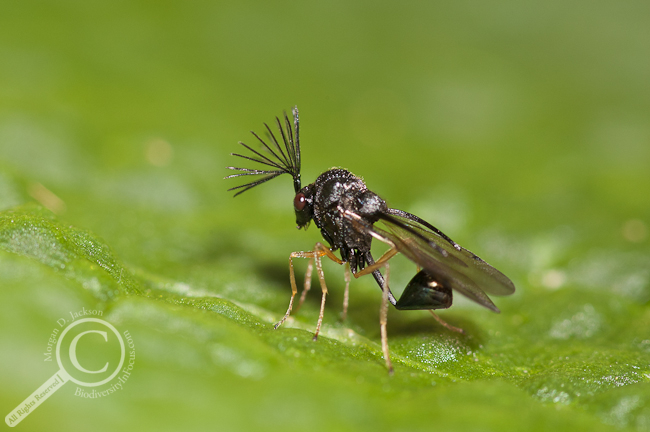
Chalcidoid wasp from Ecuador


What’s this antlered little wasp you may be asking yourself? To be honest, I have no clue! Probably something in the Chalcidoidea, but really, I have no idea.

What I do know is there’s somewhere I could go to learn all about these endearing little wasps, as well as their larger yet equally diverse parasitic brethren. That place? The HYM Course, offered by a collaboration of top hymenopterists from around the USA. This course was designed to teach you how to identify parasitic Hymenoptera, and provide information on the phylogenetic relationships between groups, as well as the behaviour, biology and host interactions which make these wasps fascinating.

The course is being held August 14-20 at the Humboldt Field Research Institute in beautiful coastal Maine, and looks to be a good time, with lessons taught in the field, in the lab, and in the classroom. The enrollment is limited to 14 people (with 5 instructors, that promises plenty of 1-on-1 interaction), and there are still several spaces available from what I’ve been told. If you’re a naturalist, insect photographer, graduate student or professional entomologist who wants or needs to learn more about parasitic Hymenoptera, then this course is a steal for gaining valuable knowledge and making important connections with some of the world’s leading taxonomists!
For more information, and to find out how you can enroll and begin exploring the Parasitica, check out the promotional PDF. Contact any of the instructors listed at the bottom of the flyer to enroll or to receive additional details!

Jul 042011
 

Science 3.0 Blog Winner IconJust a quick post to relay some exciting news. I recently entered a number of my scientific paper reviews in the Science 3.0 #Bugs Blog Contest, which ran for the month of June, and just today found out that my post discussing the Fly Tree of Life project was chosen as the winning contribution!
My effort was but a single post, and there are a bunch of great entomological entrants that you should go and check out immediately. It’s great to see so many people interested in the science of insects and relaying their excitement via blogging. Thanks to the group over at Science 3.0 for running the contest and for the first place honours, and congratulations to all the entrants for their great work!

This month’s contest is centered around Dinosaurs, so be sure to watch for some spectacular posts on giants of the past! Also, check out the advertisement, featuring art work by the talented Torontonian, Glendon Mellow!

The winning post can be found here if you’d like to give it a read – The Fly Tree of Life – Big Science, Big Results?

Jun 082011
 

With new identification aids, entomological collections begin to give up all manner of hidden treasures. The “Miscellaneous” drawers are no longer out of reach, and determining the species found in your own backyard (sometimes literally) can result in surprising finds.

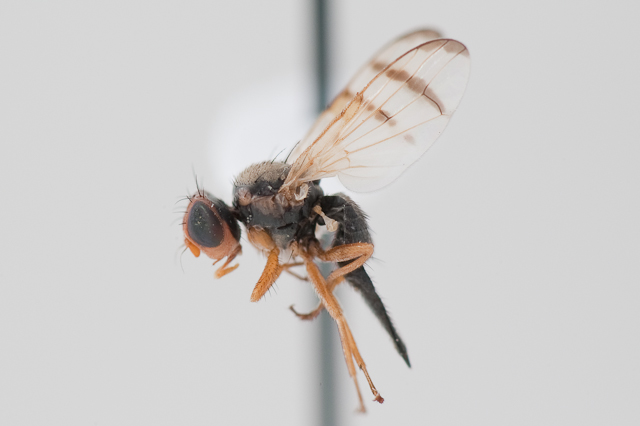
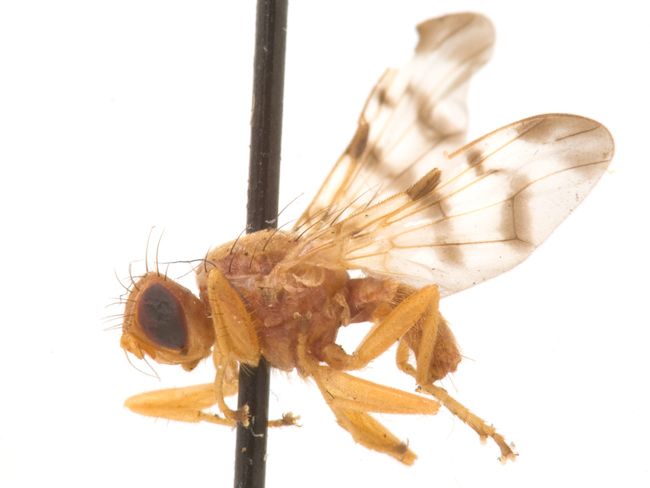
Rhagoletis meigenii Tephritidae

Rhagoletis meigenii

Rhagoletis meigenii is an introduced species from Europe which infests fruits of European barberry (Barberis vulgaris) as larvae. This species had previously been recorded in North America as early as 1986, but after examining specimens from the Lyman Entomological Museum and here at the University of Guelph Insect Collection, I found specimens collected as early as 1956 in Montreal, Quebec and 1977 in Oakville, Ontario! This indicates that it had made it’s way to North America much earlier than previously thought, and either spread extremely rapidly across eastern North America, or had multiple introduction events! Luckily this species isn’t of economic concern (European barberry fruits are eaten and used in jams in Europe, but the plant harbours wheat rust and is considered noxious in North America), but it indicates how easily a non-native species can slip into a new area unnoticed by scientists and society.

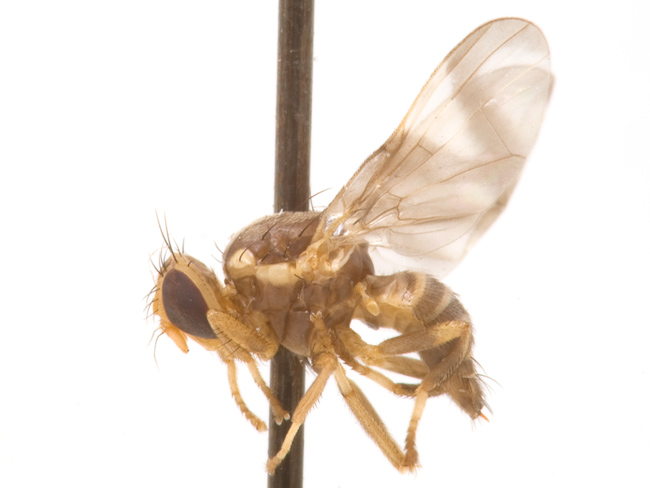
Urophora affinis Tephritidae

Urophora affinis

Not all fruit flies enter North America “illegally” though. All three species of Urophora found in Ontario are native to Europe, but were intentionally introduced to help control unwanted, invasive knapweed species. Two of the species introduced became established and quickly spread through southern Ontario (Urophora cardui and Urophora quadrifasciata) while one species didn’t appear to survive. Urophora affinis was experimentally introduced in western Canada where it seemed to thrive, but after release in the early 1980’s at a research plot in Hastings County it failed to be found the next few years, leading the researcher to assume the population hadn’t survived the winter. But, a fly collected 250 km away and more than 20 years later in Simcoe County made it through the curatorial stream, and low-and-behold it was Urophora affinis! Apparently this species did in fact survive the winter, and managed to spread at low population density across central Ontario.


Rhagoletotrypeta rohweri Tephritidae

Rhagoletotrypeta rohweri

Finding flies thought to be gone is unfortunately not as unlikely as it may seem. Rhagoletotrypeta rohweri is a rarely collected species that hadn’t been seen since 1962. Or at least it hadn’t been thought to have been seen since then! The University of Guelph Insect Collection actually has 4 specimens collected between 1978 and 1985 around Point Pelee National Park. Hopefully this is evidence that this species is still clinging to existence in small pockets of eastern North America!


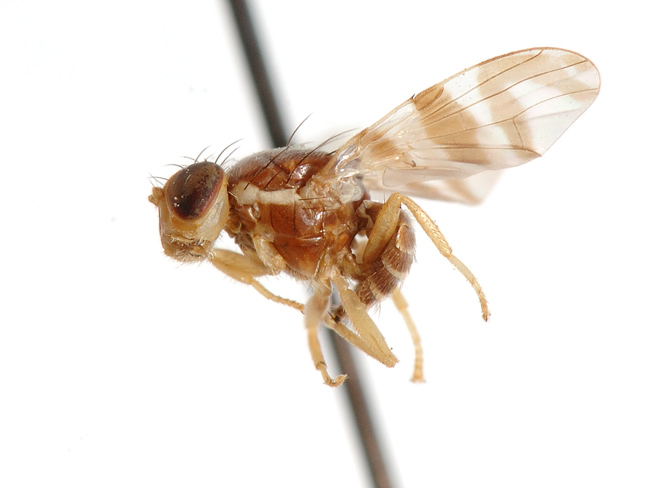
Rhagoletis chionanthi

Rhagoletis chionanthi

To round out some of the important species uncovered during this study, here’s Rhagoletis chionanthi. This species had previously only been recorded from North Carolina and Florida, making it’s presence in Ontario a significant expansion of its natural range! Of course this also begs the question as to what it’s using for a larval habitat; the only recorded host plant for R. chionanthi is Chionanthus virginicus (see what they did there, naming the species after its host? Crafty taxonomists…), a plant species which hasn’t been recorded from Canada yet! So what may be happening here? Has the plant expanded it’s range into Canada, bringing it’s pest with it? Or does Rhagoletis chionanthi have multiple hosts? Of course, the apple maggot fly, Rhagoletis pomonella, actually underwent a host-shift from hawthorn to apples when the latter were cultivated in North America, so perhaps Rhagoletis chionanthi has undergone a similar host-shift which we aren’t aware of!

Of course none of these records would have been possible without the entomological collections housed at universities or under provincial or federal care. At a time when taxonomy and natural history collections are devastatingly under funded (or threatened with military take-over), their intrinsic value is made clear through faunistic studies such as this. Who knows what other treasures are awaiting discovery in entomological collections, both large and small? New species await description, rare species make surprise appearances, and the dynamics between species and geography are unfolding with every study!

May 302011
 

Normally I’m pretty excited to see a new identification guide published in the Canadian Journal of Arthropod Identification; I get to see great images of insects I haven’t come across (yet), ID any of my photos which I couldn’t previously, and just have something new to read that I find especially interesting. The most recent publication is a little more exciting for me however, as I’m the lead author and it marks the culmination of several years work! W00t!

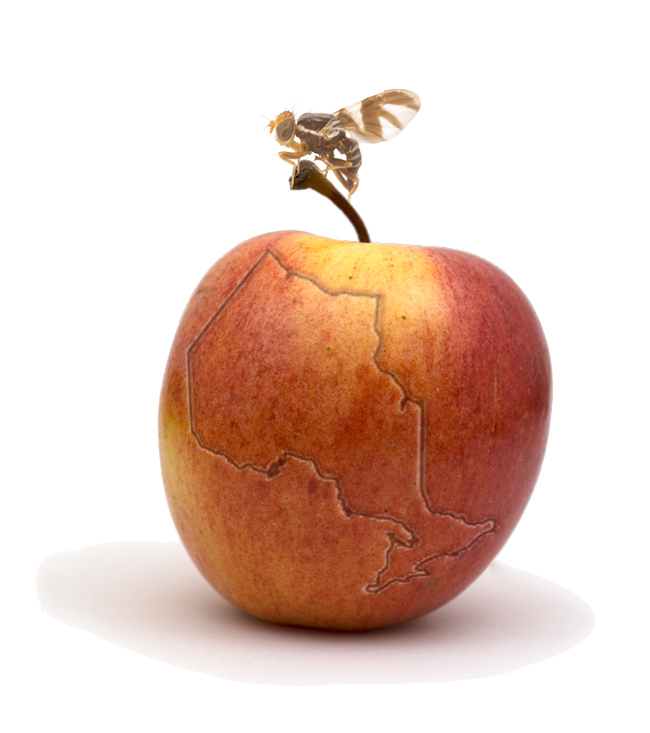
Without further ado, I present to you the Fruit Flies (Tephritidae) of Ontario! I’ll be going over the different aspects of the paper all this week; today focusing on the identification tools, Wednesday on a few of the important species, and Friday I’ll talk about how it’s relatively easy to contribute to CJAI!


Apple maggot fruit fly on apple with map of Ontario inscribed in it Continue reading »

Key to World Genera and NA Species of Clusiidae – CJAI Vol. 14

 Cool Science, Natural History, Publication, Review  Comments Off on Key to World Genera and NA Species of Clusiidae – CJAI Vol. 14
May 042011
 

The latest volume of the Canadian Journal of Arthropod Identification was published today, and it’s one of the most visually compelling keys published so far! Allowing you to identify all the world’s genera of Clusiidae as well as the species found in North America, this new key provides plenty of fantastic photos, an awesome layout and functionality, and something not yet utilized in CJAI papers, a Lucid™ Matrix key. While I’m personally not a fan of Lucid™ products in particular, matrix keys provide users an open-ended path to identification, increasing the chances of a correct identification.

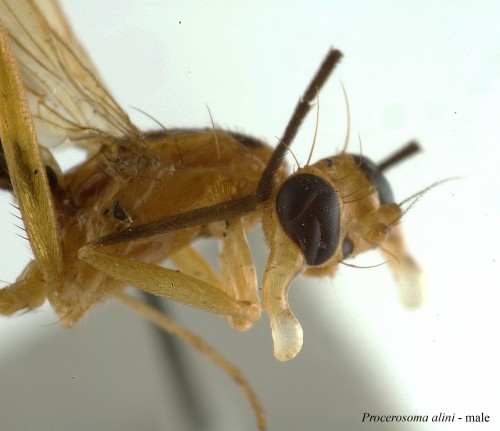
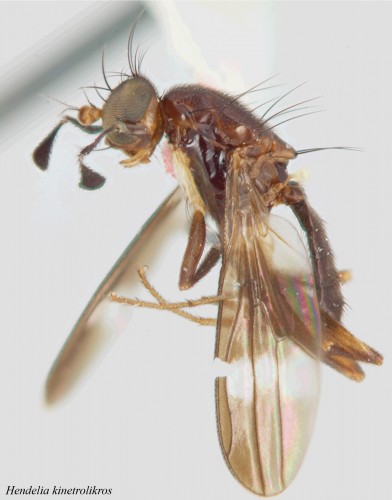
While clusiid flies aren’t necessarily the most frequently observed flies, they are nonetheless fascinating, featuring some incredible behaviours. One of the few acalyptrate families to defend lekking territories, males will take up residence on sunny stretches of logs or dry forest floors and battle with other males for prime areas. Check out the battle gear on these two males:

Procerosoma alini male head - Lonsdale et al 2011

Procerosoma alini male head - Lonsdale et al 2011

Hendelia kinetrolikros - Lonsdale et al 2011

Hendelia kinetrolikros - Lonsdale et al 2011


Continue reading »

Apr 112011
 

This post is going to be longer and a little more technical than normal; feel free to jump in and out, or just check out some of the photos on your way to the conclusions. Although I may come across as critical and occasionally cynical at times, I’m not picking on anyone just to be a thorn, but rather to promote scientific discussion; I fully encourage you to join the discussion in the comments section. Finally, in the spirit of full disclosure, a portion of my graduate research was funded via the NSF Tree of Life grant behind this paper (although neither myself nor my research contributed to this project in any manner that I’m aware of), and one of my academic advisors is a co-author on the paper.

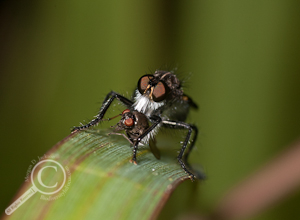
Asilidae with Prey - Ecuador

Robber Fly with Prey - Asilidae - Ecuador

Despite my best efforts here at Biodiversity in Focus, research on flies very rarely makes the mainstream media (besides mosquitoes, malaria and Drosophila of course), so when one of the most important papers on fly evolution was released and started making the science blog circuit, I was excited to see people taking an interest in Dipterology! There was one problem however, which is not limited to the blogosphere and this paper, but has been an increasingly common trend in insect systematics: the blind acceptance and assumption that a new phylogeny is the definitive answer because the researchers used an ever increasing number of genes. One influential blogger, who’s also an evolutionary entomologist, summarized the results of the Diptera tree of life as such:

But they’re solid results, since they’re based on lots of molecular data and the branch positions are well supported.   — Jerry A. Coyne, Ph.D

Similarly, the research team who published the tree are encouraging the idea that their results are infallible by labeling their work the “New Periodic Table of Flies”. A bold statement, and one that many taxonomists might be hesitant to make as it implies that they don’t expect future studies to return different relationships, much as the periodic table of chemical elements is not about to change. An analogy like this requires a strong body of evidence to support it, so let’s take a look at what they did and how the Diptera family tree looks!

Continue reading »

Jan 272011
 

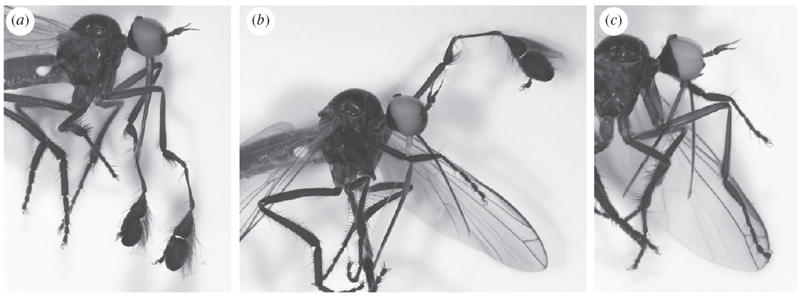
Flies are cool. You might even say they’re phat (I know, I’m pretty fly for a white guy). But a newly described dance fly species (Empididae) from Japan takes the term “phat” to an all new level. Meet Empis jaschhoforum:

Empis jaschhoforum male morphs from Daugeron et al. 2011

Figures 1a-c from Daugeron et al., 2011

Continue reading »

Jan 202011
 

Lately I’ve showcased a number of scientific papers that I’ve dubbed “Cool Science”; today is no exception, except this paper is cool for what should be all the wrong reasons. But let me start at the beginning.

Continue reading »

Jan 052011
 

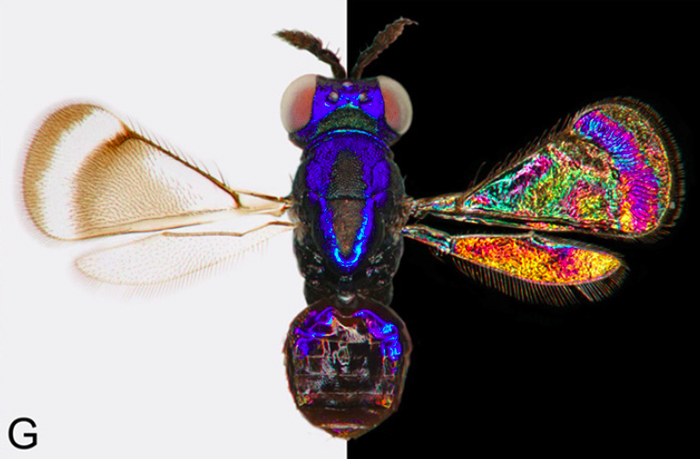
Back in August, while at the International Congress of Dipterology in Costa Rica, I reported on a new species identification technique using some pretty sophisticated technology (i.e. a black piece of paper). The study was published today in PNAS (open access), so I thought I’d revisit it in more detail as our cool science of the week!

Shevtsova et al., Fig. G, 2011

Fig. G from Shevtsova et al., 2011

Continue reading »