Jul 232012
 

Happy (Inter)National Moth Week!

National Moth Week

The organizers of National Moth Week have done a great job getting people to volunteer to do public moth-related events, so check to see if there’s something going on in your neck of the woods. If there aren’t, that doesn’t have to stop you from mothing; go hang out at bright lights just after dark and see what you can find!

This week should be pretty fun, and I’m going to try and get out at least one night to see if I can’t add to my abysmally poor list of moth photographs, and will try and tweet any encounters I have with moths throughout the week. I’ll also be contributing any new sightings to Project Noah and iNaturalist, so feel free to follow along with me there.

I’ve successfully ignored the Lepidoptera thus far in my entomological career, so I’m taking this opportunity to do a little learning and see if I can’t improve on my moth ID skills. I’m going to be posting photos of moths throughout the week, some from North America which I’ve been able to identify, and some from my tropical travels which I have no idea about. If you notice that I messed up an identification, please feel free to gloat and mock my error; perhaps it’ll teach me not to ignore an entire order of insects from now on…

Oh, and because I can’t completely turn my blog over to moths, I’m going to be featuring their dipteran parasites whenever possible, so expect plenty of tachinid talk this week too!

Happy Mothing! :)

Jul 212012
 

Exciting news since the last Weekly Flypaper: Piotr Naskrecki, orthopteroid taxonomist, photographer, and author (Relics and The Smaller Majority) has started a new blog — The Smaller Majority. So far Piotr has been killing this whole blogging business, with fascinating posts on tropical entomology and macrophotography tips. I’m pretty sure I bookmarked every post he made for future reference, but here are a few of my favourites:

Now onto the rest of the best from the last 2 weeks!

General Entomology

If you ever need a gift idea for the Dragonfly Woman, she’s got a nice wishlist of field guides that any nature nut would appreciate.

Speaking of gifts, we’re right in the midst of wedding season, and if you need nuptial gift ideas, why not take a page out of the insect world.

Erica McAlister, the Diptera curator at the Natural History Museum, London, takes you on a backstage tour of the NHM insect collection and shows off some spectacular specimens, including a grasshopper hugging a mouse. Seriously.

What’s the biggest bug? The North Carolina State University Insect Collection has a couple of options to answer that.

Entomology is a hobby all unto its own for some people, but it also happens to be a sub-hobby for some fly fisherman!

My wife and I had a date night this week and went to see The Amazing Spider-Man. I really enjoyed it, but was a little disappointed that Peter Parker didn’t snack on a fly or two at some point in the movie. Even if you’re not an arachnid-infused superhero, there’s no reason why you shouldn’t consider eating bugs as Doug Yanega explains to the University of California Food Blog. The Weird Bug Lady even has a tasty sounding recipe for entomological power bars to get you started!

Flies – Diptera

Apparently I missed the memo about Photo Bombing blogs, as Matt Bergeron, Dave Stone and Alex Wild all showed off gorgeous photos of bombyliid bee flies.

Brian Brown is having a pretty good month for publications, with his latest discussing phorid flies which are parasites of endangered ants.

Researchers have bred “super” smart fruit flies which can count. I for one, welcome our new Dipteran overlords.

Black flies take the majority of bad press for Northern pests, but don’t forget to watch out for moose flies while in Alaska.

Robber flies are popular with a lot of people, including devoted beetler Ted MacRae. And with their own special facial hair, the mystax, it’s no wonder.

The Geek demonstrates that sometimes when you’re photographing flies, you’re only able to snipe one photo before they take off.

Beetles – Coleoptera

Emerald Ash Borer (Agrilus planipennis) has continued it’s inevitable march across eastern North America, this week being detected in Connecticut for the first time. What’s important about this is that Cerceris fumipennis, a solitary wasp which specializes on buprestid jewel beetles, was the first to detect it’s presence in the state. This is the sort of Bio-surveillance that Phil Careless and the rest of Team Cerceris had hoped for, and now hopefully more government agencies will invest in expanding this simple monitoring tool.

Cerceris fumipennis is also a useful tool for collecting other jewel beetles besides EAB as Ted MacRae recently found out.

Of course you don’t need to always rely on other species to find your jewel beetles for you, as the Geek reminds us to always look.

Some people can be picky eaters,  but the same holds true for dung beetles, with species preferring different types of brown sauce, and Bug Girl is on it.

Why might it matter what type of dung a beetle prefers? Because places like Australia and New Zealand don’t have any native dung beetles, making agricultural waste a significant problem. Becky Crew has a nice feature on the work being done to bring dung beetles to New Zealand.

Not all scarab beetles like to feed on dung though, like these Green June Beetles that Derek Hennen found in his yard.

With summer comes the opportunity to watch fireflies flashing in the night. Check out this nice flash guide to see if you can recognize any of the species in your backyard, and contribute to a citizen science program.

Ants, Bees & Wasps – Hymenoptera

This photo of a flying bumblebee by Adrian Thysse might be the best of it’s kind that I’ve ever seen.

The Gratton Lab at the University of Wisconsin – Madison is working on an automated bee identification project.

Urban beekeepers in Edmonton are pushing for changes to bylaws that keep their hives in hiding.

Meanwhile in Edmonton, Matthias Buck has discovered 2 new species of paper wasps right under our noses.

The School of Ants is holding a student essay contest with a nice cash prize.

Eric Eaton shows that solitary wasps can be used for monitoring other insects, like stink bugs (potentially including the mega-pest Brown Marmorated Stink Bug) or membracids.

Moths & Butterflies – Lepidoptera

National Moth Week is coming up this week, so expect most of the bug-blogosphere to get a little scaley!

The Dragonfly Woman started a little earlier by announcing an event she’s helping with at her new job.

Other Insect Orders

Troy Bartlett thinks ants mite do a better job of taking care of their herds of membracids.

Ever wondered why your car attracts some insects like dragonflies and horse flies? The Dragonfly Woman has a great explanation.

It looks like the Cleveland Museum of Natural History is becoming ground zero for mantid research in North America.

The Neuroptera are an amazing group of insects with incredible diversity. Jonathan Wojcik provides a nice overview of that diversity, and introduced me to an amazing group called the Spoonwings (family Nemopteridae). Brian Cutting showed off a member of another one of my favourite groups, the Mantis flies, while Derek Hennen found a spectacular antlion adult.

Spiders – Arachnida

“Oh look at that lovely lady beetle! It looks so cute and cuddly and OH MY GOD!!!”

Next time I go to Chicago, I’m definitely rewarding the Chicago Hilton with my business for being so awesome with their natural history and outreach!

I hate when I get a spider web across my face while out walking in the woods, but I think I might have to learn more about spiders and their webbing from a book Bug Girl recently reviewed, Spider Silk by Leslie Brunetta and Catherine L. Craig.

Now if all spiders lived among the canopy of trees like this Hentzia mitrata that Chris Buddle and colleagues are studying, then I wouldn’t have to worry about silk wrapping my face…

Speaking of Chris, he went, he saw, he videoed; Beringian pseudoscorpions in the Yukon that is!

Taxonomy & Systematics

A parasitic isopod was recently described and named after Bob Marley. Too bad the authors messed up and published the name a few months earlier in an ecological paper before formally describing it. Everybody repeat after me — in taxonomy, the order in which you publish or publicize MATTERS.

Of course, because this species was named after somebody famous, the media took off with it and the BBC published a top 10 list of what I’m now going to start calling “Celebronyms”. Have I mentioned how much I hate these top 10 species lists lately? Because I do. With a passion. Ugh.

Where should money be invested to solve the taxonomic impediment? Quentin Wheeler of Arizona State University thinks technology leads the way (i.e. the University of Arizona’s new funding to revitalize and digitize their collection), while Bob Mesibov of the Queen Victoria Museum (Tasmania) argues that more taxonomists need to be hired first. Me? I think technology will be useless if there’s no one around to develop, maintain and actually use it. I’ll also need a job in 3-5 years, so I might be a bit biased here.

The Willi Hennig Society Meeting was held at the end of June, and Itsy Bitsy attended. So did Salva at Computer Cladistics, who has a fantastic detailed review of the conference.

Kevin Peterson is literally uprooting the mammal phylogeny with a new technique he’s developed. My question is what makes this new technique more accurate to the true evolutionary history of the mammals? Micro-RNA is also being used to study Diptera evolution, but I can’t understand why it’s considered more “accurate”. It’s a wonder I get any sleep at all with these types of questions rolling around in my head…

Does the way that we traditionally draw and think of phylogenies (i.e. a “tree” of life) block us from considering new ideas on relationships?

Academia

My post on Citations, Social Media & Science gathered some attention last week, including that of the researcher who’s improperly cited blog started the whole discussion. The author of the paper also stopped by and explained they tried to include the citation, but the publisher wouldn’t allow a blog to be cited like a journal. I’m not really sure why a publisher has so much control over the content of a journal rather than the editorial staff of said journal, but I find it troubling.

This is pretty handy for people just starting out in academia/grad school – Field Guide to Scientific Conferences: An Ecological Review.

Also handy, this complete walkthrough by Steve Hamblin on laying out and developing a poster for a conference. Many, many good tips here for balancing form and function. It’s also a pretty interesting view inside the head of a Post-Doc…

It’s good to remember that it matters how you write in academia, not just what you write.

Science Communication & Social Media

Bora Zivkovic (aka the Blogfather) drops a massive backgrounder on the history and rise of science blogging.

I’ve seen a bunch of people start blogs only to watch them peter out after a few weeks/months. As a blogger who has a relatively small (yet loyal) readership, I can sympathize with this post on Why Blogs Fail.

Here’s 10 Apps That Put Science In Your Pocket.

Dr. Olin Sander compares Twitter popularity during the recent Evolution meeting in Ottawa to a sage grouse lek. Awesome.

Photography

Ted MacRae demonstrates why the placement of your lighting sources and choice of background can have a dramatic effect on a photo’s feel.

Alex Wild has a nice flowchart of his digital darkroom workflow.

Adrian Thysse has a lovely interview with renowned nature photographer Heather Angel.

Other Fun Stuff

David Winter does a great job of explaining why red heads are here to stay. Looks like my wife won’t be getting rid of me that easily!

This fish grows ant-shaped appendages to get laid. I feel like there’s an inappropriate joke in here somewhere…

Who needs cable TV when you can get all kinds of drama & comedy from social media?

Aquaman makes a terrible marine mammal. He also makes a terrible superhero.

What would happen if a pitcher threw a baseball at 90% of the speed of light? I suspect he’d be investigated for Perfomance Enhancing Drug use and never make it into the Hall of Fame.

Video of the Week

Carl Zimmer was a plenary speaker at the annual meeting of the Society for the Presevation of Natural History Collections a few weeks ago, and they just posted his talk on YouTube. It’s long (more than an hour), but it’s an interesting talk and well delivered.

Further Reading

Bora Zivkovic – The Science Blogging Weekly, July 13th 2012 – (I made the Top 10 posts list! W00T!)

Ed Yong – Missing Links, July 14, 2012

Ed Yong – Missing Links, July 21, 2012

Jul 182012
 

I’m filing this story under “Cosmic Awesomeness”.

While I was perusing Twitter this afternoon, Dr. Matthew Francis, a physicist/science writer who I follow, randomly started spurting out astronomical terms for fun1. One of those terms was Musca, which obviously got my attention in a hurry, and I asked what was so astronomical about a common genus of flies (you can read the full conversation at the bottom of this post)2.

Turns out Musca happens to be a constellation of stars observable in the Southern Hemisphere! It was “described” in 1597 or 1598 by Petrus Plancius, a dutch astronomer who clearly has an excellent imagination. Although it was originally called Apis (the Bee), it was changed to Musca (the Fly) in 1752 to avoid confusion with the nearby constellation Apus (literally “no feet”, in honour of birds-of-paradise, which at the time were believed to footless). But why name a constellation after an insect? Plancius named a neighbouring constellation Chamaeleon and decided it would need a source of food!

Besides being a really cool constellation, Musca also contains a binary object of a star being consumed by a black hole, as well as a couple of beautiful galaxies.

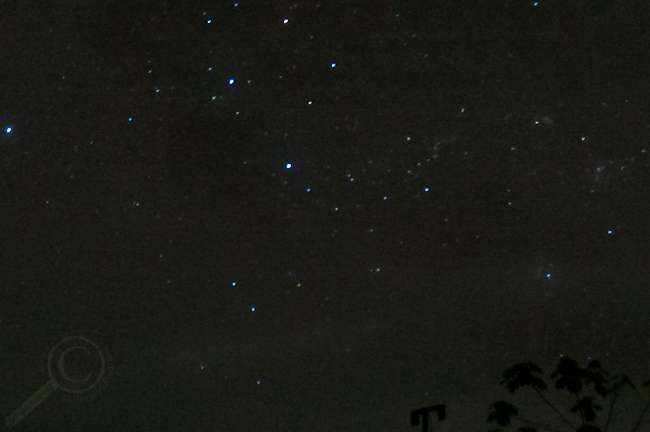
Seeing as I’m kind of a fan of flies3, I checked to see where the constellation was located so I could look for it the next time I’m on the southern half of the planet. Much to my delight, Musca is found immediately “below” the Southern Cross, the only constellation I knew about in the Southern Hemisphere, and something which I had not only seen before, but had photographed!

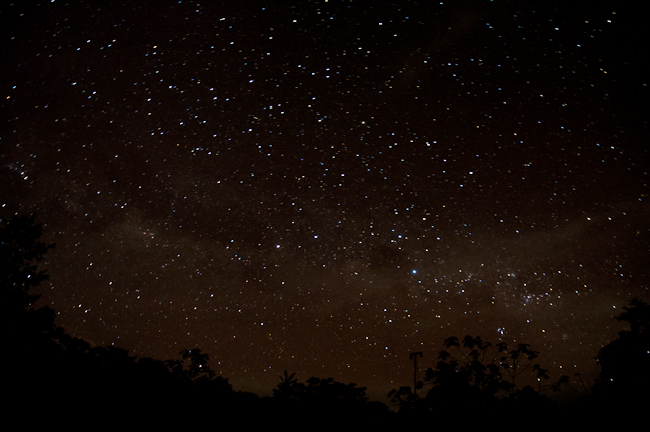
I quickly opened Lightroom to check my photos of the Southern Cross and see if I could make out Musca, and wouldn’t you know it, I found it! Not only that, I got good photos of it, and not just from one location, but from 2 totally different countries on 2 totally different trips! SWEET!

Milky Way & Musca - Peru Bolivia Stars

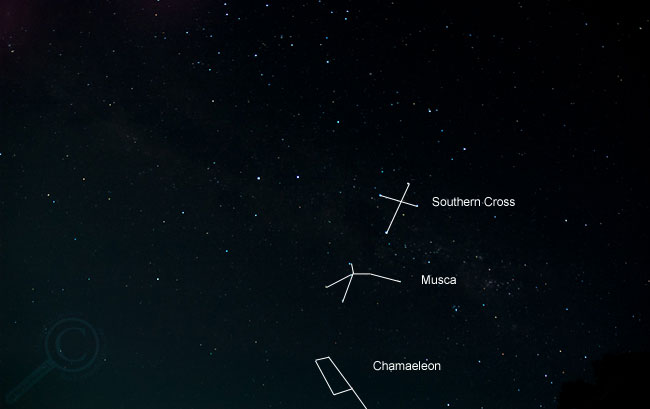
The Southern Cross, Musca and Chamaeleon over the Heath River

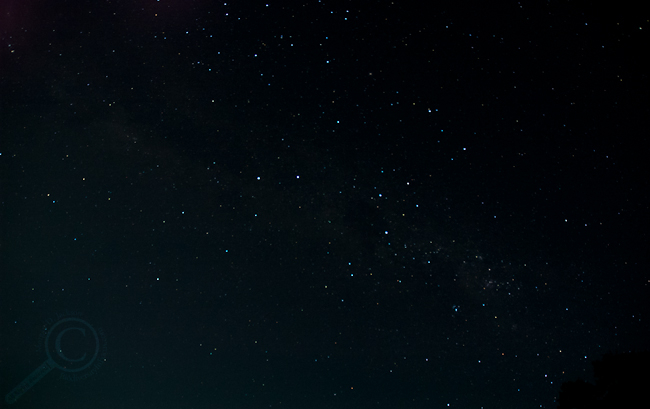
This photo was taken at the Heath River Wildlife Center on the border of Peru & Bolivia in 2007. In case you can’t see a cross, a fly or a chameleon, here they are with appropriate lines:

Milky Way & Musca - Peru Bolivia stars constellation

The Southern Cross, Musca & Chamaeleon over Peru & Bolivia

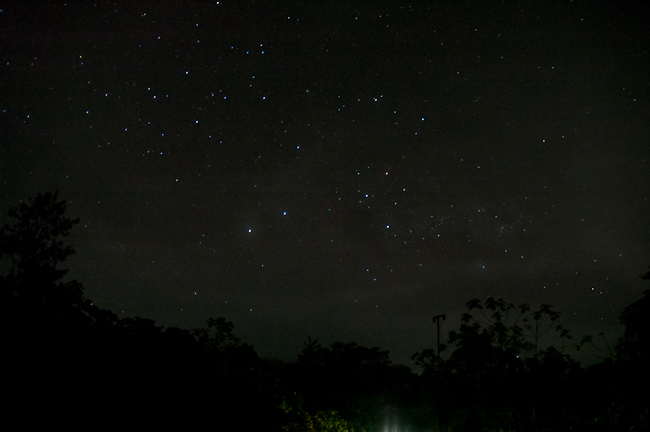
Not only did I manage to capture this celestial fly in Peru, but I also got photos of it in Ecuador while looking for real flies in 2009.

Southern Cross & Musca over Ecuador stars constellation

The Southern Cross & Musca over Yasuni Research Station, Ecuador

Here’s a massive crop showing the Southern Cross and Musca more closely:

Southern Cross & Musca - Ecuador stars constellation

The Southern Cross (top) with Musca (bottom half and faint) over Yasuni Research Station, Ecuador

When out in remote dark-sky locations deep within the Amazonian jungle, both constellations are visible to the naked eye, but picking them out from several thousand other stars and the Milky Way is a bit more of a challenge.

Musca with Milky Way - Ecuador

Musca within the Milky Way – Yasuni Research Station, Ecuador

I can’t wait to get back to South America to collect & photograph more flies, both the corporeal ones within the jungles of Earth and the shiny one above it!

—————————————

1- I don’t know either, it must be a physicist thing. They’re all about the entropy I hear…

2- Another excellent example of the scientific benefits of Twitter.

3- This may come as a surprise to many of you, I know.

http://storify.com/BioInFocus/social-media-among-the-stars

Jul 112012
 

This morning I was reading a newly published paper that I found intriguing, not only for its content1 but also for who it cited — sort of.

Among the regular cadre of peer-reviewed journal articles supporting the author’s findings were two blog posts by University of Glasgow professor Roderic Page. Rod is a major proponent for digitizing and linking biodiversity literature with all aspects of a species’ pixel-trail across the internet, so I was excited to see his blog being “formally” recognized. As I finished reading the paper and reached the References section, I skimmed through to see how a blog citation might be formatted. Much to my dismay, after breezing through the L’s, M’s, and N’s I found myself within the R’s, with nary a Page in sight.

Despite having directly referenced Rod’s work on three separate occasions, the authors failed to formally acknowledge his contributions to the field. I may still be a little wet behind the ears in this whole academic publishing game, but I suspect that if someone didn’t properly cite a Nature paper, they’d be quickly reprimanded by the editor of the journal they submitted to and be told to include the citation or face rejection.

I’ve been thinking about this situation all day, and I can’t come up with a reason why the author’s didn’t include a proper citation, other than the continuing bias against blogging (and social media in general) among the scientific community. Certainly there are those in the scientific community who realize the potential of social media and blogging in science2, but in large part it seems the message is being ignored because of prejudices regarding the medium in which it’s published.

But why do scientists have such a hard time accepting blogging & social media as valid outlets? It can’t be because of the holy peer-review process, as Bora Zivkovic3 elegantly points out:

“One of the usual reasons given for not citing blog posts is that they are not peer-reviewed. Which is not true. First, if the post contained errors, readers would point them out in the comments. That is the first layer of peer review. Then, the authors of the manuscript found and read a blog post, evaluated its accuracy and relevance and CHOSE to use it as a reference. That is the second layer of peer-review. Then, the people who review the manuscript will also check the references and, if there is a problem with the cited blog post, they will point this out to the editor. This is the third layer of peer-review. How much more peer-review can one ask for?”

There’s also plenty of evidence that the content being produced by today’s bloggers, tweeters and G-plussers is slowly earning the attention of the academic community. Kate Clancy, a tenure-track anthropologist who blogs at Context and Variation, had someone skim one of her blog posts and intellectually plagiarize her ideas by publishing them in a traditional journal, further evidence that “attention” doesn’t necessarily mean “respect”. Just this week Eric Michael Johnson, a science history PhD student, wrote an incredible article summarizing the arguments between kin vs group selectionists and published it on his blog, The Primate Diaries; it has since been recommended by E.O. Wilson himself, via his Facebook fanpage no less! And of course there’s Rod’s work which was included in the paper in question, even if it was improperly cited, and which started this entire digression.

So if the quality of content published on blogs is of interest, well supported and being recognized by our peers, why do we still see this disconnect between traditional literature and social media when it comes to proper credit? I think the social media movement4 is so new, seemingly free of traditional rules & roles and so quickly evolving that many academics have yet to take the time to explore its potential before dismissing it as a waste of time best reserved for celebrities and teenagers. Frankly, with the ever increasing pressure to publish, find funding and shoulder more responsibilities within academic circles, I can’t say I totally blame them. But just like those in academia have (mostly) accepted and embraced other technologies, I’m confident that social media, including blogging, will find its place among the scientific community and will revolutionize the ways we go about doing, discussing and disseminating scientific research. Certainly it will be an uphill battle for those who aspire to change the way this new technology is perceived and credited within the academic community, but ultimately I think it’s in all our best interest to push the boundaries!

Perhaps Rod Page summarized this entire post in a single tweet:

———————-

1- Which I won’t comment on here for a variety of paranoid political reasons, but I would still highly recommend you read the paper.

2- I’m talking about you, the people (person?) who took the time to read this blog post; thank you!

3- Nicknamed The Blogfather among the ScienceOnline community, he also appears to have the distinction of having the first blog post cited by a technical scientific article. Fitting.

4- Which is exactly how I see it. Much like the cladistic wars of the 1980s and the Darwinian debate 100 years before that, it’s only a matter of time until social media is embraced by the scientific & academic communities.

Jul 082012
 

I was going through my photos today for a project and happened across one I completely forgot I had taken:

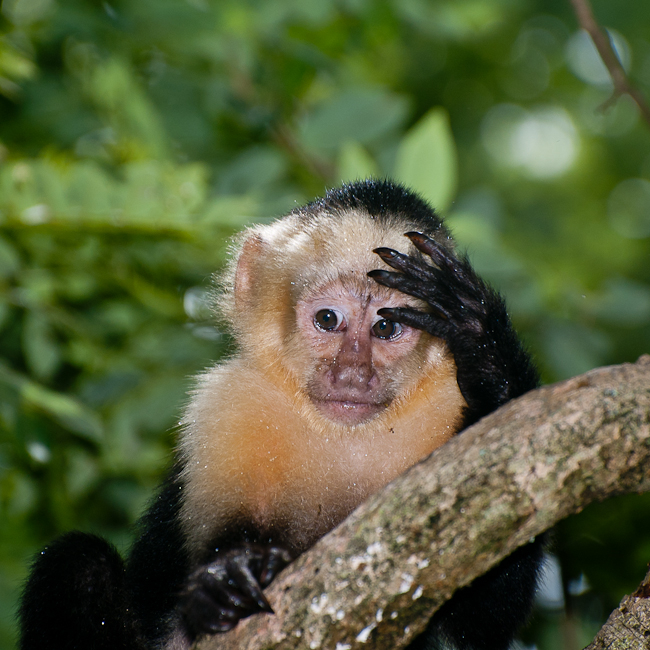
#MonkeyFacePalm

Taken in Area de Conservacion Guanacaste, Costa Rica, this white-faced capuchin monkey (Cebus capucinus) and its troop stumbled across our group while we were hilltopping for flies. Clearly this one thought we looked like fools swinging nets around while wearing our ridiculous field clothes. On reflection, I can’t say I really blame it, we probably did look odd.

I’ve left my usual watermark off the photo because I think everybody could use a little  Monkey Face Palm from time to time. Feel free to download and use this image however you see fit, whether in blog posts, on Facebook, as a Twitter rebuttal, or printed out and given to friends/colleagues/students when they do something dumb!

I just ask that if you happen to make money from it, you ask me first and share the spoils, because I’d hate to #MonkeyFacePalm myself for missing that opportunity…

Jul 072012
 

Evolutionary biologists from around the world have converged on Ottawa this weekend to partake in the First Joint Congress on Evolutionary Biology. Luckily for those of us who couldn’t make it, there are a ton of people tweeting about talks, the conference and evolution in general. I’ve been watching the #evol2012 hashtag all morning while writing this, and although I’m even more jealous of those that are attending the conference in person, I’m glad I can enjoy a slice of the conference through the tweets of others!

General Entomology

There was plenty of talk about national insects this week. I brought up Canada’s distinct lack of a national insect over at ESC Blog, while Brian Cutting noted how lame many of the state insects are in the US. Meanwhile, across the pond, Africa Gomez found some insects who had come out to celebrate the UK’s National Insect Week.

Charley Eiseman has a fun party trick: watch a walking stick emerge from it’s egg and then get guests to try and figure out how the hell it fit in there to begin with!

While teaching this winter, my students were equal parts horrified and fascinated when we talked about entomopathogenic nematodes. I can’t wait for them to read Ed Yong’s story about the glowing green bacteria who lend a deadly hand.

Dragonfly Woman continues to find cool stuff at her new job, including a magnificent phantom midge larva!

Unlike Gatorade, which fails to contain any actual alligator, Chapul energy bars will contain plenty of ground up crickets to help keep you jumping!

The Amazing Spider-man was released this week and looks great, but I kind of wish Peter Parker had been bitten by any of these other superpower-inducing arthropods.

Diptera

An amazing new fly was described this week by Brian Brown, and now ranks as the smaller species of fly we know of at only 0.4mm long! Brian has an excellent write up of his discovery over at flyobsession, and he also posted a bonus illustration of the fly which wasn’t in the paper.

The Geek in Question was asked what a strange looking aquatic arthropod was.

Dave Stone got up close and personal with a Diogmites robber fly.

In what was easily the most galling post of the week, Charley Eiseman explores the hickory homes of flies.

The Home Bug Gardener starts with a pretty picture of a flower fly, but soon begins an etymological exploration into the meaning behind Syritta pipiens.

Everytime Africa Gomez posts a photo of beautiful fly like this Scaeva pyrastri, it makes me more determined to get to the UK and see some of these things for myself!

And just to further established which order is truly the best:

Boo yah!

Hymenoptera

Fresh off the pixels, Siricidae of the Western Hemisphere was just published in Issue 21 of the Canadian Journal of Arthropod Identification. Including a number of new nomenclatural changes, new species descriptions and beautifully illustrated keys to all of the horntail wasps found in the New World, I highly recommend you check this one out as a sterling example of where taxonomic monographs are heading in the digital age.

If an ant could sneeze, I imagine it would look a little like this.

Arachnophobic statistics professor Dan Gillis discovers he’s sharing his home with mud daubers (Sphecidae) and finds himself in conflict about whether to remove his new neighbours.

Adrian Thysse has a great photo of an aphid-killer that doesn’t get much recognition.

Pretending to be a part of the pack, Takashi Komatsu exposes other interesting imposters amoung army ant raids.

Proof that even honey bees suffer from petty sibling rivaly.

Coleoptera

I’m excited to see so much entomological love at Scientific American Blogs now that Becky Crew has joined the team. Her piece on colour changing tortoise beetles is an absolute must read!

It’s that time of year again when fireflies start making yards and urban parks a veritable orgy of light displays!

A wonderful short story by Derek Niemann about a beetle attempting to climb a blade of grass.

Ted MacRae is running an ID Challenge this week with a twist!

Other Arthropod Orders

Bug Girl is in top form as she asks whether stick insects can really mate for 1400 hours.

Will the Sea Grape Flatid become a pest in the US one day? Ted MacRae worries it might, and he has some nice photos to help people keep an eye out for it.

What do dog-day cicadas and the Teenage Mutant Ninja Turtles have in common? Ask Brian Cutting.

Atlantic Canada had 3 endemic butterflies to call their own, until a keen butterfly collector in Maine went and found one of them just within state lines. Nice post by U of Guelph Diptera alum John Klymko in his new role as director of the Maritime Butterfly Atlas.

Chris Buddle is off to the Yukon in search of a neat Beringian pseudoscorpion.

Taxonomy/Academia

Kai Burington shares his thoughts on the “Do species names need to change?” thread from last week.

On Thursday, University of Wisconsin PhD candidate (and science communication proponentJacquelyn Gill defended her thesis and streamed the entire process live over the internet! She did a great job, and I really enjoyed seeing how her live-stream worked, as it’s something that I am hoping to do at the conclusion of my PhD1.

Rosie Redfield (of #ArsenicLife renown) shares some very helpful tips for coming out of your shell and connecting with other people at scientific conferences. I’m pretty bad at this sort of thing, but I’m looking forward to trying some of her tips out this fall!

Science Communication

Christie Wilcox has launched a new wiki to help scientists interested in using social media for science communication find the tool that works best for them.

Although not a scientist, Moose Peterson is a highly published wildlife & conservation photographer who regularly blogs about his work. This letter from one of his reader’s is a perfect example of the power that a blog can have in affecting people’s lives.

If you’re a grad student, you’re probably well aware of PhD Comics and their eerily accurate portrayal of grad student life. A new contest from PhD comics wants to turn YOUR THESIS into an animated comic!

Other Fun Stuff

How useful are those middle-school career aptitude tests? Marine biologist David Shiffman found his old report and puts it’s utility and advice to the test.

Apparently biodiversity ads don’t make enough to warrant inclusion by Google Ads as Chris Clarke found out.

Cuttlefish are much too clever for their own good.

This portrait of a spring peeper (Pseudacris crucifer) by TGIQ is absolutely stunning.

Your thesis can be a comic, but why not submit your own identity to Jason Hogle for the chance to become a character in his upcoming novel series!

In one of the most creative and touching pieces of feature journalism I’ve ever read, the Toronto Star turns up at a woman’s funeral and writes a beautiful biography of her life by interviewing her friends & family.

I leave you today with an interview that John Klymko gave to The Weather Network about record butterfly numbers in the Canadian Maritimes.


Further Reading

Ed Yong – Missing Links – July 7, 2012

Bora Zivkovic – Scienceblogging Weekly – July 6, 2012

—————————

1- Not sure whether I’ve explicitly mentioned this here on the blog, but I’m starting my PhD at the University of Guelph in September! Lots of work to finish up before then, but I’m really excited to become a student again. :)

Jul 022012
 

I’m over at ESC Blog today writing about Canada’s lack of an official insect. I provide a few potentials, but more importantly I want to hear from you about what you think would make a good national insect!

I’m not-so-secretly lobbying for a fly, but I swear I’ll be unbiased in the discussion. Well, I’ll try to be at least.

An Insect for Canada – ESC Blog

Jul 012012
 

Parliament Hill & Canada Day StageWhile working on my MSc in Ottawa back in 2008, my wife-to-be and I decided it would be appropriate to celebrate Canada Day on Parliament Hill with thousands of our fellow Canadians1. After spending a beautiful day taking in our country’s history with a full range of festivities including the RCMP Musical Ride, a stellar concert series that ran all afternoon, and speeches by politicians and other notable Canadians, we settled on the main lawn in front of the Peace Tower for an evening concert series and some killer fireworks. Continue reading »