Dec 232010
 

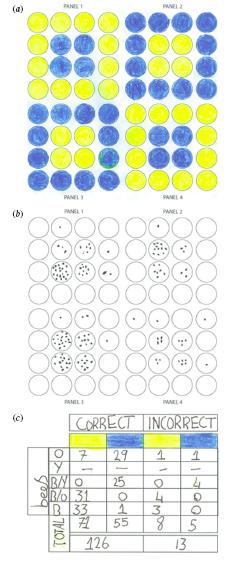
Ever wish you didn’t need those pesky references, formal writing style, or time consuming computer graphics when going to publish your work? A new study published in Biology Letters demonstrates that as long as your science is well done, nothing else matters. The project I’m referring to was done by a group of 8-10 year old elementary school children under the guidance of an ophthalmology professor at University College London (Dr. Beau Lotto), and studied the ability of bumblebees to utilize colour and spatial information while foraging. There have been papers published in the past by student researchers, but what makes this paper special is that the students not only helped with the experiments, but dictated the actual paper itself over a Coke at the local pub and hand drew the figures!

Figure 1 from Blackawton Bees (Blackawton P.S. et al)

Figure 1 from Blackawton Bees (Blackawton P.S. et al)

There are absolutely no references within the paper as it was argued that the comprehension level of the background material was beyond that of the research group, and ultimately irrelevant to their experimental design and conclusions. Likewise, the writing itself is refreshingly simple and full of truths that many researchers (or at least many grad students I know) can’t put into their papers. My favourite quote (discussing the need to train the bees prior to experimentation):

We did this so that they would learn not to go just to the colours, but had to learn the pattern. Otherwise they might fail the test, and it would be a disaster.

It apparently took Lotto 18 months to find a journal willing to accept it for review given its unorthodox style, with the likes of Nature, Science and pLOS One turning it down before the Royal Linnean Society agreed to run with it. Biology Letters included several independent commentaries on the paper vouching for the novelty of the study. The research itself is a nice little example of citizen science, and worth a read all on its own, but the style in which it was presented is a huge paradigm shift for the scientific community. While I wouldn’t want this sort of publication to become commonplace, it does illustrate that just because someone doesn’t have the resources of an extensive library or 8 years of postgraduate work (heck, even a high school diploma) behind them, doesn’t mean they have nothing to contribute to our understanding of the natural world. The kids say it best:

Science is cool and fun because you get to do stuff that no one has ever done before.

Reference:

Blackawton, P. S., S. Airzee, A. Allen, S. Baker, A. Berrow, C. Blair, M. Churchill, J. Coles, R. F. J. Cumming, L. Fraquelli, C. Hackford, A. Hinton Mellor, M. Hutchcroft, B. Ireland, D. Jewsbury, A. Littlejohns, G. M. Littlejohns, M. Lotto, J. McKeown, A. O’Toole, H. Richards, L. Robbins-Davey, S. Roblyn, H. Rodwell-Lynn, D. Schenck, J. Springer, A. Wishy, T. Rodwell-Lynn, D. Strudwick and R. B. Lotto “Blackawton bees.” Biology Letters.

http://rsbl.royalsocietypublishing.org/content/early/2010/12/18/rsbl.2010.1056.abstract

Thanks to Danielle Fife for passing along the story!

Dec 082010
 

If you ask any Dipterist which fly species they daydream about collecting, most will likely respond with a dazed smile and choose Mormotomyia hirsuta (family Mormotomyiidae). This little beast has only been collected twice (once in 1934 and once in 1948) and is believed to live within a single 1 metre wide crevasse on a hilltop in Kenya. This enigmatic fly has been searched for on several occasions since, but each excursion has been unsuccessful.

Continue reading »

Dec 022010
 

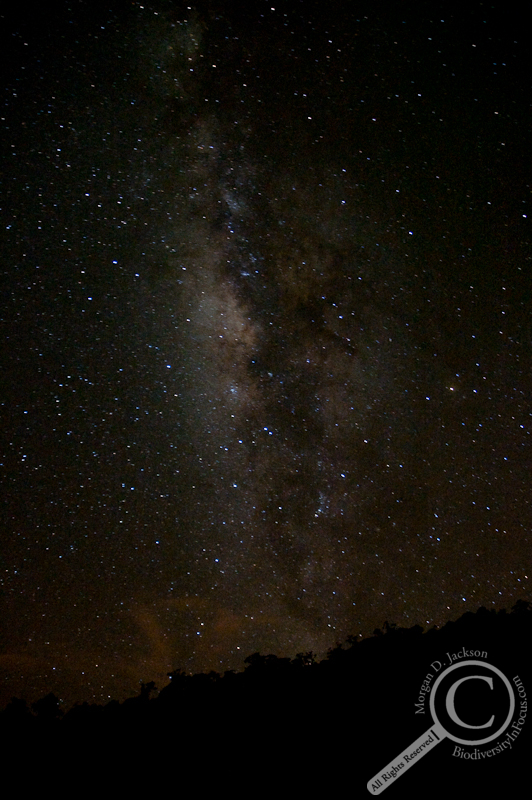
Milky Way Galaxy over the jungles of Costa RicaNASA has called a big news conference for this afternoon to discuss a new discovery in the field of Astrobiology (the science of extraterrestrial life) for this afternoon at 2pm. Leaked stories are reporting that NASA scientists have discovered a new life form in Mono Lake, California. Reportedly this life form is arsenic-based, unlike every other animal, plant, fungi and bacteria on the planet which is phosphorous-based. Tune in here to watch along.

The implications of such a find are beyond huge, if true! Does this mean life on Earth has arisen twice in 2 totally different ways (take that ecology and niche partitioning)? Is it extraterrestrial seeding (is the truth really out there)? Either way, phylogenetics and the taxonomic structure as we currently know it (Domain, Kingdom, Phylum, etc) has no room for independently derived life forms, necessitating an entirely new and parallel taxonomic lineage. Not to mention the fact that if it’s happened here there is no reason to assume that it hasn’t happened someplace else in the universe!

I’ll be live-blogging throughout the news conference and trying to provide insights into what this means for taxonomy and science in general. Stay tuned as the world learns of this new life! I encourage everyone to join the discussion below in the comments! Until then, live long and prosper and let the force be with you! (You knew the geek quotes were coming at some point didn’t you?)

Update (1:30pm, Dec 2, 2010): The cat’s out of the bag, and it’s certainly not the white tiger it was made out to be. While the early media reports I read ranged from the extremes of NASA actually finding life on other planets to the story I reported above, in actuality researchers did not discover a new arsenic-based life form, but rather forced an extremo-phile bacteria from Mono Lake to survive on arsenic rather than phosphorous. Even then there are conflicting reports on how much arsenic the bacteria are actually incorporating into their biochemistry. Needless to say I’m fairly disappointed, but I’ll leave that for a more in depth discussion later this afternoon. I’ll still be reading the paper and watching the news conference in case there is something interesting to report, but don’t expect a new taxonomic hierarchy this week!

Update (2:30pm, Dec 2, 2010): Well, that confirms it. The bacterial strain in question (GFAJ-1) was found to live in the mud of Mono Lake, where the concentration of arsenic is higher than most other aquatic habitats, and the researchers decided to see how far they can push the bacterium’s flexibility in accepting arsenic. By slowly weaning bacterium cultures from high phosphorous-content growth medium to low phosphorous-content they found the bacteria could survive and incorporate arsenic into the different cellular and molecular components necessary for life (nucleic acids, proteins, etc).

Update (2:35pm, Dec 2, 2010): I’m going to be candid here, and point out that the lead researcher, Felisa Wolfe-Simon, is coming across as really condescending. I imagine she’s trying to relate her results in a way that laypeople can easily understand (including referring to these bacteria as “bugs”… science fail) but her inflection and attitude is coming across as condescending in my mind.

Update (2:45pm, Dec 2, 2010): They’ve brought a phosphorous expert in who is going on and on about the potential for using arsenic-based life forms to solve the impending phosphorous shortages caused by the agricultural revolution. Not sure how he expects to incorporate arsenic-laden plants into our diet, seeing as it’s extremely toxic as repeatedly stated throughout the news conference. That’s also assuming that you could get non-arsenic adapted plants to accept it in the first place (remember, toxic).

Update (2:50pm, Dec 2, 2010): That was patriotic. She just made clear that all this research was done by Americans, on American soil, and using American dollars. I wonder if she’s worried about US congress criticizing her work on astrobiology like ant workers were criticized for working on ants from outside of the US of A!

Update (3:00pm, Dec 2, 2010): I believe it was USA Today that just phoned in and called out the research team of over-hyping their research and the reaction of the readers looking for proof of alternate life or aliens! I’ve got to agree with them on that (and I’ll bring that up when this circus is over). The researcher’s reply even included a plot line from Star Trek to explain how, although they didn’t find aliens, they now have more options when searching for life.

Final Update and Opinions: That brings this underwhelming scientific discovery to a close. When I first came across the story this morning, I was in awe that perhaps we’d have definitive proof of independently evolved life (whether native to Earth or elsewhere) and all of the implications I outlined originally. As more and more of the research was made available however, I couldn’t help but become frustrated and disappointed, not only with the media (which I expect to sensationalize news to garner attention), but especially with the scientists who allowed and, in some sense, promoted this wild speculation to increase their exposure. Is it any wonder that a large portion of the general public is dubious of science and it’s “wild” and “exaggerated” claims on climate change, extinctions, and now life? Perhaps it’s because I come from a scientific field that is largely ignored by the populace, but grandstanding with big claims and minor results seems like a waste of everyone’s time. Sure there are pressures on young researchers to establish a reputation for themselves, but at who’s expense? Their colleagues? The media? Or worst of all, the public? I’m of the firm belief that your science should speak for itself, without needing to resort to wild media campaigns, vague releases promising big results, or the fall back of “this has so much future potential”.

With that rant aside, I do think that this research is exciting (in a different way than originally), especially if they are able to back up their claims on the full integration of arsenic into biological systems. I’ve long been a believer that there is life in the universe beyond Earth, and have always been confused by astrobiologists saying that finding the exact conditions believed to be necessary for life (oxygen, phosphorous, liquid water, etc) are like a needle in a haystack. Why can’t something evolve to exploit a silicon environment where the mean daily temperature is 100°C? It’s often said that nature abhors a vacuum, so why provide limits on what conditions you believe are required for life to survive? This research lays the groundwork that these alternate hypotheses on the origins of life are feasible and that although alien life is still a matter for science fiction, the day is quickly approaching when we’ll be able to accept an independently evolved life form as scientific fact.

Oct 312010
 

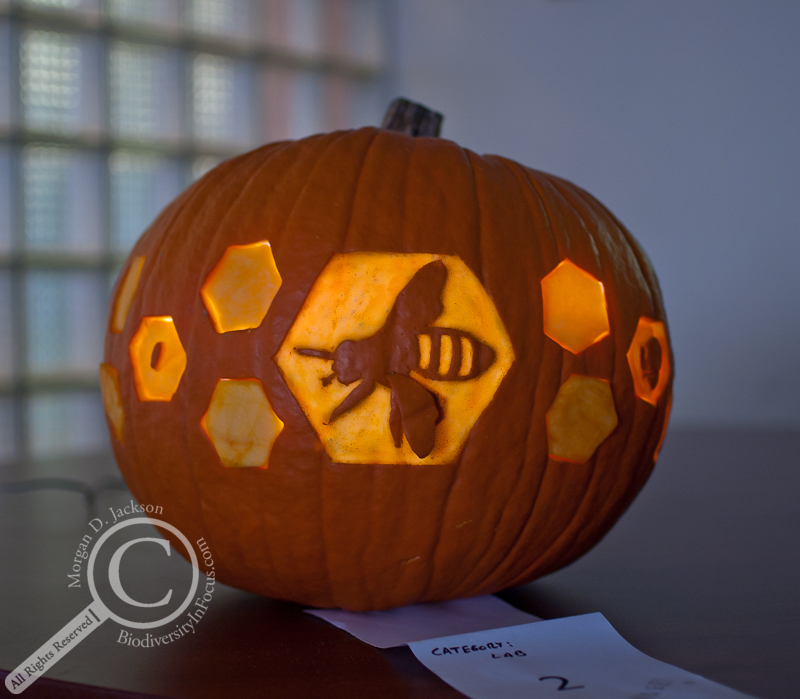
Although we had a good time carving our various insects Thursday night, we still had to come up with a new pumpkin design for our department’s contest Friday afternoon. With a pumpkin supplied by the graduate student council and 2 hours to carve our winning design, the pressure was on to uphold our title as pumpkin champions! After a strategy session over coffee, we decided to bee proactive and get busy.

Bee Pumpkin Jack-o-Lantern

Continue reading »

Oct 272010
 

Having found success with our jumping spider, we ventured further into the realm of morphological correctness, and constructed an ode to our advisor, Dr. Steve Marshall:

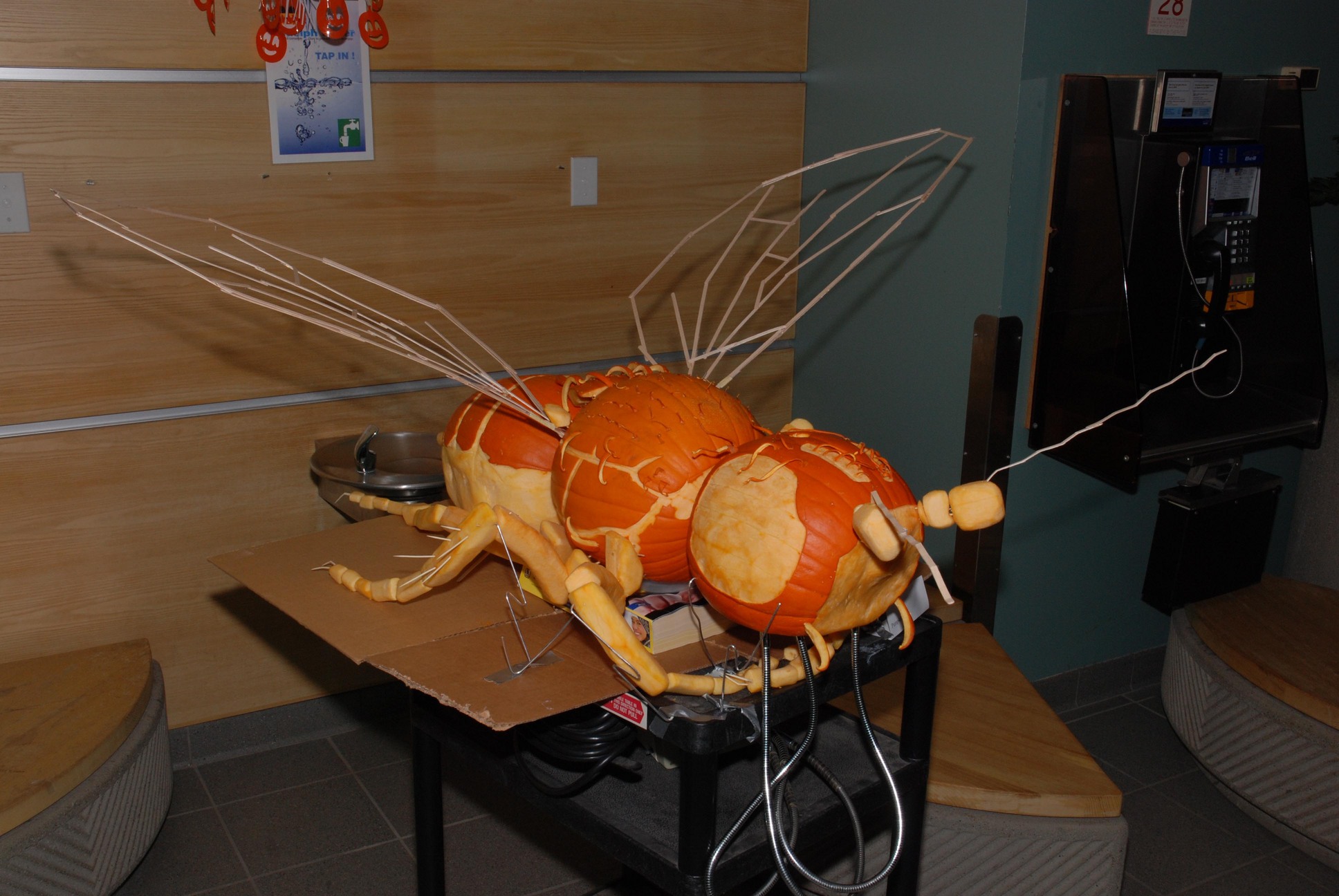
Sphaeroceridae Pumpkin Carving Jack-o-Lantern Fly Insect

Photo courtesy of Matt Bergeron

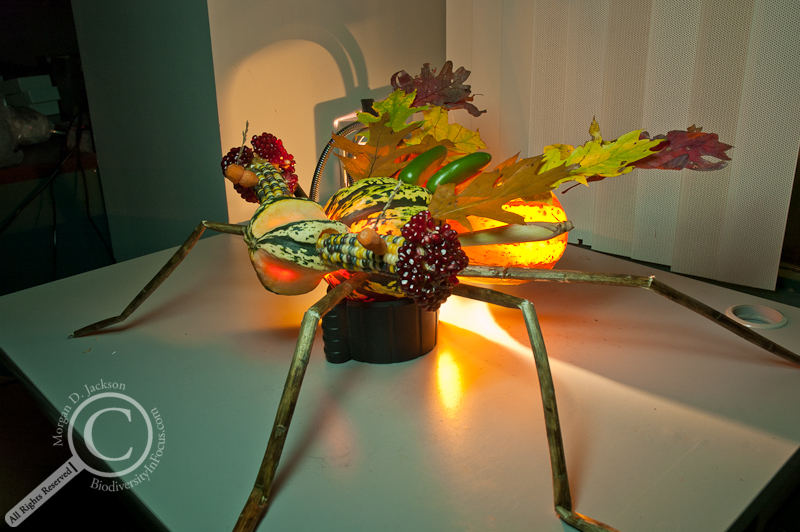
This lovely creature is a morphologically correct Sphaerocerid fly, right down to wing venation and the square rear basitarsus (hard to see in this picture, but it’s there, trust me). I was working in Ottawa at the time so I can’t claim any credit for this, but I believe it was another 8+ hours of work between 3-4 grad students. The sculptors incorporated a range of materials, including a wire frame for leg and head support, toothpicks for bristles and tarsal claws, and popsicle stick wing veins. As per the jumping spider, we use fiberoptic microscope lights to illuminate our creations (the silver tubes sticking out from below the head). Unfortunately there are no images of the fly lit up, but I hear it was pretty spectacular!

Oct 252010
 

Leading up to Halloween, I thought I’d share some of the pumpkin creations that our lab creates for our annual departmental pumpkin carving contest. We’re lucky to belong to a department full of competitive and talented pumpkin carvers, so we’ve needed to up our game every year, resulting in some pretty cool pumpkin designs. We generally make an evening of it, with all the available grad students, undergrad volunteers, post-docs, lab managers, etc joining in and making some ent-o-lanterns!

2007 was my first Halloween as a grad student, and the pumpkin carving really started to take off:

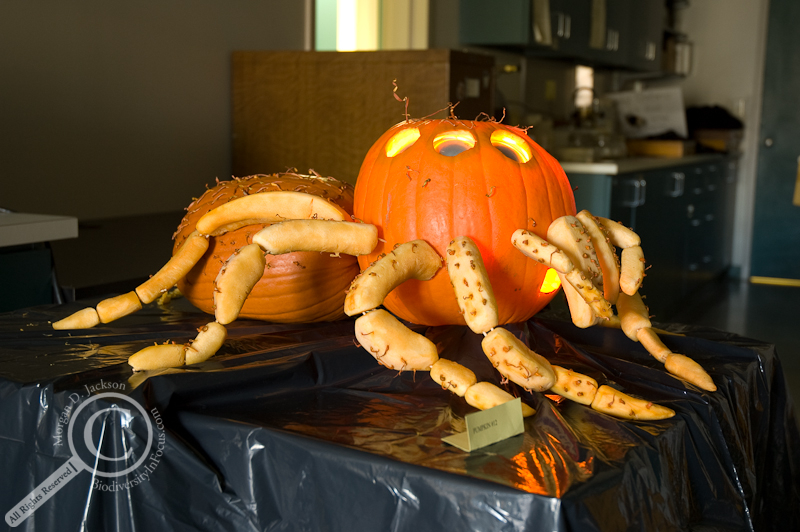
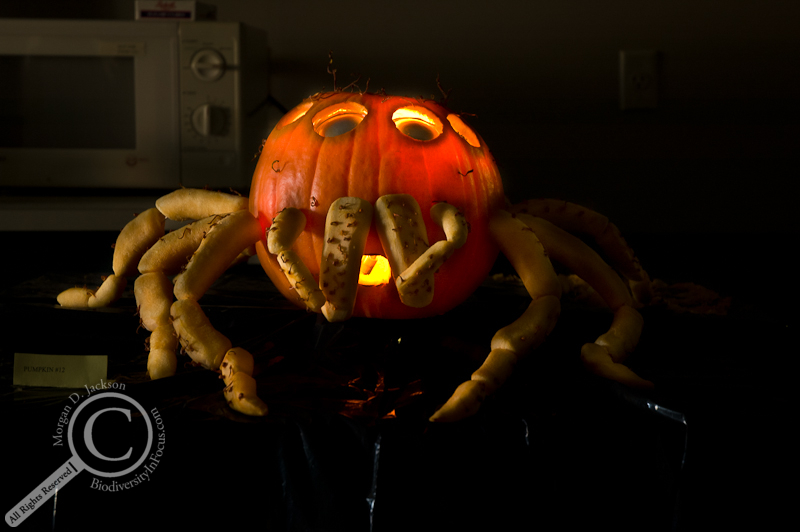
Jack-o-Lantern of Jumping Spider Pumpkin Insect

Jumping Spider Jack-o-Lantern Pumpkin Insect

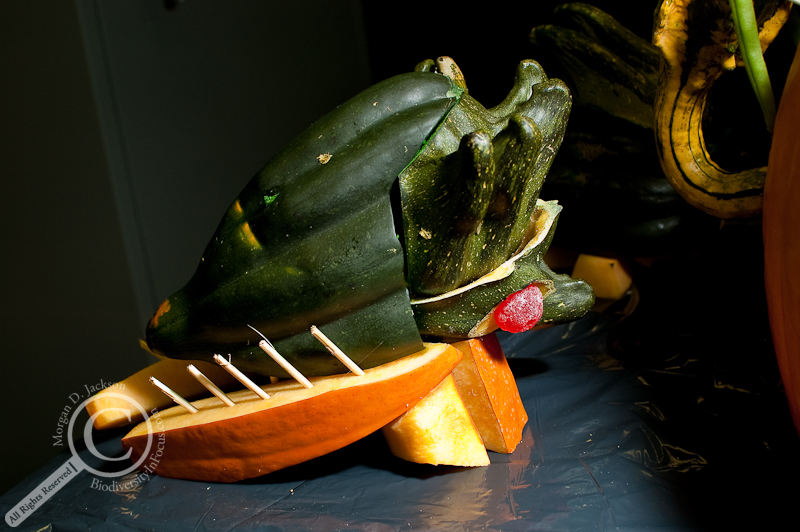
Composed of 3 pumpkins (one each for the cephalothorax and abdomen, and one carved into legs), we used the bottoms of popcans to recreate the globular shining eyes, and small peelings of pumpkin skin embedded into the parts for bristles. The “bristles” actually dried out over night, curling and appearing more life-like. Time for completion? 8+hours with 5 grad students.

The tiny beauty around us

 Blogosphere, Cool Science, Insects, Photography  Comments Off on The tiny beauty around us
Oct 132010
 

The winners of the yearly Nikon Small World Photomicrography Contest were announced today, and some incredible and ingenious insect images took top honours!

Mosquito (Anopheles gambiae) Heart by Jonas King from Nikon Small World Contest

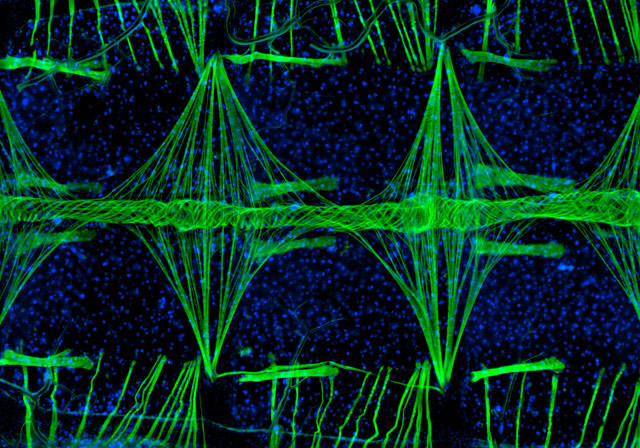
1st Place - Mosquito (Anopheles gambiae) Heart by Jonas King

This image by Jonas King, a graduate student at Vanderbilt University in Tennessee, is the heart of Anopheles gambiae, a mosquito species which serves as a vector for malaria. Kings’ research examined how hemolymph circulation influences malaria trypanosome migration from the gut to the salivary glands, and this image of the heart (muscle fibres are dyed green with individual cell nuclei bright blue) was a fantastic result of that research.

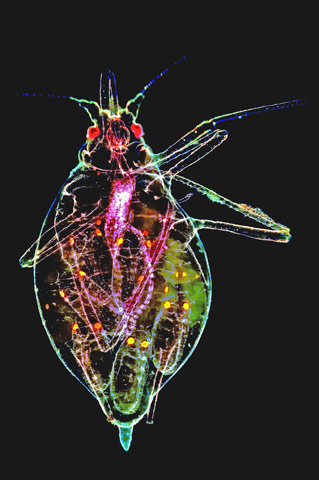
Black bean aphid with offspring inside her body by Dr. Tomas Cabello from Nikon Small World Photomicrography Contest

Popular Vote Winner - Black bean aphid (Aphis fabae) with offspring inside her body by Dr. Tomas Cabello

Earning an Image of Distinction from the contest judges, Dr. Tomas Cabello’s photo of a black bean aphid carrying live young was voted the most popular by the public. By using phase contrast microscopy, Dr. Cabello illustrates just how crowded it can be when you’re parthenogenetically viviparous!

There’s a further 120 images from this years competition that I encourage you to peruse, and feature a wide range of colourful, beautiful natural wonders revealed through magnification. There is also an historical record of winners going back to 1977, and I just want to highlight how far photomicrography and photography have come in that time.

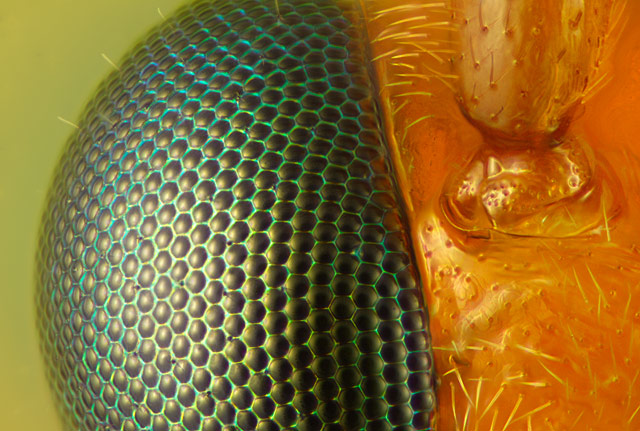
Ichneumonidae Eye by Charles Kreb from Nikon Small World Contest

17th place 2010 - Ichneumonidae Eye by Charles Kreb

This image of an ichneumonid wasp compound eye and antennal base by Charles Kreb garnered a 17th place finish in this year’s contest. In contrast, check out the 11th place image from 1987:

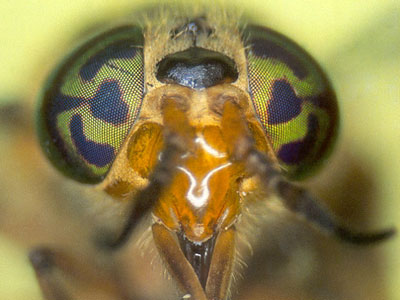
Deer fly (Tabanidae) head by Robert L. Calentine from Nikon Small Wonders Contest 1987

11th place 1987 - Deer fly (Tabanidae) head by Robert L. Calentine

This is still a great photo given the resources and technology of the time, but with new digital cameras, photo stacking algorithms and photo manipulation techniques, the sky is the limit for the future of imaging even the smallest of insects now. If you have experience with photomicrography or a subject which you think the world should see up close and personal, I encourage you to enter next year’s competition and help people see the beauty in all aspects of nature!

Aug 272010
 

One of the talks that drew the largest crowds at the 7th International Congress of Dipterology a few weeks ago was on the functional morphology and sexual selection in mating tsetse flies, Glossina pallidipes & Glossina swynnertonni (Glossinidae)*. Why was a talk on fly porn so popular you may ask? Well  Dipterists in general are always on the lookout for mating opportunities (of their research subjects – get your mind out of the gutter) and with the promise of videos and a new technique, it was like a moth to a flame (so to speak). The videos were amazing, and as of last night were made available via YouTube for the world to see! (Explanation after the videos)

Full speed video of G. pallidipes:

Slow Motion video of G. pallidipes:

Slow motion video of G. swynnertonni:

So what’s going on here? These are x-ray videos of copulation made by the research team using a synchrotron facility in Europe. The female (the abdomen on the right) has been glued to a stage and the tip of her abdomen placed in the path of the beam of x-rays. Barry White is piped into the chamber, candles are lit, the lights are turned down low, and the male is released into the chamber to do his thing (his abdomen is on the left). When coupling begins the x-ray beam is turned on and we get a very intimate idea of mating in tsetse flies! What we see happening is the phallus of the fly is the part that is thrust in and out within the vagina of the female (easiest to see on the first slo-mo video), and is apparently stimulating the female with ornate, inflatable projections. Possibly he is attempting to make her receptive to his sperm. Meanwhile on the outside, the hook pressing the outside of the female’s abdomen is also involved in stimulation. In this case, experiments have shown that these stimuli induce the female to receive and transport sperm, to ovulate, and to reject future mating attempts by other males. These routines are hypothesized to be an evolutionary race between the males to be especially effective stimulators, with the female requiring just the right touch to accept the males sperm and use it to fertilize her eggs. Ejaculation occurs only after many minutes of rhythmic thrusting and squeezing (in G. pallidipes, in the last minute or two of an approximately  45 minute copulation).

To the best of my knowledge this is the first time that anyone has seen what’s happening inside, in real-time, during copulation in flies. A really amazing insight into the mojo of flies, and hopefully a technique that can be used more in the future to untangle the complicated world of fly genitalia!

Thanks to the research team for making this video available:

R. Daniel Briceño, William Eberhard, Ernesto Chinea-Cano, Dariusz Wegrzynek, and Tommy dos Santos Rolo

ICD7 Talk:

Species-specific behavioral differences in male tsetse fly genitalia revealed by x-ray videos – R.D. Briceño, W.G. Eberhard, E. Chinea-Cano, D. Wegrzynek, T. dos Santos Rolo. Presented to the ICD7 Aug. 11 2010, San Jose, Costa Rica.

* – Tsetse flies are the group of flies responsible for commuting the trypanosomes that cause sleeping sickness in Africa, making them one of the most important human disease vectors on Earth.
UPDATED Aug-10-2010 4:00PM : In order to make sure the details of the research were correct I contacted Dr. Briceño, who kindly provided the information highlighted in BOLD. I’ve removed erroneous information from my initial post.
UPDATED MAR-9-2011: Here’s the reference to the published paper:
Briceño, R. D., D. Wegrzynek, E. Chinea-Cano, W. G. Eberhard and T. dos Santos Rolo “Movements and morphology under sexual selection: tsetse fly genitalia.” Ethology Ecology & Evolution 22(4): 385 – 391.